





An outdoor air conditioning condenser unit on a concrete pad beside a house with horizontal siding, with an electrical disconnect box on the wall and shrubs to the right in low evening light.

One request and it's handed off

AC can't keep up on hot days in Dundalk, MD

On the worst days of summer, your AC runs nonstop and the house still sits at 78. That usually comes down to a system that's low on refrigerant, a condenser coil caked with dirt, or a unit that was never sized right for your house. This page gets into what's behind it and what fixes it. Send the form once and you're done calling around, explaining the problem to one company after another, and weighing quotes against each other. That part becomes someone else's job.

Let a pro reach out

When your AC can't keep up on a hot day, it usually means the system is running close to its limit even when nothing is broken yet. Humidity near the Chesapeake adds to the load, so the unit has to work harder to pull moisture out of the air before the house even feels cooler. A dirty condenser coil or a refrigerant charge that's a few pounds low won't stop the system from running, but it will stop it from cooling enough, so the house creeps up a few degrees and stays there no matter how long the unit runs. Blocked airflow from a clogged filter or closed vents does the same thing. If the unit was sized for a smaller house or a cooler summer than the ones Dundalk actually gets, it may simply run out of capacity on the hottest afternoons. None of this means the system needs to be replaced. Most of the time it means something specific is wrong and fixable, and it is worth having someone look before the next heat wave.

A smiling man in a green long-sleeve shirt stands at a dark kitchen counter with a ceramic mug, with wood cabinets, white tile backsplash, and a window and dining table behind him.
A smiling man with wavy dark hair and a beard, wearing a navy sweater, sits at a kitchen counter with a gray mug, with a dining table, potted plant and windows behind him.
A bearded man in a dark green sweater smiles and looks to his right while seated at a white kitchen counter with a gray mug, with windows and greenery behind him.
A smiling man in a dark navy sweater stands in a home interior beside a counter with a white mug, with a kitchen, hallway and potted plant in the background.

Your AC doesn't make cold air. It moves heat from inside the house to the outdoor air, and that only works if the outdoor air can take it. Once it's in the high 90s outside, the condenser has less room to dump that heat, so it runs longer to move the same amount. Inside, refrigerant has to boil at a set pressure to pull heat out of the air passing over the indoor coil. If the system is low on charge, it can't hold that pressure, and the house stops dropping. Even a system with nothing wrong with it is built to cool the air about 20 degrees below whatever it is outside, so on a 98 degree day, landing in the high 70s is the system working the way it's supposed to. The compressor also pulls more current as it gets hotter out, and a run capacitor that's already weak tends to give out right when the load is highest. Airflow matters too. A dirty filter or a blocked return cuts the air moving across the indoor coil, and that shows up as a house that feels muggy before it feels warm.

Why hot days push it past its limit

  • A central AC moves heat out of the house, it doesn't make cold air, so once outdoor temps climb past the mid 90s there's less room for that heat to go.
  • The condenser outside has to dump that heat into the outdoor air, and the hotter the air around it, the slower that happens.
  • Refrigerant has to boil at a set pressure inside the indoor coil to pull heat out of the house air, and a system low on charge can't hold that pressure.
  • Most residential units are built to drop the indoor temperature about 20 degrees below outdoor, so on a 98 degree day even a healthy system may only get the house into the high 70s.
  • The compressor draws more current as outdoor temperature rises, and a run capacitor that's weakening will fail faster under that load.
  • Airflow across the indoor coil has to stay steady for the system to remove humidity, and a clogged filter or blocked return cuts that airflow before anyone notices the house feels muggy.
An outdoor air conditioner condenser unit on a concrete pad beside a house with beige horizontal siding and a stone-veneer base, with refrigerant lines running to a gray wall-mounted electrical box, surrounded by dark mulch, a flowering shrub and an evergreen on the left.
This is what a healthy setup looks like: a clear pad, a clean condenser, nothing crowding the airflow around it.
An outdoor air conditioning condenser unit on a concrete pad beside a house with light vinyl siding, an electrical disconnect box and conduit on the wall, bare shrubs and mulch to the right, and a concrete walkway in the foreground.
Shrubs grown in or mulch piled against the cabinet choke the airflow the condenser needs and make it work harder than it should.
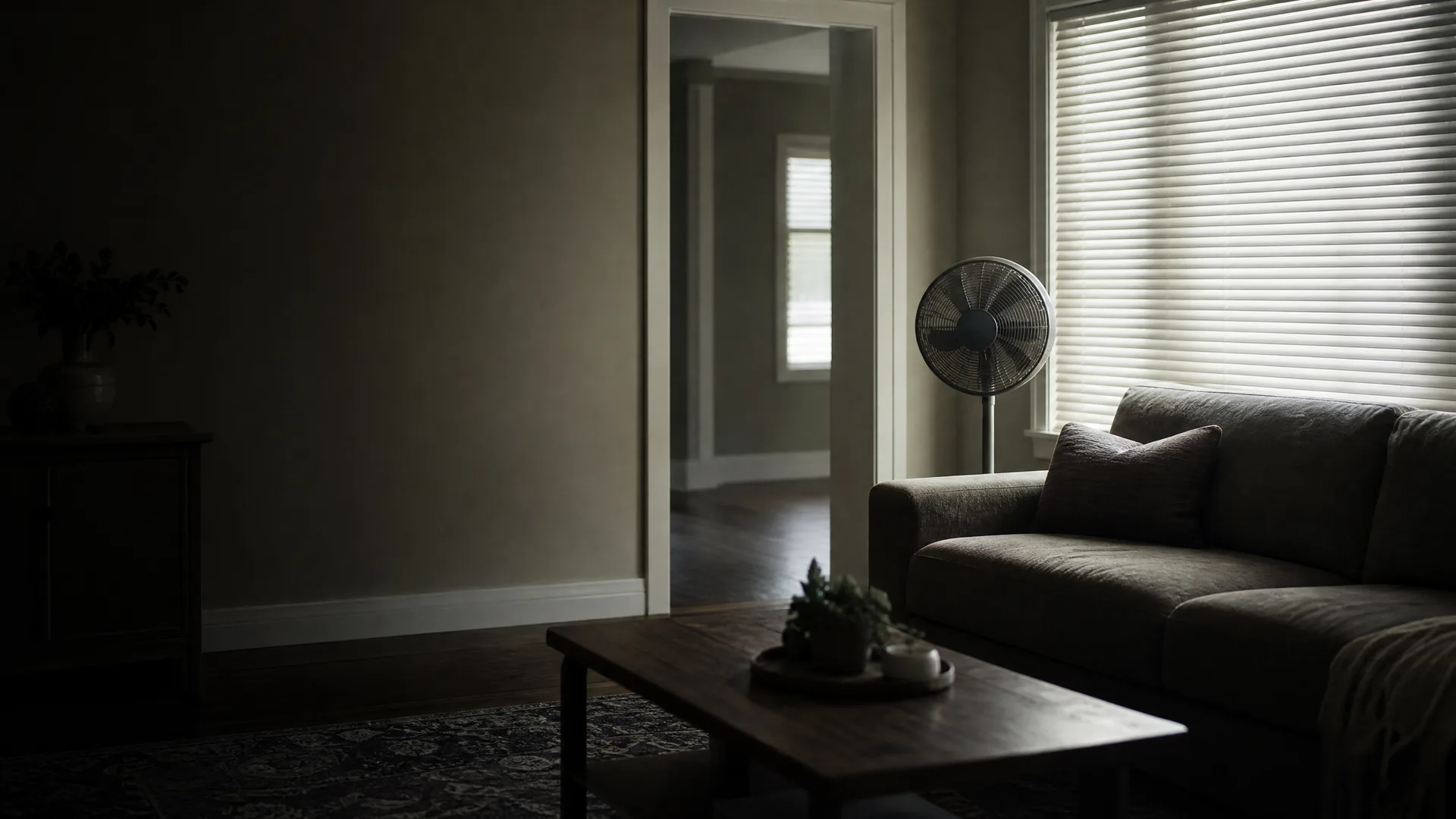
Dimly lit living room with a dark sofa, wooden coffee table holding a small potted plant, a pedestal fan near a window with closed horizontal blinds, and an open doorway to a hallway.

It's a little past three on a July afternoon and the blinds are drawn against the sun. The floor fan by the couch is turning on its highest setting, pushing the same warm air around the room. The thermostat on the wall reads 78, same as it did an hour ago. Outside, the air over Baltimore County sits heavy and still, the kind of afternoon where even the shade feels close. You've stopped waiting for the house to catch up and started waiting it out instead, shirt sticking to the couch cushion, condensation ringing the glass on the side table. The AC is running. You can hear it. The room just isn't getting any cooler.

Done looking for an air conditioner pro

A system that can't keep up on a 95 degree day rarely fixes itself by evening. It runs the same hard hours tomorrow, and the strain on the compressor doesn't let up until someone gets eyes on the refrigerant charge, the coil, or whatever is making the unit lose the fight against the heat outside. Most people in this spot start by searching for a contractor, then calling two or three, explaining the thermostat reading and the runtime each time, then sitting with quotes that are hard to compare because no two visits cover the same ground. Sending this request skips that part. One licensed contractor near Dundalk gets your information and takes it from there, so instead of spending the next few days chasing someone down, you're waiting on a call back, with the heat outside no longer something you have to manage alone.

What a tune-up checks

A technician measures the refrigerant charge against what the nameplate calls for, checks the temperature split between the air going into the system and the air coming out, and looks at amp draw on the compressor. Each of those numbers either falls in range or it doesn't. A unit running low on charge will show a narrow split, maybe 10 degrees where it should be 18 to 20, and that alone explains a house stuck at 78 while the system runs straight through the afternoon.


Why age changes the math

An AC that's 12 or 15 years old wasn't built to the same efficiency standard as one sold today, and a worn compressor loses some of its pumping capacity well before it fails outright. On a 90 degree day that difference shows up as a house that used to hold 72 now settling for 76. Age on its own isn't a verdict. Plenty of older units run fine with the refrigerant and airflow right. It's age combined with a system already struggling that points toward replacement instead of another repair.

An outdoor air conditioner condenser unit on a concrete pad beside a house with light horizontal lap siding, with an electrical disconnect box and conduit on the wall behind it.
Before you get your air conditioner repair
An outdoor air conditioning condenser unit on a concrete pad beside a house with white horizontal lap siding, with an electrical disconnect box and insulated refrigerant line on the wall and a shrub over mulch to the right.
After you get your air conditioner repair
A gray outdoor air conditioner condenser unit on a concrete pad beside a house with white horizontal siding and a brick foundation, with a wall-mounted disconnect box and conduit, and a green shrub with mulch at left.

Clean and clear

The pad around this condenser is clear and the cabinet is clean, so air moves through it the way it was designed to. The disconnect box and lines are easy to check too. A unit that looks like this one has a far better shot at holding 78 degrees on a 95 degree day.

An outdoor air conditioning condenser unit on a concrete pad beside a house with white horizontal vinyl siding, with a gray electrical disconnect box and refrigerant lines on the wall behind it.

Dirty and choked

Dirt and grime cake the grille and top cover of this condenser, and that buildup blocks the airflow it needs to dump heat outside. A unit working this hard against its own cabinet draws more amps and still falls behind on the hottest afternoons.

A smiling bearded man in a blue-gray t-shirt sits on a gray couch in a living room with wooden shelving and a bright window behind him, looking down toward a device at the lower edge of the frame.
A bearded man in a dark plaid flannel shirt stands indoors looking out a window at a snow-covered yard, with a dark gray mug on the windowsill and kitchen shelves behind him.

Cooling runs June through September

Four months of real heat is all your AC gets to prove itself in. There's no long shoulder season to coast through. Once June hits, the system runs close to its limit right away, and if it was going to fall behind on the hottest afternoons, this is when you find out.

NOAA nClimDiv 1991-2020

A closed silver laptop and a white mug of dark coffee sit on a wooden table in a sunlit room, with a blurred kitchen counter, shelf and window with plants in the background.

An AC that can't keep up has a reason behind it

A system struggling on a hot day in Dundalk is usually low on charge, dirty at the coil, or wasn't sized for the house it's cooling. None of those get better by waiting through another 95 degree afternoon. The thermostat still reads 78, and it will again tomorrow, until someone checks the charge, the coil, and the airflow around the unit and finds which one is the problem.

You already know the parts that tend to fail. What takes time is finding a contractor who's free this week, explaining the same symptoms over the phone to three different companies, and sorting through quotes that don't quite match. Send the form once and that part is off your plate. A licensed contractor near Dundalk takes it from there.

A wooden table holding a stone vase with a bare branch, two stacked books and a small dark bowl, beside a window with green foliage outside and a sofa in the dim background.
A single-story white stucco house with dark roof, stone-clad entry tower and three dark garage doors, lit from within at dusk, with a curved concrete driveway and dark mulch beds with boulders and bare young trees in the foreground under an orange and blue sunset sky.

Air Conditioner Repair

It's off your list after this

RepairCentral ACBaltimore County, MD
Step 1 of 2

What ZIP code is the job in?

  • A ceramic table lamp with a tapered beige shade sits on a wooden side table with a drawer, beside a shallow wooden bowl holding a stone sphere and a potted green plant, next to an upholstered chair with a knit throw.
    • Get matched with a pro who fixes air conditioners in Baltimore County.
    • A Baltimore County pro who repairs air conditioners gets your request.
  • A potted green trailing plant in a textured ceramic pot with saucer sits on a wooden side table beside a small wooden bowl, with a ceramic table lamp, framed picture, and sunlit window nearby.
    • Send the request today and let an air conditioner pro reach out to you.
    • Get the air conditioner repair search off your mind today.
  • A beige upholstered armchair with a green cushion and knit throw sits beside a tall indoor plant and a wooden side table holding a potted plant near a bright window.
    • Explain the job once and skip repeating it on every call.
    • Skip searching for an air conditioner pro and answer a few questions instead.
  • A beige upholstered armchair with a striped cushion and fringed throw sits beside a window with sheer curtains, next to a wooden side table holding a dark ceramic lamp, with a potted tree in a woven basket behind and a jute rug on the dark wood floor.
    • A licensed pro who repairs air conditioners in Baltimore County gets your request.
    • A licensed pro who works in Baltimore County gets your request.