

AC keeps tripping the breaker in Baltimore, MD

Get the air conditioner repair search off your mind today.

Send it today

A breaker that trips every time your AC kicks on usually means the unit is pulling more current than the circuit can handle. Most often that's the compressor, the part in your outdoor unit that does the hard work of running the system, drawing extra power because it's straining to start. A weak capacitor can't give the compressor the jolt it needs to get going, so the motor draws heavy amps instead and trips the breaker. A dirty condenser coil or a fan that's stopped turning makes the compressor work harder than it should, which does the same thing. Sometimes the problem isn't the AC at all but a breaker that's worn out from years of this and needs replacing itself. In the thick of a Baltimore summer, an AC that won't stay on is more than an inconvenience, and running it again and again against a tripping breaker risks damage to the compressor itself. It needs a licensed contractor to find which of these it is before more than the breaker gets hurt.

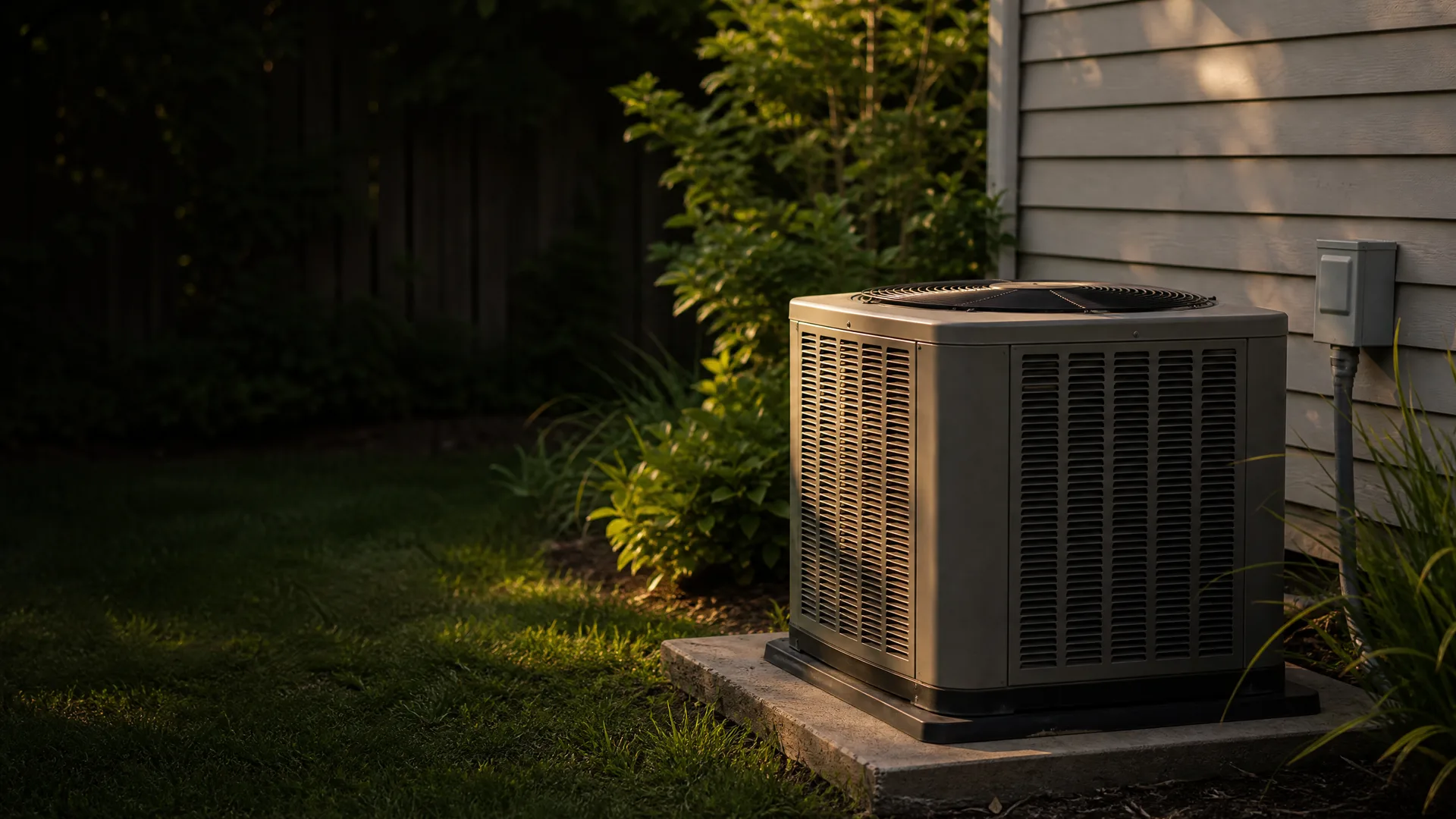
A gray outdoor air conditioning condenser unit on a concrete pad beside a house with horizontal lap siding, with a wall-mounted electrical disconnect box and refrigerant lines, shrubs, mulch and lawn around it.

When it's running the way it should

A healthy condenser cycles on, runs steady, and holds the breaker without issue. The fins stay clear, the panel stays closed, and the disconnect box up on the wall does nothing but sit there. If yours looks like this and still trips the breaker, the problem is likely inside the unit, not on the outside.


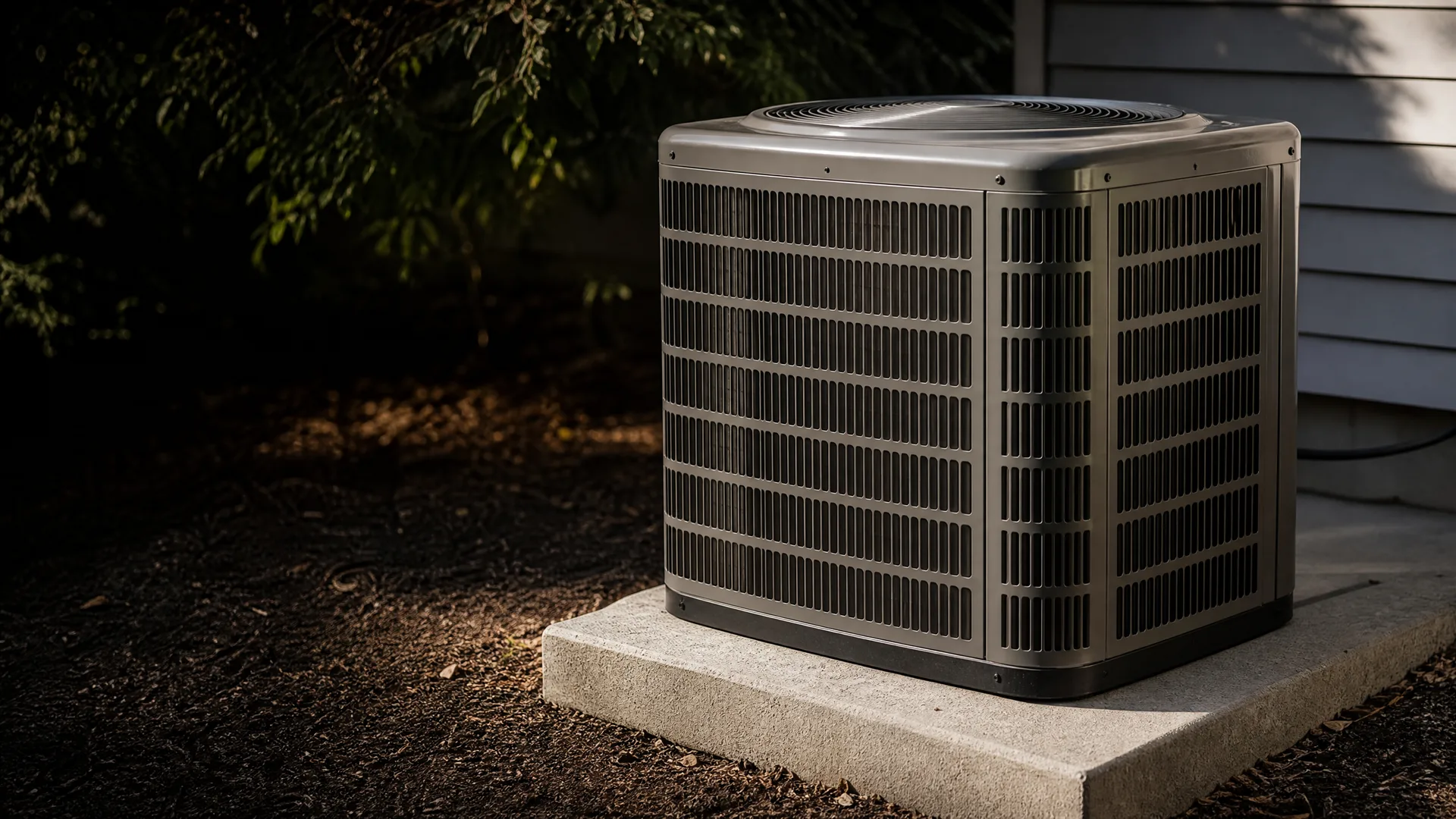
An outdoor air conditioner condenser unit on a concrete pad beside a house wall with stucco lower section, horizontal siding above, and a white downspout to the right.

When it's the one tripping your breaker

Dirt and grime packed into the fins make the compressor work harder to move the same heat, and that extra strain shows up as extra current. An older unit in this shape, caked on the housing and the coil, is a common reason a breaker that used to hold starts tripping every time the AC kicks on.

Why does my AC trip the breaker every time it starts up?

Why does my AC trip the breaker every time it starts up?

It's the surge the compressor draws the moment it starts, not how hard it runs after

A compressor pulls far more current the instant it starts than it does once it's running. That jump is normal, but a breaker right at its limit, a weak start capacitor, or a compressor that's starting to fail will push that surge past what the circuit can take. The breaker trips at the exact moment the outdoor unit kicks on because that's when the load is highest, not while it's running steady. In a Baltimore summer, your AC might cycle on and off a dozen times a day, so each startup is another chance for a marginal part to give out.

A middle-aged man with gray hair and a beard, wearing a dark green sweater, sits on a light sofa in a sunlit living room with large windows, a potted plant, and a dining area in the background.
A gray-haired man in a dark green ribbed sweater sits on a light sofa in a living room, looking toward a sunlit curtained window with a potted plant and lamp nearby.
A gray-haired man in a navy button-up shirt over a white tee sits on a light gray sofa in a living room, looking off to the side, with a window, houseplant, framed picture and shelving behind him.
A man with gray hair and a beard wearing a dark green shirt jacket over a navy top sits on a gray sofa in a living room, looking to the side, with a window, potted plant and shelving in the background.

Reset the Breaker or Call Someone

Keep flipping it back

  • Flipping the breaker lets the AC run a little longer, but the overload that tripped it the first time is still there.
  • If the trip is the compressor's hard start, pushing through it just makes that part work harder every time it fails.
  • A breaker that trips repeatedly is wearing down, and one that's been stressed enough can fail to trip when it actually needs to.
  • Running a short cycle before it trips again puts the same strain on the wiring and the panel each time.
  • You lose whatever cooling you were getting the moment it cuts out again, so nothing is actually gained.

Get it looked at

  • A contractor can check the compressor's amp draw against what the unit is rated for and see exactly where the overload is coming from.
  • If it's a failing capacitor, that's a part that gets swapped out rather than a problem that goes away on its own.
  • Finding a frayed wire or a loose connection now means it gets fixed before it damages the breaker or the panel.
  • A licensed electrician or HVAC tech can tell you if the breaker itself is undersized or just worn out from repeated trips.
  • Once the actual cause is found, the AC goes back to running full cycles instead of cutting out partway through.
  1. The compressor kicks on and pulls a hard surge of current.

  2. That surge runs through the breaker meant to protect the circuit.

  3. A failing capacitor or start component lets the surge run too high or too long.

  4. The breaker senses current past its rating and trips.

Why does my AC breaker keep tripping in the afternoon heat

You'll usually notice it when the house is warming up fastest, mid-afternoon, and the AC shuts off instead of catching up. You go to the panel, flip the breaker back, and it holds for a while before tripping again. Sometimes the outdoor unit hums for a second and clicks off without really starting. You might smell something warm near the panel if it's tripped a few times in a row, or notice the breaker feels warm to the touch. Left alone, this isn't a problem that fixes itself. Each hard trip puts more strain on the compressor, and a compressor that fails is a far bigger job than the part causing the trips now.

An outdoor air conditioner condenser unit sits on a concrete pad beside a house with horizontal lap siding, surrounded by grass and shrubs in low evening light.

The sun is low over the yard, that orange light you get on an August evening in Baltimore. The air is still thick even though the worst of the heat has passed. You're standing by the condenser because the house has started to feel warm again, and when you look down you notice the fan isn't spinning. No hum, no air moving through the fins, nothing. The breaker's already tripped once tonight. You walked out here half hoping it would just be running fine, and instead it's sitting dead quiet while the house behind you holds onto the day's heat. You've got the form open on your phone. Once it's sent, this stops being something you have to figure out standing in the yard.

Hand off the search today

A breaker that trips once might be a fluke. One that trips every time the compressor kicks on is telling you something inside that unit is failing, and it won't fix itself by cycling the power. In Baltimore, that usually shows up on the first real hot stretch, when the compressor is working hardest to catch the house up, and by the time you notice it the inside is already climbing past what the thermostat is set to. A contractor who works this equipment all summer has seen this exact pattern enough times to know what to check first, the start components, the compressor windings, the connections at the disconnect, without guessing. One request here goes to one local contractor, not a handful of companies competing for the job, so you're not fielding five calls while your house sits warm. Send it now and let someone who knows this part of the system take it from here.

What the breaker is rated for

The breaker at your panel is sized to the wire and the circuit, not to the compressor. Most residential AC circuits run on a 20 to 60 amp double-pole breaker, depending on the size of the unit, and that number is set when the system is installed. It's not adjustable to match whatever the compressor happens to be drawing on a given day. When the compressor's draw climbs past what that breaker allows, even for a second or two on startup, the breaker does exactly what it's built to do. Swapping in a larger breaker doesn't fix anything. It just lets more current reach wiring that wasn't sized for it, which is a fire risk, not a repair.

What a contractor checks first

A licensed contractor working on this starts with an amp reading at the compressor while it starts up, because that number says whether the draw is normal or already too high before anything else gets tested. From there it's the capacitor, since a weak one is the most common reason a compressor's starting surge runs longer than it should. After that, the contactor contacts and the compressor windings themselves get checked for a short to ground. Someone who services AC units in Baltimore through the summer sees this same sequence often enough to know which of those three is behind it before the panel cover is even off.

An outdoor air conditioning condenser unit on a concrete pad beside a house with light vinyl siding, with electrical conduit running to a wall-mounted disconnect box and a shrub in mulch to the right.
Before you get your air conditioner repair
A gray outdoor air conditioning condenser unit on a composite pad beside a house with horizontal lap siding, with a wall-mounted disconnect box, refrigerant lines, and a wooden fence and shrubs to the left.
After you get your air conditioner repair

Cooling runs June through September

Four months a year, your AC is the thing standing between your house and a Baltimore summer. That's four months of the compressor starting up and drawing that hard surge each time, and if something in the circuit is already weak, those are the months it gives out.

NOAA nClimDiv 1991-2020

A gray outdoor air conditioning condenser unit sits on a concrete pad beside a house with horizontal siding, connected by insulated lines to a wall-mounted disconnect box, with a shrub and gravel bed to the right.
A clean condenser cycles on quietly and the breaker never notices it's running.
An outdoor air conditioning condenser unit sits on a concrete pad beside a house with horizontal vinyl siding, with a gray electrical disconnect box and insulated refrigerant line on the wall above, surrounded by bare mulched ground.
Grime packed into the coil fins makes the compressor work harder and pull more than the breaker allows.
A two-story house with light gray siding and a small front porch, framed by leafy trees and shrubs, with a concrete walkway leading from a wet sidewalk across a green lawn in low sunlight.

NOAA puts the average summer dew point in Baltimore at 63°F, the number that tells you how heavy the air sits rather than just how hot it reads. Air that thick holds onto heat, so your AC has to pull moisture out before the house feels any cooler, and that's more work than cooling dry air. The compressor runs longer to do it, drawing that hard startup surge more times over the course of a day. If something in the circuit, a weak capacitor, a loose connection, is already marginal, a muggy stretch is when it finally gives out and the breaker starts tripping.

NASA POWER T2MDEW

A woman with shoulder-length graying hair in a beige knit cardigan sits in a dark gray armchair near a window, looking to the side with a slight smile, with a bookshelf and potted plants behind her.
A woman sits on a couch under a chunky knit blanket with a sleeping young child resting against her, with a lit lamp and window in the dim background.

What this trip is telling you

  • A breaker that trips every time your AC starts is pointing at the compressor's hard start, not a weak breaker.
  • Flipping the breaker back and letting it run again doesn't fix the surge that's tripping it in the first place.
  • A clogged coil, a failing capacitor, or a compressor on its way out all show up the same way, as a trip at startup.
  • The fix is finding which of those it is, which means someone opening the disconnect and testing the unit, not guessing from the panel.
  • A contractor who works on Baltimore systems all summer has seen this exact trip pattern before and knows where to look first.
  • You'll be matched with one licensed local contractor for this, so you're not fielding calls from several companies at once.

A breaker that trips the moment your AC starts is doing its job. It's reacting to a surge the compressor shouldn't be pulling, and that surge has a cause sitting inside the unit. It might be a coil packed with grime making the compressor strain to cycle on. It might be a capacitor too weak to carry it through that first second of startup. It might be the compressor itself, worn enough that every start draws more than it used to. All three look the same from the panel. All three mean the breaker will keep tripping until the actual part gets replaced.

Flipping the breaker back buys you a little cool air, not a fix. Each time it trips, the same strain happens again, and whatever is causing it doesn't get better on its own.

Finding which of the three it is means someone opening the disconnect, testing the capacitor, checking the coil, and watching what the compressor draws when it starts. That's diagnostic work, not something to guess at from across the yard.

This is a pattern a contractor who works Baltimore summers has seen plenty of times, on units that look just like yours, straining through the same heat and the same humidity. You'll be matched with one licensed local contractor for this, so it's one person getting the full picture of your system, not three or four companies working off a half-explained problem over the phone.

A gray outdoor air conditioner condenser unit sits on a concrete pad beside a house with horizontal lap siding, with shrubs and bare soil to the left.

Stop chasing an air conditioner pro

RepairCentral ACBaltimore city, MD
Step 1 of 2

What ZIP code is the job in?