



A row of illuminated white colonial houses with black shutters and a stone wall along a road at dusk.

Heat Pump Repair in Chestertown, MD

Tell us about the job

Takes about a minute. No obligation.

RepairHeat PumpKent County, MD
Step 1 of 2

What ZIP code is the job in?

Chestertown sits in a mixed climate, zone 4A, which means the heat pump earns its keep in both directions rather than running flat out one season and sitting idle the next. Winter nights average 28°F here, cold enough for the system to work but not the deep cold that pushes a heat pump to its limit for months straight. That's a reasonable load for a machine built to handle both heating and cooling. So when a heat pump in Chestertown starts short cycling or losing output, the cause is rarely the climate wearing it down. It's more often a part reaching the end of its life or something that got missed on a service call. That's usually worth fixing rather than replacing outright.

7 months
October through April, your system heats
4 months
June through September, it cools
28°F
the average winter night it heats against
86°F
the average summer afternoon it cools against
Isometric cutaway illustration of a small house showing interior ductwork and an air handler connected by lines to an outdoor condenser unit on a pad beside the building.
Your system heats October through April and cools June through September.

NOAA nClimDiv, 1991–2020 normals

Heat pumps in Kent County run heat from October through April, about seven months a year.

September is worth a check, before the first cold nights put a full heating load on a part that was already weak.

A bad heat pump costs more here than most placesMaryland electricity ran 17.86 cents per kilowatthour in 2024

Wind is the other thing worth naming. Kent County has taken damaging wind 98 times between 2015 and 2024, and an outdoor unit sits right out in it. A bent fin or a panel knocked loose doesn't mean the heat pump is failing, it means it took a hit. Have it checked after a bad storm the way you'd check the roof. Most of the time it still runs fine. When it doesn't, the fix is usually to the cabinet or the coil, not the whole system.

A struggling heat pump still runs up your bill. Get it looked at.

A heat pump that's struggling still runs, drawing power the whole time it underperforms, and at 17.86 cents a kilowatt-hour that adds up fast. Getting the actual cause found and fixed stops the bleeding sooner than letting it ride.

Find a contractor
A residential heat pump outdoor unit mounted on a concrete pad next to a house with gray vinyl siding.

What a struggling heat pump sounds and feels like before it fails

Most heat pump problems announce themselves before the system quits outright. The unit runs but the air coming out doesn't feel warm, or it blows warm for a while then switches to a cooler stream that never quite gets there. That often means the reversing valve isn't shifting cleanly between heating and cooling. Short cycling is a different problem. The system kicks on and off in quick bursts instead of running a full cycle, and that usually points to a dirty coil, a low refrigerant charge, or a thermostat sensor giving it bad information. Ice building up on the outdoor unit and not clearing is another sign. A healthy system runs a defrost cycle and melts that off on its own several times a day. Listen for it too. A low hum that turns into a knock or a squeal usually means a motor bearing or a fan blade losing its balance, and that part won't fix itself by running longer. None of these mean the whole system is done. Most of them are a single part worn past its range, caught before it takes anything else down with it.

What actually wears out

A heat pump fails from a handful of parts, not from being a heat pump. The compressor ends the system's life if it goes, but it's rarely the first thing to fail. More often the capacitor goes first, the part that kicks the compressor or fan motor into motion. Capacitors weaken gradually until one day there isn't enough of a jolt to start the motor. Contactors pit and stick from years of electrical arcing. A fan motor bearing dries out and starts dragging. These are wear parts, built to wear out eventually, and replacing one is a normal repair, not a sign the system is failing.
The reversing valve does the most work

The reversing valve is what makes a heat pump a heat pump instead of just an air conditioner. It switches refrigerant flow so the system can pull heat from outside air and push it indoors instead of the other way around, and it takes that command every time the system changes mode. That's far more cycling than a straight cooling system ever asks of one part. When it starts sticking, the system doesn't fail outright, it just stops switching cleanly, caught halfway between heating and cooling. That points to a worn valve or a weak solenoid behind it, not a system on its way out.

Before calling anyone, check the thermostat is set to heat and the temperature set above room temperature, not just on. Then look at the outdoor unit. Clear away leaves, mulch or anything stacked against it, since the heat pump needs air moving through that coil to work at all. Check the indoor filter and swap it if it's gray or clogged. A blocked filter starves airflow and can make the system short cycle or ice up even when every part inside is healthy. Walk around the breaker panel too. A heat pump runs on separate breakers for the outdoor unit and the air handler, and if one tripped the system won't run right even though it looks like it's trying. None of this fixes a bad capacitor or a sticking reversing valve, but it rules out the easy stuff first.

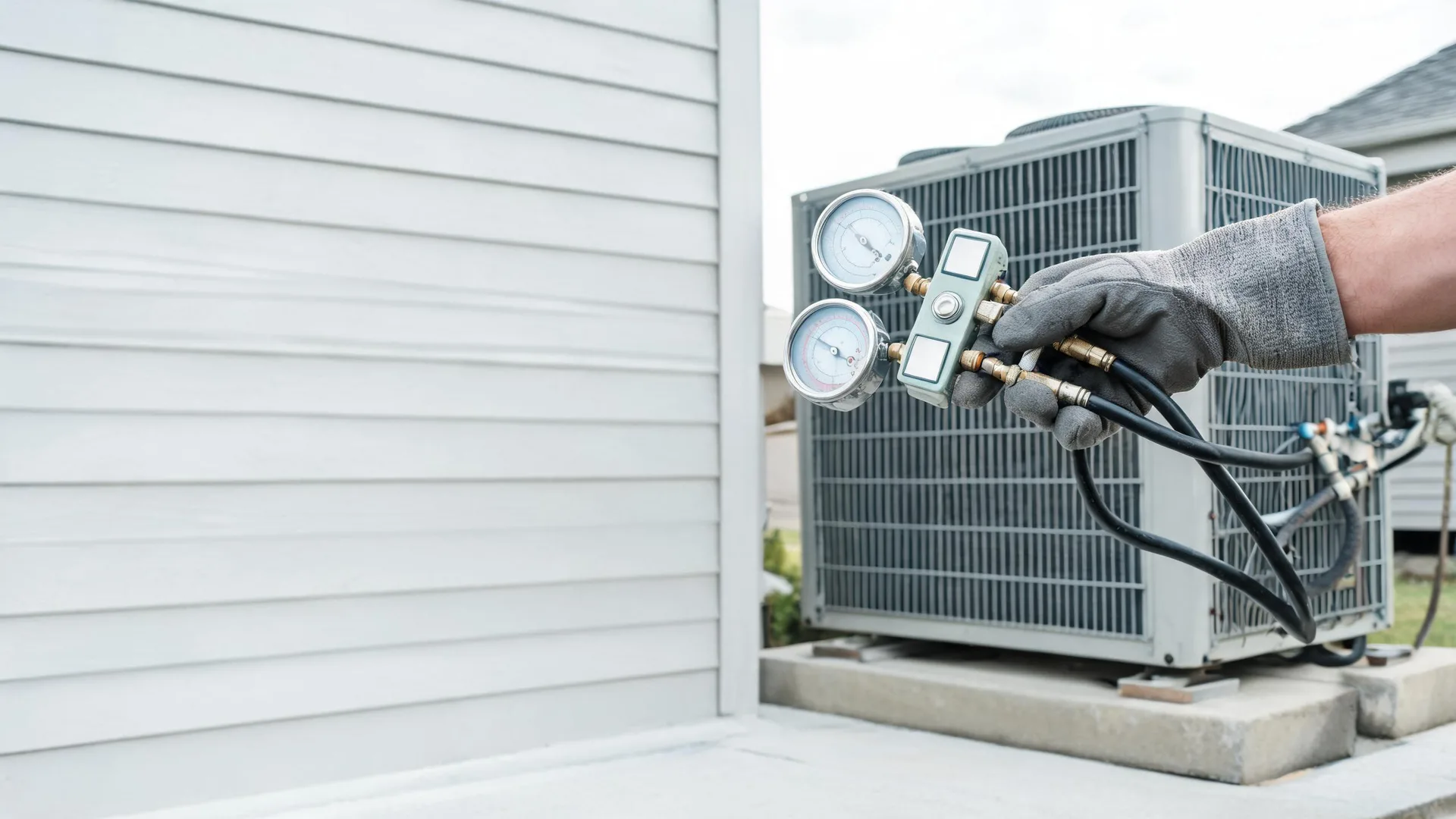
A diagnostic visit starts outside, at the unit itself, before any panel comes off. A tech checks static readings and temperatures at the vents to see how far off the system actually is from where it should be. Refrigerant pressures get checked with gauges, since a charge that's even a little low tells a different story than a charge that's correct but not moving right. Electrical components get tested under load, not just looked at, because a capacitor or contactor can look fine sitting still and still fail to do its job when the system calls for it. The reversing valve gets checked by watching whether it actually shifts when commanded, not just whether it's wired in. Most of this takes less time than people expect, because the readings usually point to one part fairly fast. The slower part is confirming it, so the fix made is the one the system actually needs.