A two-story red brick house with black shutters and a gray roof sits behind a mowed lawn, framed by large deciduous trees, with a dry-stacked stone wall running across the foreground.

Heat Pump Repair in Frederick, MD

Tell us about the job

Takes about a minute. No obligation.

RepairHeat PumpFrederick County, MD
Step 1 of 2

What ZIP code is the job in?

The tech checks both modes before touching anything

A heat pump has to work in heating and cooling, so a tech will run it both ways even if you only noticed trouble on one side. Switching it over shows whether the reversing valve is doing its job and whether the problem follows the mode or shows up in both.


That first look tells you if it's worth repairing

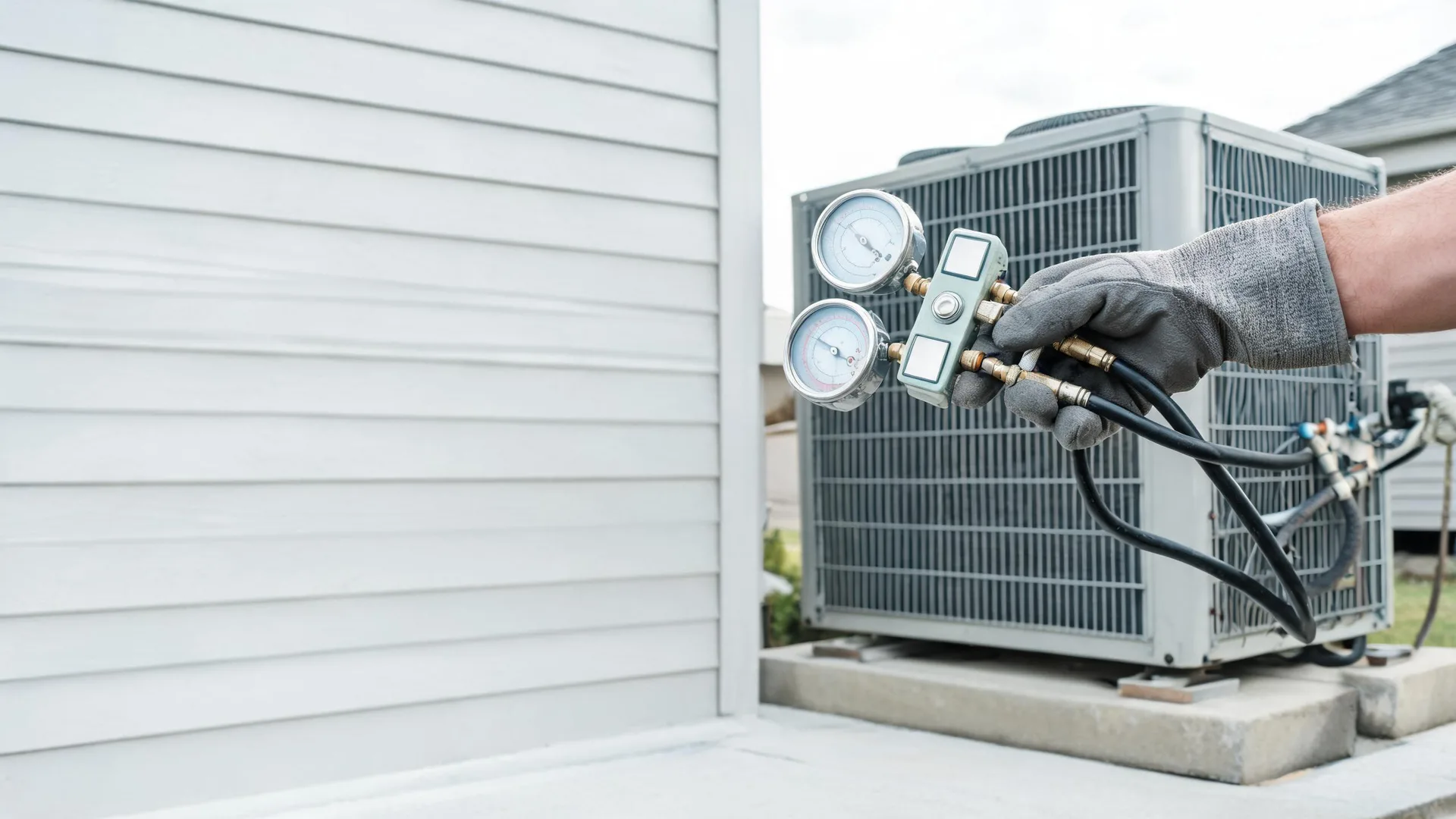
Readings off the refrigerant lines, the condenser, and the air handler point to whether this is a worn part or a sign the system is further along than it looks. That's what decides whether you're fixing a problem or buying time on an old unit.

7 months
October through April, your system heats
4 months
June through September, it cools
26°F
the average winter night it heats against
84°F
the average summer afternoon it cools against
Isometric cutaway illustration of a house showing interior ductwork, an indoor air handler unit, and an outdoor condenser unit beside the building.
Your system heats October through April and cools June through September.

NOAA nClimDiv, 1991–2020 normals

A heat pump leans on the reversing valve to switch between heating and cooling, and that valve is usually the first thing to stick or fail.

When it sticks, the system can get stuck blowing cold air in heating mode or warm air in cooling mode, and that's a valve problem, not a thermostat setting.

Electricity here runs 17.86 cents a kWh, so a heat pump stuck in the wrong mode is burning money while it struggles

Power costs 17.86 cents a kWh statewide
276 damaging wind events from 2015 to 2024
20 hail events from 2015 to 2024

Frederick County sees its share of wind and the occasional hail or snowstorm, but nothing here runs a heat pump harder than one would run anywhere else. Weather can knock out power, and when it comes back on, the heat pump should restart on its own. If it doesn't, or if it comes back and still blows the wrong temperature for the mode it's in, the storm isn't the cause. That points back to the reversing valve, a stuck contactor, or a control board that needs a reset a thermostat can't give it. A tech checking the system after an outage is looking for the same failures they'd check for on any ordinary day.

A newer home usually means a newer system worth fixing

Half the homes in Frederick County were built in 1991 or later. If yours is one of them, the heat pump giving you trouble probably isn't worn out from age, it's a part that failed. That's a repair, not a replacement.

Find a contractor
A residential heat pump outdoor unit mounted on a concrete pad next to a house with gray vinyl siding.

A newer system is worth the service call

If your heat pump came with the house and the house is newer, don't let anyone talk you into a full replacement before a tech has even looked at the reversing valve or the contactor. A stuck part gets swapped out. The rest of the system keeps running.

A failing part rarely fails cleanly

A reversing valve that's starting to stick doesn't always stop working all at once. It can still switch most of the time, so the system keeps running, keeps cycling, keeps pushing refrigerant through a valve that's wearing out a little more with every cycle. Leave it alone and the occasional misfire turns into the valve staying stuck one way for good.

The compressor pays for the valve's problem

When the reversing valve doesn't fully seat, refrigerant can flow where it shouldn't, and the compressor ends up working against pressures it wasn't built to handle. It runs hotter and strains harder every time that happens, and a compressor that's been running under that kind of strain doesn't recover on its own once the valve gets fixed.

Most heat pump trouble shows up as something the system is doing wrong, not something that quit. It runs but blows air that feels wrong for the mode. It short cycles, kicking on and off before a room ever catches up. It ices over on the outdoor unit during a cold snap and doesn't clear that ice on its own once the weather breaks. You hear a hum at the outdoor unit but the fan doesn't turn, or the fan runs and nothing else does. Sometimes it just runs long and steady without the house feeling any different, which usually means it's moving less heat than it used to even though the motor sounds fine. None of these mean the same thing, but all of them mean something inside it has started to give out, and running it while you wait only asks more of the parts around whatever already failed.

Age isn't the only thing that decides this. A heat pump that's short cycled for months or run through a few bad freeze-thaw cycles on the outdoor coil can be asking a lot of a compressor that's otherwise fine. The question a tech is really answering is whether the failure is contained to one part or whether it's already spread. A bad capacitor or a stuck contactor is a clean fix because nothing else had to suffer for it to happen. A compressor that's been laboring against a bad reversing valve for a long stretch is a different conversation, because the valve might be cheap to replace and the compressor might not be worth saving anymore. That's why the same symptom, a system that won't heat right, can lead to a part swap in one house and a real conversation about the whole unit in another.