






A two-story red brick house with black shutters and a columned entry sits behind a mown lawn, framed by two large deciduous trees, with a long dry-stacked stone wall across the foreground.

Heat Pump Repair in Salisbury, MD

Tell us about the job

Takes about a minute. No obligation.

RepairHeat PumpWicomico County, MD
Step 1 of 2

What ZIP code is the job in?

Half the homes in Wicomico County were built in 1984 or later. That puts a lot of heat pumps in this area well inside their working life, not past it. A system that age is usually a good candidate for repair rather than replacement. If your house went up in the last few decades, the compressor and coils likely still have years ahead of them. A breakdown now is more often a failed part than a system at the end of its life.

7 months
October through April, your system heats
4 months
June through September, it cools
29°F
the average winter night it heats against
86°F
the average summer afternoon it cools against
Isometric grayscale illustration of a cutaway single-story house showing interior rooms, ductwork and an air handler, an exterior condenser unit connected by lines, and dark solar panels on the roof.
Your system heats October through April and cools June through September.

NOAA nClimDiv, 1991–2020 normals

Winter here only averages 29°F on the coldest nights.

A heat pump in Salisbury isn't fighting single digits, so a breakdown is more likely a failed part than a system that's been pushed too hard.

October is when a weak heat pump gets found out

Cooling runs June through September
Heat runs October through April
68 damaging wind events from 2015 to 2024

Maryland electricity ran 17.86 cents per kilowatthour in 2024, among the higher rates homeowners pay. A heat pump that's short cycling, icing up, or running its backup heat strip more than it should burns through that power fast. You won't always notice right away that something's wrong, but the bill will show it before the house feels it. A unit that's struggling to hold temperature is working harder for the same result, and at these rates that adds up month to month. Worth having someone look at it before another billing cycle passes.

Fix it first if the house is newer

Get a repair quote before you get a replacement quote. If your house was built in the last few decades, the heat pump likely still has years left in it, and a stuck part is worth fixing rather than ripping out a system that's got plenty of life left.

Find a contractor
A man in a cap, long-sleeved shirt and work pants carries a canvas tool bag up concrete steps toward a wooden front door of a gray-sided house, with a shrub in a terracotta pot to the right.
A dark gray heat pump unit mounted on a concrete pad next to a house with gray siding and a stone veneer wall.

A milder climate means less wear to begin with

Zone 4A means real heat and real cold, but nothing extreme either direction, and that keeps the yearly wear on the compressor down. Less cycling over a year means a part that fails now more likely just failed, rather than got run into the ground. Worth getting the actual problem looked at before deciding the system's done.

A frozen coil keeps freezing

Once a heat pump starts icing up, it doesn't fix itself by running longer. Weak refrigerant charge or a stuck reversing valve means the coil can't shed that ice in defrost mode, so each cycle adds more frost than it melts. Left alone, that ice blocks airflow across the coil entirely, and the compressor ends up working against a block of ice instead of moving heat.
The backup heat hides the real problem

When a heat pump can't keep up, the backup heat strip kicks in to cover the gap. That makes the house feel fine, so the underlying fault, a failing compressor or a low charge, keeps running unchecked while the strip quietly does the work it was never meant to do full time. By the time the house actually feels cold, the part that failed first has usually been failing for a while.

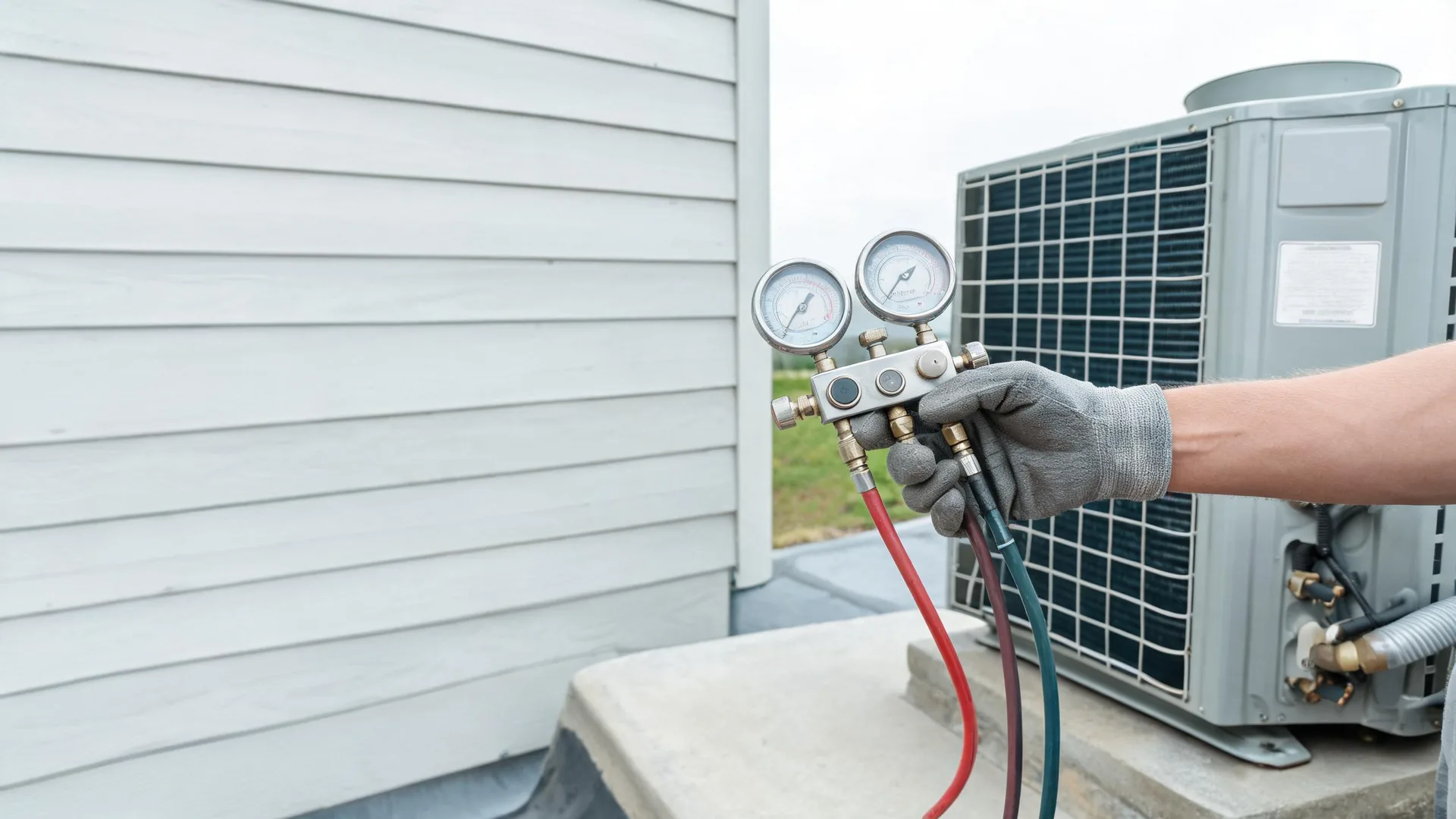
Before you call, go outside and look at the outdoor unit. If the coil is covered in ice or frost, flip the system to fan only or off and let it thaw before anyone works on it. Check that nothing is blocking airflow around the unit. Leaves, a cover left on, anything piled against the side will choke it. Inside, check your thermostat is set to heat, not auxiliary or emergency heat. That setting runs the backup strip instead of the heat pump itself. Look at your air filter. A filter clogged with dust chokes airflow across the indoor coil, and that alone can cause icing and weak heat. Last, check the breaker panel for anything tripped before assuming the worst. None of this fixes a bad reversing valve or a low charge, but it rules out the easy stuff first.

A single failed part doesn't mean much on its own. A capacitor weakens, a contactor sticks, a fan motor seizes, and the fix is to replace that part and move on. What matters more is whether the same fault keeps coming back after it's been repaired. A reversing valve that fails again, or a system that keeps losing refrigerant, points at wear spreading through the system rather than one component quitting on its own. The compressor sits in a different category entirely. It's the part that moves refrigerant through the whole system, and when it's failing, there's rarely a small fix that solves it. A tech who's looked at the actual failure can tell you which kind you're dealing with, a part that quit or a system that's wearing out.