






A two-story red brick house with black shutters and a dark roof sits on a mown lawn behind a long dry-stacked stone wall, framed by large deciduous trees under an overcast sky.

Heat Pump Repair in Westminster, MD

Tell us about the job

Takes about a minute. No obligation.

RepairHeat PumpCarroll County, MD
Step 1 of 2

What ZIP code is the job in?

Carroll County sits in a mixed climate, zone 4A, which asks a heat pump to work in both directions. It earns its keep in winter and summer alike. But the real strain on a system comes from weather extremes, and winters here are moderate rather than brutal, with overnight lows averaging 25°F across December, January and February. That's cold enough for the system to lean on its backup heat sometimes, but it isn't the kind of deep, sustained cold that wears down a compressor year after year. A heat pump with a problem here is more often dealing with a failed part or a service it missed than with years of hard running. That's usually worth fixing.

7 months
October through April, your system heats
3 months
June through August, it cools
25°F
the average winter night it heats against
84°F
the average summer afternoon it cools against
Isometric illustration of a cutaway single-family house showing interior ductwork and an air handler, with an outdoor condenser unit connected by lines along the exterior wall.
Your system heats October through April and cools June through August.

NOAA nClimDiv, 1991–2020 normals

Half the homes in Carroll County were built in 1983 or later.

A heat pump in a newer Westminster home usually still has years of working life in it, which makes repair the right call.

A heat pump running badly here keeps costing you at 17.86 cents a kilowatthour

Power costs 17.86 cents a kWh statewide
173 damaging wind events from 2015 to 2024
13 hail events from 2015 to 2024
Heat starts in October here, and early trouble shows up fastSeptember is the month to catch a weak part before heat season asks more of it.

A heat pump that's short cycling, low on charge, or leaning hard on backup heat is pulling more power than it should, every day it runs like that. At 17.86 cents a kilowatthour, that difference shows up on the bill before it shows up as a breakdown. Worth getting a contractor out to look at it rather than waiting to see if it sorts itself out. Most of the time it won't.

Get the repair done, not a replacement quote

If your heat pump came with a newer Westminster house, it's worth getting diagnosed rather than replaced. Have a contractor look at it and make the repair.

Find a contractor
A gray heat pump outdoor unit mounted on a concrete pad next to a residential house with lap siding and stone accents.

Running year round isn't what's wearing this one down

A heat pump here runs both ways, so it rarely gets a season off to rest. That steady use is what to expect, not a sign of a problem by itself. If this one is acting up now, look at when it last got serviced rather than how hard this place runs it. A yearly check catches a weak capacitor or a dirty coil before it strands you on a cold night. If no one's looked at it in a while, that's the more likely cause than the climate wearing it out.

What you can check yourself

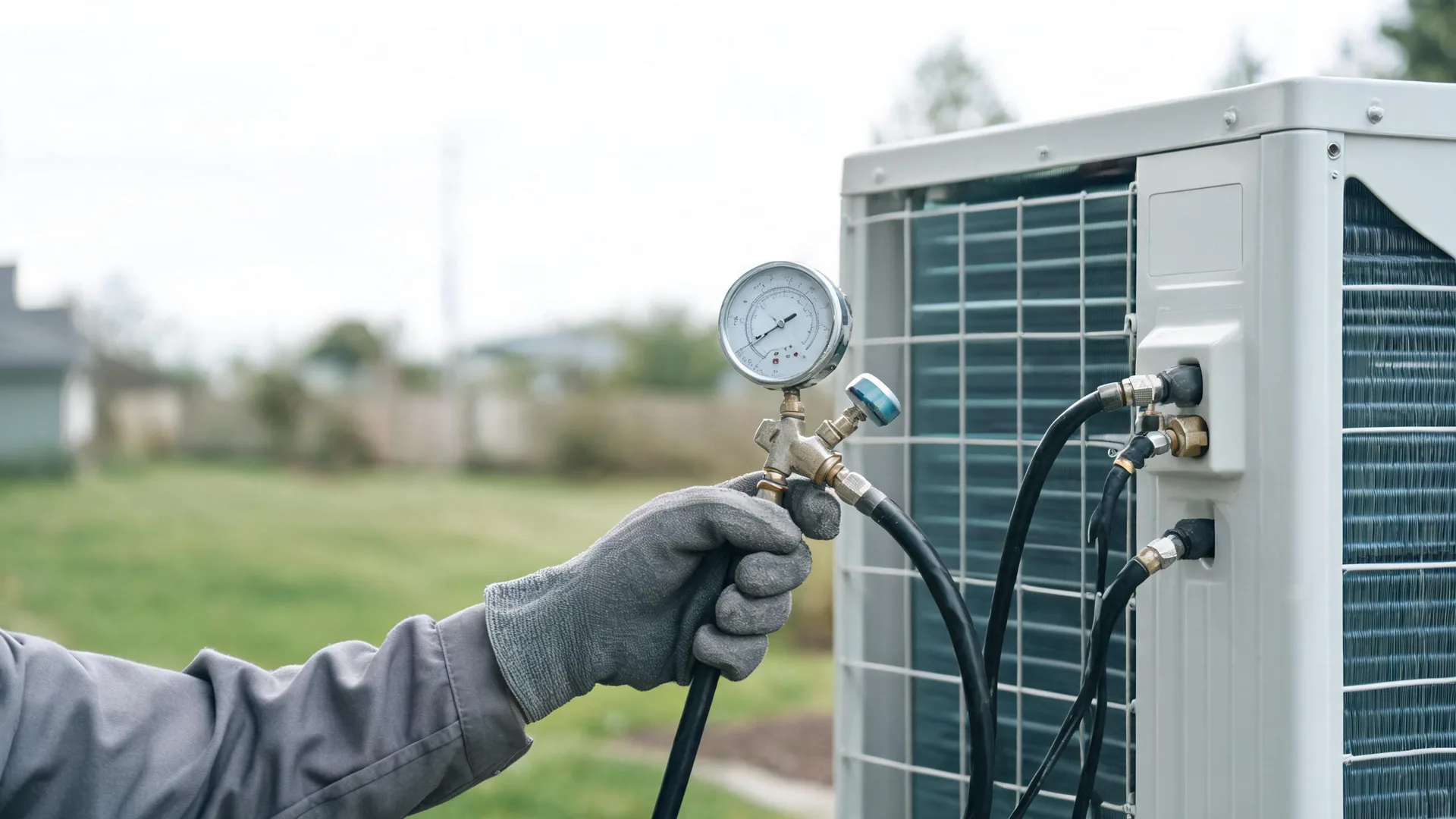
Look at the outdoor unit first. If the coil is packed with leaves or caked in ice beyond a thin frost layer, that alone can cause weak heating or weak cooling. Check the air filter inside, a clogged one starves the system of airflow and can cause icing or short cycling. Walk around the house and make sure nothing is blocking the vents or return grille. Check the thermostat batteries and settings, a thermostat stuck in the wrong mode or with a dead battery looks exactly like a broken heat pump.
What to leave to a contractor

If the outdoor unit isn't running at all, don't start pulling panels off it. That's usually a capacitor, a control board, or a stuck contactor, and those involve line voltage. A hissing sound, oily residue near the lines, or ice that keeps coming back after you clear it points to a refrigerant leak, and only a licensed contractor can legally handle refrigerant. If the system is running but blowing air that isn't warm or cool enough, that's a diagnosis job, not a filter swap.

A heat pump that's struggling doesn't fail cleanly. It fails slower, in a way that hides for a while. Low refrigerant charge is the clearest case. The compressor keeps trying to do its job with less to work with, which makes it run hotter and longer than it should, and that heat is what shortens its life. A coil losing its battle with ice behaves the same way. Each cycle leaves a little more frost behind, airflow drops further, and the system leans harder on parts never meant to carry the load alone. A weak capacitor is the easiest to picture. It can still start the compressor most days, until the one day it can't, and a hard-starting compressor wears faster than one that starts clean. None of this announces itself. The unit keeps running, the house stays close enough to comfortable, and the part underneath keeps losing ground.

A diagnostic visit starts outside, with the system running if it can run at all. A contractor checks refrigerant pressure and amp draw on the compressor. They'll watch whether the outdoor fan and indoor blower are both moving the air they should. Electrical parts get tested under load, not just looked at, because a capacitor or contactor can look fine sitting still and still be the thing failing. Indoors, they check the temperature of the air coming off the coil against what's expected for the mode it's running in. That split tells them more than the thermostat reading does. If the system is short cycling or icing over, they trace it back to whichever part started that chain rather than just clearing the frost and calling it done. The visit ends with a straight answer about what failed and whether it's worth repairing.