Electricity here runs 17.86 cents per kilowatthour
Maryland's electric rate sits well above the national average. A mini split that pulls less power to do the same heating or cooling job matters more here than in a state where power is cheap.
Takes about a minute. No obligation.
Maryland's electric rate sits well above the national average. A mini split that pulls less power to do the same heating or cooling job matters more here than in a state where power is cheap.
A mini split's SEER2 and HSPF2 ratings tell you how much electricity it takes to move a given amount of heat. At Maryland's rate, a unit with better ratings costs less to run every month it's on.
NOAA nClimDiv, 1991–2020 normals
Baltimore County has logged 314 damaging wind events and 33 winter storms over the past decade.
A standard mini split, sized and installed correctly, holds up fine through that. There's no case here for oversizing or upgrading past what the room needs.



Half the houses in Baltimore County went up in 1973 or before. A house that old usually has no ductwork built for cooling, which is a big part of why people look at a mini split in the first place. It mounts on a wall and runs refrigerant lines through a small hole, so there's no duct work to plan around. What matters instead is matching the unit to the room. It needs the right size for the square footage and a wall placement that lets air move across the whole space. An oversized unit cycles on and off instead of settling into a steady run, so bigger is not the goal. The job is picking the size and spot that fit the room you have.
Baltimore County sits in climate zone 4A. Any mini split installed here has to clear the regional minimum for a split-system heat pump. That means 14.3 SEER2 for cooling and 7.5 HSPF2 for heating, the floor new units start from. A system that meets it also qualifies for the federal tax credit available this year.
Find a contractorCooling runs June through September here, four months a year. May is the month before that starts. Install the mini split in May and it's in place and tested before the first hot week, not during it. Wait until the house is already warm and you're installing on the contractor's schedule, not yours, and living with the heat in the meantime.
Sizing a mini split means working out how much heat the room gains in summer and loses in winter, counting the windows, the exterior walls, the ceiling height and what's on the other side of each wall. A contractor measures the room and runs that calculation rather than reading a size off a chart. Rooms that look alike on paper can need different capacity depending on how many walls face outside and how much glass is in them.
A unit sized too big cools the room fast and shuts off before it pulls the moisture out of the air, so the room feels cool but damp. It also cycles on and off more than a correctly sized unit would, which wears the compressor harder over time. A unit sized too small runs constantly during the hottest or coldest stretches and still can't hold the temperature you set. Either mistake shows up as comfort you can feel and a system that runs more than it should.
SEER2 and HSPF2 are ratios. They measure how much heating or cooling a mini split delivers against the electricity it uses to do it. A higher number means the unit pulls less power to move the same amount of heat. That rating comes from a lab test under fixed conditions, so it's a way to compare one unit against another, not a promise of what you'll see on a bill. Rooms hold heat differently, and people run the system differently, so the same unit can work harder in one house than another. What the rating does tell you is real. A unit with a better rating costs less to run than one with a worse rating, doing the same job, in the same room.
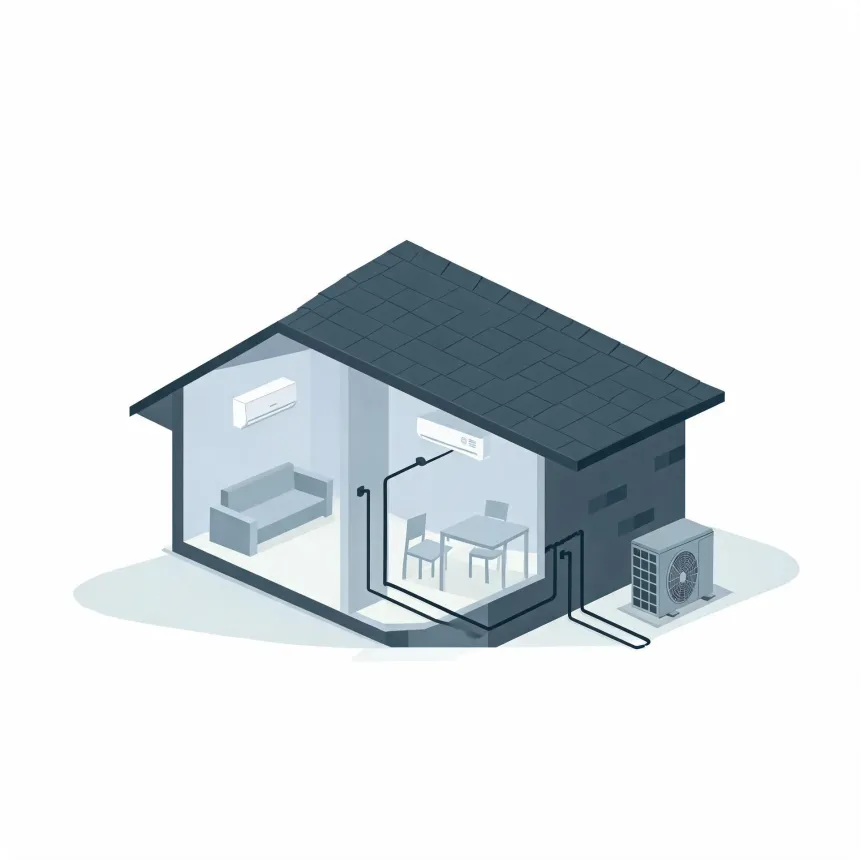
Installation starts with a hole through the exterior wall, sized for the line set that carries refrigerant lines, a drain line and electrical wire between the indoor and outdoor units. The indoor unit gets mounted to the wall first, usually positioned to hide that hole behind it once it's in place. The outdoor condenser goes on a pad or bracket outside, close enough for the line set to reach without excess coiling. Once both ends are connected, a vacuum pump pulls the air and moisture out of the lines before any refrigerant moves through them. Moisture left behind is what damages a compressor down the road, so this step gets checked, not assumed. After the system holds vacuum, the contractor runs it through both heating and cooling to confirm it's pulling the charge it should, and checks that the condensate drain is actually carrying water away before calling the job finished.