









Should you cover your AC unit in a Maryland winter

A local pro who services air conditioners gets in touch about the tune-up.

Tune-up, service, or cleaningCentral ACMaryland
Step 1 of 2

What ZIP code is the job in?

Should I cover my AC unit for the winter?

You see your neighbors throwing tarps over their AC units once the weather turns, and you're wondering if that's something you should be doing too, or if it's just an old habit that doesn't actually do anything for the unit sitting outside your house all winter.

No, leave it uncovered

Your outdoor unit is built to sit outside year round, through Maryland winters included. A full cover traps moisture against the coil and the cabinet, and that moisture causes rust and corrosion faster than open air ever would. It also gives mice and other small animals a dry, enclosed place to nest for the winter, right up against the wiring. If you want to cover anything, cover only the top, with a flat piece of plywood or a purpose-made top cap, weighted or secured so wind can't lift it. That keeps falling ice and debris off the coil without sealing in moisture. Leave the sides open so air moves through freely.

  1. Leaves and seed pods settle into the fan and coil fins

  2. Trapped moisture sits against the coil instead of draining off

  3. A full cover traps humidity and invites rust and mold

  4. A mesh top cover keeps debris out and lets air through

Full Cover vs. Mesh Top Cover

Full cover

  • A full vinyl cover traps the moisture that collects inside it against the coil and the cabinet.
  • That trapped damp air gives rust a head start on the fins and the coil, and gives mold a place to grow.
  • Mice and other small animals look for a closed-in space to nest in over the winter, and a full cover gives them one.
  • If any moisture was already sitting in the unit when you covered it, the cover seals that moisture in instead of letting it dry out.
  • A full cover does stop sun and ice from hitting the cabinet directly, which a bare unit doesn't get.

Mesh top cover

  • A mesh or screen cover over just the top keeps leaves, seed pods, and sticks out of the fan and coil fins.
  • Air still moves through the sides and bottom, so condensation doesn't build up inside the cabinet.
  • It leaves the coil and fan exposed to light rain and snow, which the unit is built to handle on its own.
  • It gives mice and other animals less to work with than a full cover does, since the sides stay open.
  • A contractor can pull it off in seconds each spring, with no rust or trapped moisture to deal with underneath.
An older man with gray hair and a beard, wearing a dark coat dusted with snow, stands smiling in a doorway of a warmly lit home with a sofa, lamp and window visible behind him.
An older man with grey hair and a beard, wearing a dark coat dusted with snow, stands in a dimly lit entryway with a ceiling lamp, a side table with two shaded lamps, and a lit fireplace visible in a room beyond.
A bearded older man in a dark snow-dusted coat and scarf stands just inside a home's front door, with a lamp-lit room and snowy window visible behind him.
An older man with gray hair and a beard stands in a doorway of a home, wearing a dark coat dusted with snow, with a lit fireplace and lamp visible in the blurred room behind him.
A gray outdoor air conditioning condenser unit on a concrete pad beside a house with horizontal lap siding, with a wall-mounted disconnect box and conduit to the left and a green shrub with mulch to the right.
Left alone, the coil stays dry and the cabinet can breathe through the colder months.
A dirty outdoor air conditioning condenser unit on a concrete pad beside a house wall with horizontal siding above a painted brick foundation, with a gray electrical disconnect box and conduit on the wall.
Caked in leaves and grime like this, the coil blocks airflow and rusts faster once spring cooling starts.

What This Means for Your Unit

  • A full cover left on through a Maryland winter can trap moisture against your coil for five or six months straight.
  • Rust that starts on the fins over the winter shows up as weaker cooling once you turn the AC back on in April or May.
  • A unit nesting mice chewed through over the winter can mean a refrigerant line repair before the first hot week hits.
  • Skipping a cover entirely leaves the coil exposed to wind-blown leaves and grit all winter, which a contractor has to clean out before startup.
  • A cracked or clogged unit in June costs you comfort on the muggiest days, right when you need it most.
  • A mesh top cover keeps the worst debris out without sealing in the damp air that causes the bigger problems.

Your AC sits outside from October or November through March or April, longer than most people guess when they picture winter. That's the stretch a full cover has to work through, and it's long enough for trapped moisture to do real damage to the coil and cabinet. Maryland winters bring enough wet weather that a sealed cover keeps condensation sitting against the metal instead of letting it evaporate off. Rust doesn't wait for spring to announce itself. It starts quietly on the fins over those cold months, and you won't see the cost until you flip the AC on for the first hot day and notice it's not cooling like it should. A covered unit also looks like shelter to a mouse hunting for a dry place in December. Once inside, they chew insulation and lines, and a chewed refrigerant line is not a quick fix before the first 90 degree afternoon. Leave the unit bare and uncovered, and you trade one problem for another: wind carries leaves and grit into the fan and coil all winter, and that buildup has to come out before the system can run right. A mesh top cover splits the difference. It blocks what falls from above without sealing off the sides, so air keeps moving through the cabinet and moisture doesn't collect. For a house you're keeping up, that's the version worth doing before the first freeze.

An outdoor air conditioner condenser unit on a concrete pad beside a house with horizontal siding and a lower concrete foundation wall, with coiled refrigerant lines at right.
Before you get your air conditioner maintenance
An outdoor air conditioning condenser unit on a concrete pad beside a house with horizontal lap siding, with an electrical disconnect box and conduit on the wall and a green shrub to the right.
After you get your air conditioner maintenance
A gray outdoor air conditioning condenser unit on a concrete pad beside a house with horizontal lap siding, with a wall-mounted electrical disconnect box and refrigerant lines, shrubs, mulch and lawn around it.

Left uncovered

Your unit sits open to the weather, conduit running up to the disconnect box, mulch and shrubs around the pad. Rain and snow drain off the way the cabinet was built to handle. Air moves through the fins all winter, so nothing sits trapped against the coil waiting for spring.


An outdoor air conditioner condenser unit on a concrete pad beside a house wall with stucco lower section, horizontal siding above, and a white downspout to the right.

Buried under a cover

Grime and dirt build up on the fins when a cover stays on through the cold months, trapping damp air against the coil and the housing. The refrigerant lines and cabinet weather faster underneath, and by the time you pull the cover off, the unit looks like this one.

A woman wrapped in a thick wool blanket sits in an armchair with an open book on her lap, beside a lit lamp and a frost-patterned window.
A woman in a cream knit sweater sits in an armchair with her eyes closed and head tilted back, beside a window showing orange autumn foliage and a wooden side table with a mug.
A two-story house with tan horizontal siding and a dark shingled roof, fronted by a mowed lawn, trimmed shrubs, leafy trees on both sides, and a concrete walkway leading from a wet sidewalk to the white front door.

A Maryland summer averages a dew point of 64°F across June, July and August, per NOAA. That's heavy, sticky air, and your AC has to pull real moisture out of it every time it runs, not just drop the temperature. That load is what wears on the coil and the fins over a long cooling season here. A unit that goes into winter with a dirty coil or bent fins from that wear carries the problem forward, covered or not. Once you send the form, you're done hunting for someone to look at it. A contractor takes it from there.

NASA POWER T2MDEW county cells weighted by homes

Matched to your air conditioner job

Send the form, and lining up the air conditioner tune-up stops being yours to chase.

You only hire the pro if you want to.

What the coil is built for

The coil and cabinet on your outdoor unit are built to sit outside year round. The fins are coated metal, the cabinet has weep holes or gaps low down so water finds its way out, and the whole thing is designed to take rain, snow and freezing temperatures without a cover. A full cover changes that. It stops the cabinet from draining the way it was built to and holds the damp air from Maryland's winter weather right against the coil instead of letting it pass through. Manufacturers that sell a cover at all sell a mesh top piece, not a full wrap, because the unit needs the sides open.

What a contractor checks each spring

When a contractor comes out for spring maintenance, part of the visit is looking over the coil and fins for rust and corrosion that built up over the winter. A unit that sat uncovered with clear airflow usually shows less of it than one that spent the winter under a full tarp. Corrosion on the fins doesn't reverse itself once the weather warms up. It's there until the metal is replaced. That's one more thing for the contractor to flag and work around when they're getting your AC ready for a Maryland summer, rather than a clean coil they can just confirm is working.

Power costs 19.53 cents per kilowatt-hour statewide

At 19.53 cents per kilowatt-hour, running your AC all summer already costs real money. A rusted coil or dirty fins from a bad winter cover makes the unit work harder to cool the same house, and that harder work shows up on the electric bill before it shows up as a repair.

EIA-861 2025 statewide residential average

A gray outdoor air conditioning condenser unit on a composite pad beside a house with horizontal lap siding, with a wall-mounted disconnect box, refrigerant lines, and a wooden fence and shrubs to the left.

Uncovered and sitting open

The pad is bare, conduit running up the wall to the disconnect box same as always. Rain runs off the cabinet and out through the weep holes it was built with. Cold air moves through the fins all winter, so nothing sits trapped against the coil.

An outdoor air conditioning condenser unit on a concrete pad beside a house with light vinyl siding, with electrical conduit running to a wall-mounted disconnect box and a shrub in mulch to the right.

Covered and shut in

A tarp pulled down tight over the siding unit holds moisture against the coil instead of letting it drain. The conduit and wiring still run in the same way, but the air behind the cover stays damp for months, and that damp sits right where the coil can't shed it.

A woman in a long cream cardigan and jeans stands at an open wooden front door of a gray shingled house with stone-based porch columns, with a second person visible inside, and potted flowers and shrubs beside the entry.

What a winter cover costs you by May

Think about where your unit actually sits. Maybe it's tucked along the side of the house, maybe it's near the patio where you'd notice it every day. Either way, once you wrap it and forget it, you won't see what's happening underneath until you pull that cover off in spring and turn the system back on.

In a Maryland winter, that's five or six months of a sealed cabinet sitting over a coil that never gets to dry out. By the time the sticky air rolls back in and you need the AC to work, it's pulling harder through fins that have had a winter to rust. If you'd rather know the unit is ready before the first humid week hits, a maintenance visit can check the coil and cabinet now and sort out anything a bad cover left behind. Answer a few questions and a local contractor who handles this will be in touch to look at your specific setup.

Interior corner with sheer white curtains at a window, a brown upholstered sofa in the foreground, and a wooden multi-drawer cabinet holding a round ceramic vase with leafy branches.
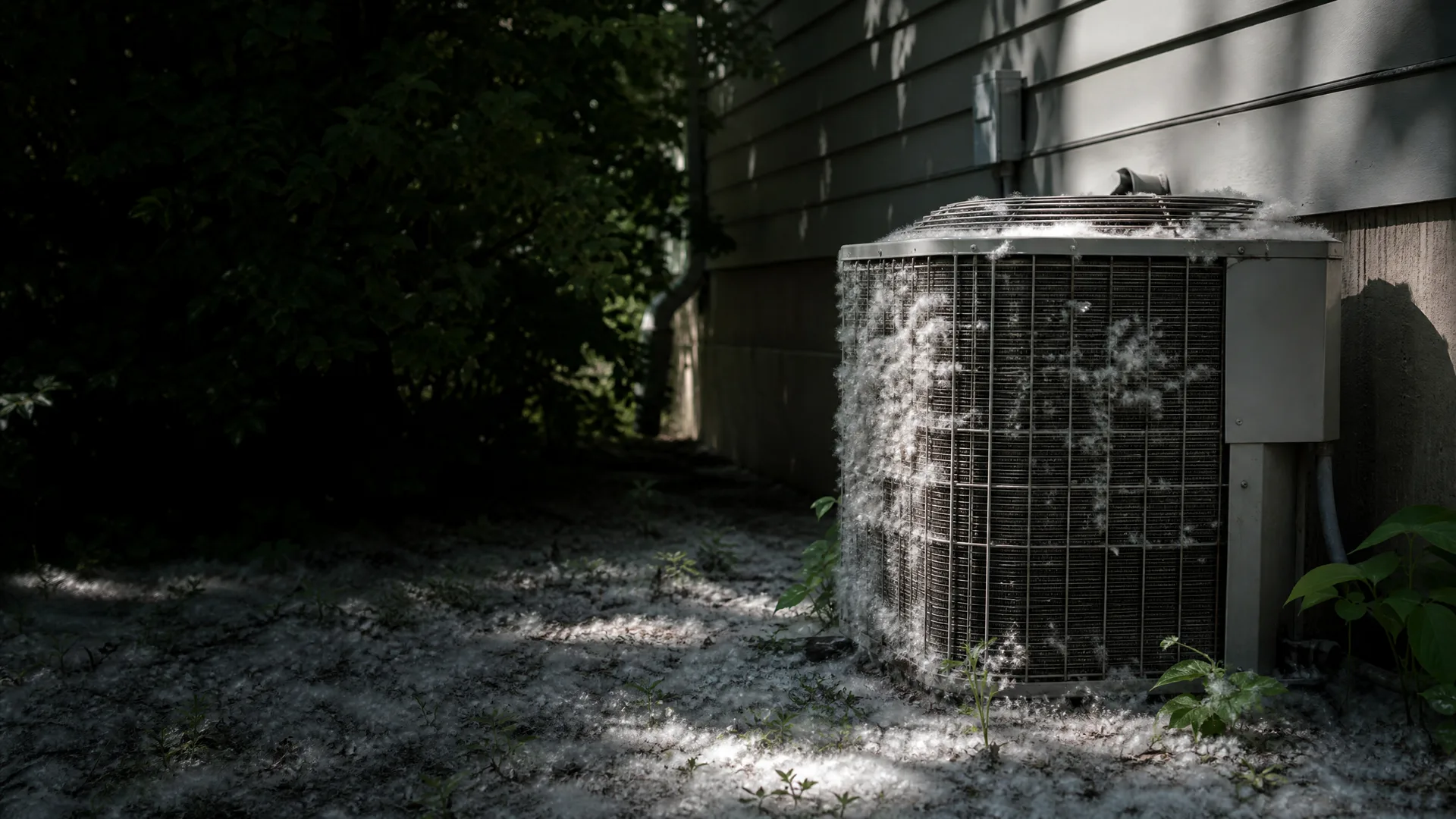
An outdoor air conditioner condenser unit beside a house with horizontal siding, its coil covered in white cottonwood fluff that also blankets the ground around it.

Late May, and the cottonwood trees a few yards over have let go. You notice it when you're out checking the flower beds along the side yard: a layer of white fluff caught in the fins of your AC condenser, thick enough that you can't see the metal underneath in spots. It's been sitting there a few days at least, maybe longer, blown in on the wind and packed in tight by the last rain. You give the cabinet a knock out of habit. The fluff doesn't move much. Somewhere behind it, the fan is already due to kick on for the season.

Leave your AC alone this winter, or cover just the top if you want to keep leaves out. A full cover does more harm than the weather ever would. Your unit was built to sit outside through rain, snow and ice, and it needs to breathe while it sits idle from November to March. If the coil already has a winter's worth of grime on it, or last year's cover left rust starting on the fins, a contractor can check it before you need the AC again in May. You send one form, and from there it's not your job to track down who's available or who does good work in your area. That part is off your plate. What's left is simple: let the unit sit uncovered, and let someone who does this for a living make sure it's ready before the first hot week hits.

Corner of a house with cream horizontal lap siding and tree shadows, beside a covered porch with a square column, wooden deck, steps, white balusters, and a shrub at right.
Corner of a white clapboard house with a multi-pane wood window in warm low-angle sunlight, with hydrangea shrubs and other green foliage growing along the base and dark trees behind.
A wooden front door with divided-light glass panes set under an arched entry on a white shingled house, with a black wall lantern, a tall gray planter, flowering shrubs, and a flagstone walkway.
Exterior corner of a house with cream horizontal siding, a dark-framed three-section window, and a stone veneer foundation, with white hydrangeas and clipped shrubs along a paved walkway and tree branches overhead.
Corner of a white-clad house with a dark-framed grid window, dark downspout and eaves, surrounded by trimmed hedges, shrubs, white hydrangeas and a leafy tree in sunlight.

An air conditioner pro near you

Send the form and the air conditioner tune-up stops being something to remember.

Find a pro near me

Asking costs nothing, and the choice to hire stays yours.