Oversized by even half a ton
A unit too big for your house cycles on and off fast, so it cools the air but leaves the house feeling damp all summer.

There's no single tonnage that fits every Maryland house. The right size comes from a load calculation, a room by room look at your square footage, windows, insulation and ceiling height, because a unit picked by square footage alone almost always comes out wrong. Too big and it cools the air fast but shuts off before it pulls the humidity out, so the house feels sticky even with the thermostat satisfied, a real problem once summer here turns muggy. Too small and it runs constantly trying to catch up, pushing your electric bill higher without ever getting the house comfortable. Either mistake costs you comfort or money for as long as that unit is installed. A contractor who runs the calculation on your actual home, not a chart, is what gets you a unit sized to how your house holds and loses heat.


Sizing an AC starts with the Manual J calculation, which weighs your home's orientation, window area and insulation against the outdoor design temperature for Maryland. That number matters more than square footage, because two houses the same size can need different tonnage depending on how many windows face west or how high the ceilings run. Get it wrong one way and the unit cools the air fast, then shuts off before the humidity drops, leaving rooms cold and clammy at the same time. Get it wrong the other way and the unit runs nonstop on the hottest days, never holds the thermostat setting, and drives the electric bill up without solving anything. The ductwork gets checked too, since even a correctly sized unit will leave some rooms warmer than others if the ducts are leaky or too small to carry the air it's pushing. Contractors also look at attic insulation and how many people live in the house day to day, since both add to or ease the load in ways a square footage number alone never shows.


A unit too big for your house cycles on and off fast, so it cools the air but leaves the house feeling damp all summer.
A unit too small runs nearly nonstop on hot days, driving up your electric bill without ever quite catching up to the thermostat.





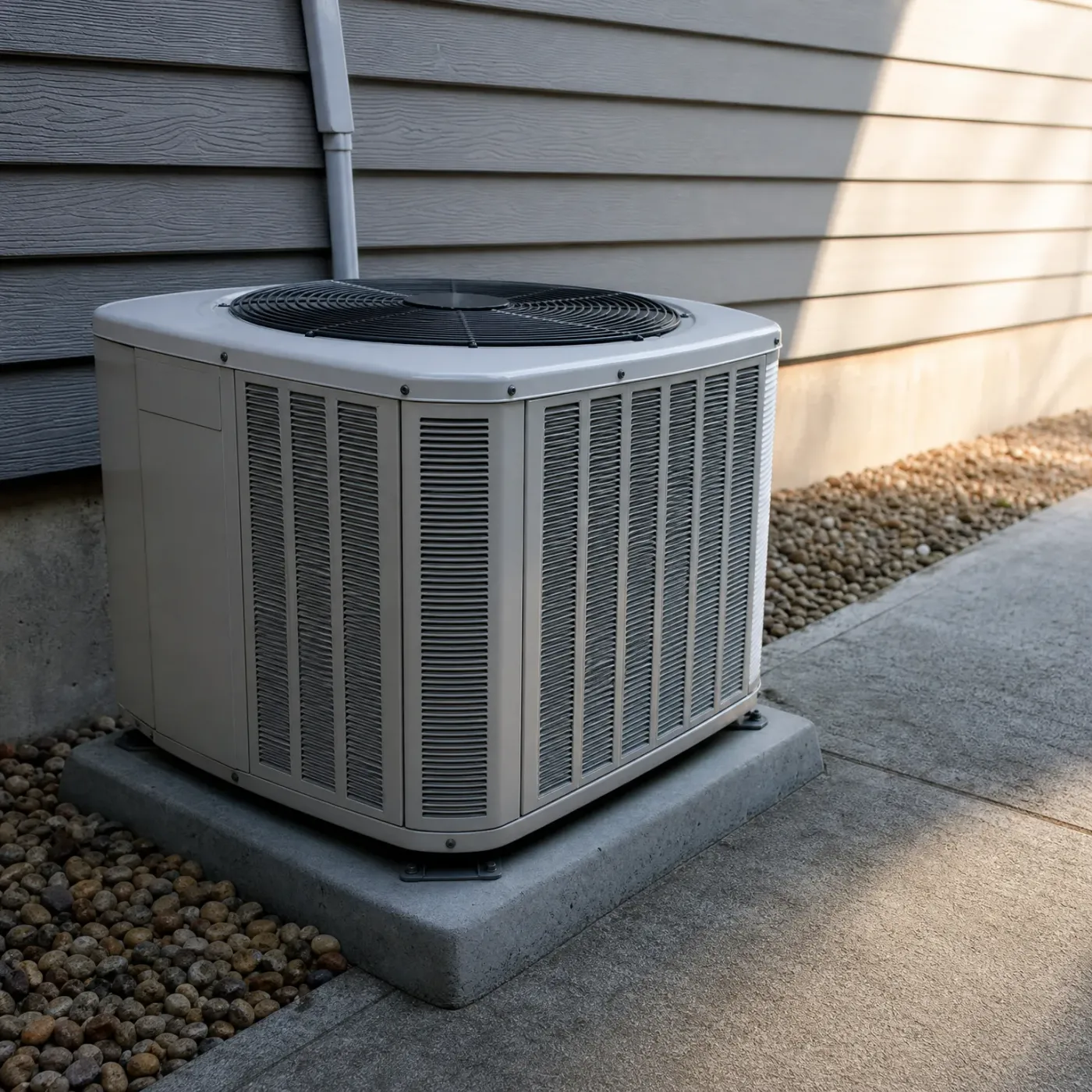
The pad is clear, the grass is cut back, and the shrub next to it has room to bloom. Air moves through the coil the way it was designed to, so the unit holds steady instead of fighting for every degree.

Grime coats the fins and the cage is caked with debris, so the coil can't shed heat the way it should. Even a unit sized right for your house loses capacity when it has to push through buildup like this.
If your AC runs and runs on a muggy afternoon and the house still feels clammy, that's a sign worth paying attention to. You might notice the air coming out of the vents feels cold but the house never quite feels dry. Or the opposite: it shuts off after a few minutes, then kicks back on again and again. You may see moisture on the windows, or the upstairs stays warmer than the rest of the house no matter how long it runs. None of that is normal wear. A system fighting its own size pushes your electric bill up every month it runs, and the extra moisture it leaves behind gives mold and mildew a place to start.

The box fan is doing nothing. It's past eight and still bright out, the kind of June evening where the heat just sits in the upstairs rooms all day and doesn't leave. You're on top of the sheets, the fan pushing the same warm, heavy air back and forth across the bed. Downstairs the AC is running, you can hear it cycle, but whatever it's pushing up through the vents in this room gives up somewhere in the ductwork. The glass in the window is still warm from the day. You keep thinking about the thermostat reading seventy-two and not believing it, because seventy-two downstairs and this room are not the same house tonight.
The pro who reaches out is licensed in Maryland.
It costs nothing to send, and you don't have to hire anyone.
Average summer dew point across Maryland runs 64°F, per NOAA, and that's the number that decides whether your house feels dry or sticky, not the thermometer. A unit matched to your square footage and layout pulls that moisture out as it runs, so the air feels dry even on a 90 degree day. A unit sized wrong, especially one too big, cools the room fast and shuts off before it has time to wring the humidity out. You end up with a house that reads 72 on the thermostat but still feels damp against your skin.
NASA POWER T2MDEW county cells weighted by homes
You stand by the vents and the air coming out is cold, so it doesn't make sense that the house never gets there. The thermostat just climbs, or holds a degree or two above where you set it, no matter how long the unit runs. In a Maryland summer, with the humidity doing its own work against you, it's easy to assume the unit is broken. Usually it isn't.
An undersized air conditioner isn't failing, it's working at its limit the whole time. It moves the air it's rated to move and no more, so on a 90 degree day with high humidity it can run for hours and still lose ground against the heat coming through your walls and windows. That's the load calculation at work in reverse: a unit sized for fewer square feet than you actually have, or for a layout that doesn't match your home's orientation and window area, can't keep up no matter how long it runs. A properly sized replacement, matched to your house instead of a guess, reaches the set temperature and then cycles off like it's supposed to.


At 19.53 cents per kilowatt-hour, every hour your AC runs past what your house actually needs shows up on the bill. An oversized or undersized unit both run more than they should, just for different reasons, and at that rate the gap is easy to feel.
EIA-861 2025 statewide residential average
A Manual J calculation is what tells you the tonnage your house actually needs, not a chart based on square footage. That number accounts for your windows, your insulation, your ceiling height, the direction your house faces. Skip that step and you end up with a unit that either short cycles and leaves the air damp, or runs nonstop and still can't keep up on a humid afternoon. Either way you're paying for it on the electric bill, and in Maryland, where summers run sticky and most homes heat with electric too, that cost adds up both directions.
The part worth knowing is that this isn't a guess a homeowner or a general contractor makes well. It takes someone who does load calculations and installs on Maryland homes regularly, who knows how a house with your layout and exposure tends to come out, and who has seen which sizing mistakes show up again and again in this area. When you get matched, it's with one licensed, local contractor, not a handful of companies all calling you back. That contractor handles the calculation and the install as one job, so you're not relaying the same details to three different people or trying to compare quotes that were never built on the same numbers.
Once the unit is sized to your house, the rest tends to take care of itself. It holds temperature instead of swinging, it pulls moisture out of the air as it runs, and the bill reflects a system that's running the amount it should and no more.
Only one pro gets your request, so you hear from one company.
No charge to send it. You decide if you hire them.
