
Running fine
The outside unit hums along steady, the fan spinning, air coming out of the top warm to the touch. The pad is clear, the conduit to the disconnect box is intact, and nothing around it looks disturbed. This is what normal looks like.
When the air conditioner stops cooling or starts acting up in the middle of a Maryland summer, it's worth spending a minute looking at a few things yourself before anyone gets on the phone. Sometimes what looks like a repair is something you can see right away, and even when it isn't, knowing what you checked makes the call shorter and the diagnosis faster.
Start with the thermostat. Make sure it's set to cool and set below the room temperature, since a setting bumped by accident is more common than people think. Next check the breaker panel. Central air draws a lot of power, and a tripped breaker will shut the whole system down without any other warning. Then walk outside and look at the condenser unit. If it's covered in leaves, pollen, or grass clippings, or if you can't hear the fan running, that's often enough to stop cold air from the vents. Also check your air filter. A filter clogged with a summer's worth of dust can choke airflow until the system struggles to keep up. If all of that looks normal and the air still isn't cold, the problem is inside the unit itself, and that's where a repair comes in.

The outside unit hums along steady, the fan spinning, air coming out of the top warm to the touch. The pad is clear, the conduit to the disconnect box is intact, and nothing around it looks disturbed. This is what normal looks like.

The unit sits quiet when it should be running, or it's running but the air inside hasn't changed. Check the disconnect box on the wall and make sure the breaker inside hasn't tripped. If it has and trips again after you reset it, that's one to leave alone and get checked.




Your thermostat is just a switch at the start of a chain. Once it calls for cooling, a low voltage signal goes out to the outdoor unit, and a contactor closes to send full power to the compressor and the condenser fan together. The compressor's job is to squeeze refrigerant into a hot gas, and the fan's job is to pull outside air across the condenser coil so that gas gives up its heat and turns back into a liquid. That liquid refrigerant lines run inside to the evaporator coil, and the indoor blower pushes your house air across it, which is where the actual cooling happens. Every part of this depends on the step before it working right. If the filter is dirty, airflow across the evaporator coil drops, and a coil that isn't getting enough air can ice over even when it's 95 degrees outside. Once ice builds up, the system can't cool at all until it melts off. The run capacitor matters earlier in the chain. It stores the charge that gives the compressor and the fan motor the push they need to start spinning. A capacitor that's gone weak might let the fan limp along while the compressor hums and never kicks in, or it might stop the whole outdoor unit from starting. None of these parts work in isolation. A problem at any one step shows up as the same complaint from inside the house: the air just isn't cold anymore.


Thermostat sends a signal to the outdoor unit's contactor.
Contactor closes and sends power to the compressor and fan.
Compressor pressurizes refrigerant and pushes it to the condenser coil.
Condenser fan pulls outside air across the coil to release heat.
At that rate, a struggling air conditioner shows up fast on your bill. A dirty coil or a low charge makes the compressor run longer to reach the same temperature, and every extra hour it runs costs more at 19.53 cents a kilowatt-hour. Catching the problem early keeps your home comfortable without that cost stacking up all summer.
EIA-861 2025 statewide residential average


You've checked the pad, looked at the coil, maybe reset the breaker once. If the unit still isn't cooling, that's the point where guessing stops helping. A Maryland summer doesn't leave much room to wait on a system that won't come back on its own, and the longer a bad contactor or a low charge runs the compressor ragged, the more it costs you at 19.53 cents a kilowatt-hour. What you send through gets to one contractor, someone local who works on this equipment all summer and has a good idea what's wrong before they even get to your house. No sorting through five different companies calling back, no explaining the problem over and over. Just the next step, off your plate.
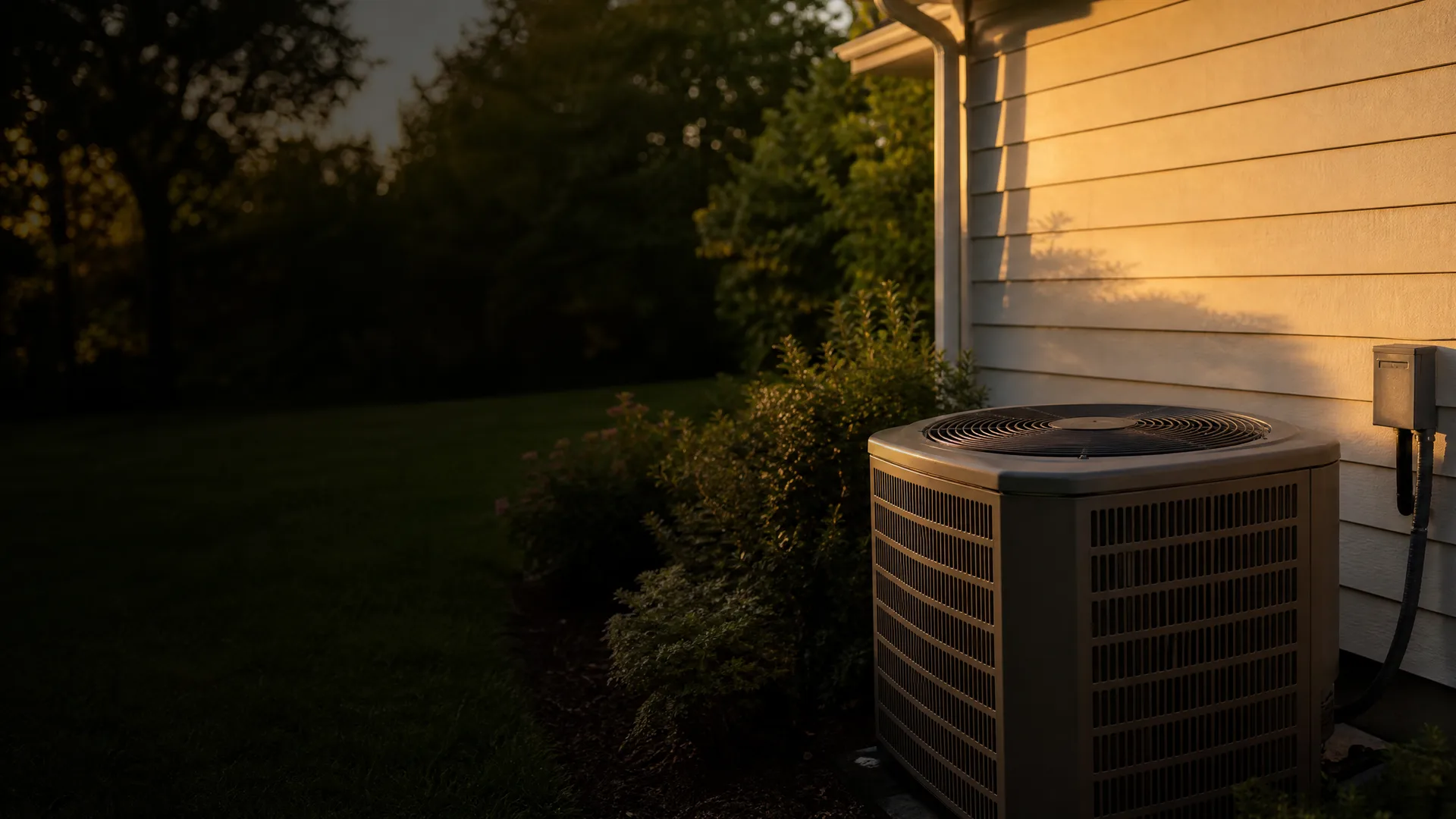
You're out back around seven, watering the tomatoes before the light goes. The air is thick the way it gets in August, and the condenser against the fence has gone quiet. You stop and look. The fan isn't turning. No hum, no click, nothing moving behind the grille. Inside, you know the thermostat is still set to 72 and the house is starting to hold heat the way it does when the AC gives up for the night. You crouch down by the pad, hand near the vents, feeling for any air at all. Nothing. The sun's dropping behind the trees and the bugs are starting up, and the unit just sits there, still.
You notice it in the rooms people actually sit in. The air coming out of the vents feels weak or barely cool, and the thermostat says 74 when it's set to 70. Maybe you hear the outdoor unit clicking on and off every few minutes instead of running a steady cycle, or it runs for hours without the house catching up. Some homes get a musty smell from the vents, a sign water isn't draining where it should. None of this is just an inconvenience in a Maryland summer. A system working harder than it needs to runs up the electric bill fast, and if it's actually frozen or shutting itself off to protect the compressor, that delay can turn into a bigger repair.


A clear pad, a clean coil, a breaker that holds, that's most of what you can check on your own. Past that point, it takes someone who can put a gauge on the system and see what the thermostat can't tell you. When you send in a request, it goes to one contractor, local to your part of Maryland, who works on these systems all summer and has a good idea what's behind a given symptom before they even pull up. You won't end up fielding calls from five different companies trying to win the job. Just someone who already knows what a weak contactor sounds like, what a low charge does to a compressor, and how to get your house back to 70 without you standing out back squinting at the condenser.





The pro who reaches out is licensed in Maryland.
It costs nothing to send, and you don't have to hire anyone.