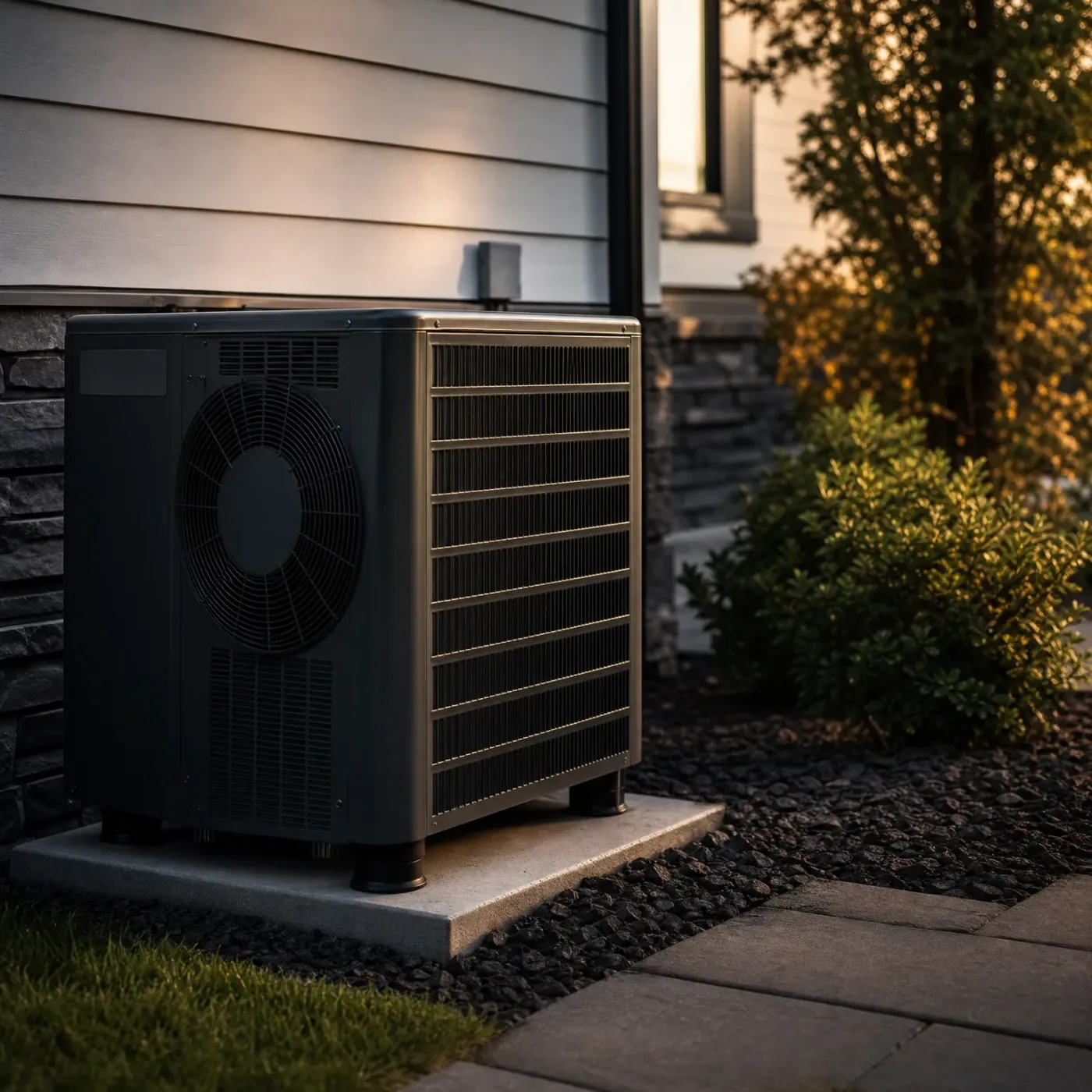







A dark outdoor heat pump unit with a round fan grille and finned coil sits on a concrete pad beside a house with horizontal siding and stone veneer, next to gravel, a paver walkway, grass and shrubs in warm low light.

A pro who works on heat pumps

Why your heat pump has ice on it in a Maryland winter

A heat pump builds up frost in cold weather, that part is normal, and it should melt off on its own a few times a day. Ice that stays, spreads across the coil, or shows up on a mild day is different. This page gets into what causes that and when it means a repair, so you're not stuck calling around and explaining the problem to one contractor after another.

Get a local pro

A little frost on the outdoor unit is normal. Your heat pump switches into defrost mode on its own, melting it off and sending up a puff of steam. What's not normal is ice that stays put, builds up thick, or coats the whole coil. That happens when the defrost cycle itself stops working right, often because a sensor or control board has failed and the system no longer knows it needs to defrost. It can also happen when airflow across the coil is blocked, by a dirty filter, a failing fan motor, or snow packed around the unit. Maryland winters bring real cold, and a heat pump that can't clear its own ice has to work harder to pull heat from that cold air, which shows up fast on an electric bill. Left alone, the ice spreads, the coil stays blocked, and the system loses its ability to heat your home at all.

A woman in a mustard knit sweater sits on a light-colored sofa indoors, looking toward a bright window, with a potted fiddle-leaf fig plant behind her.
A woman with long brown hair in a cream knit turtleneck sweater sits on a light sofa indoors, looking off to the side, with a shelf of plants and pottery blurred behind her.
A woman with long brown hair in a dark red knit sweater sits on a gray couch with cushions, smiling and looking off to the side, with a window and indoor plant behind her.
A woman with long dark hair in a cream knit sweater sits on a sofa indoors, smiling and looking off to the side, with a blurred room, hanging light bulb and window behind her.

When your heat pump senses the coil has gotten too cold, it reverses itself for a few minutes. Hot refrigerant runs backward through the outdoor coil to melt the frost off, and the outdoor fan stops so that heat doesn't just blow away into the yard. A sensor on the coil is what tells the system to start this and when the coil's warm enough to switch back to normal heating. While all that's happening, backup heat strips in the indoor unit kick on so the air coming through your vents stays warm instead of turning cold for a few minutes. It's a short cycle that runs a few times a day in cold weather and then shuts itself back off. The trouble starts when one piece of that chain doesn't do its job. A defrost sensor that's failed or a reversing valve that's stuck won't send the signal, so the coil never gets its hot refrigerant and the ice just keeps building. Low refrigerant does something similar from the other direction, running the coil colder than normal so frost forms faster than a working defrost cycle can keep up with.

How defrost mode actually works

  • A reversing valve switches the heat pump into defrost mode, running the system backward so hot refrigerant flows through the outdoor coil to melt the ice.
  • During defrost the outdoor fan shuts off so heat isn't blown away from the coil before it can do its work.
  • A sensor on the coil tells the system when it's cold enough to need defrost and when the coil has warmed enough to switch back.
  • The indoor unit kicks on backup heat strips during defrost so the air coming through your vents doesn't suddenly turn cold.
  • A failed defrost sensor or a stuck reversing valve means the unit never gets the signal to melt the ice, so it keeps building instead.
  • A low refrigerant charge keeps the coil colder than it should run, so frost forms faster than a normal defrost cycle can clear it.
A gray outdoor heat pump unit on a concrete pad beside a house with horizontal lap siding, with a conduit running to a wall-mounted disconnect box and a green shrub to the left.
A clean coil and clear airflow let the unit shed frost on its own between cycles, the way it was built to.
An outdoor air conditioner condenser unit on a concrete pad beside a house with horizontal vinyl siding, with refrigerant lines and an electrical disconnect box on the wall and dry leaves on the ground.
Dirty fins and a pile of leaves trap cold against the coil, so the ice builds faster than defrost mode can clear it.
A dark bedroom at night with a rumpled duvet and pillows on a bed beside a rain-streaked, condensation-covered window with distant lights, a curtain, and a bedside lamp.

It's past eleven on a night in August, the kind where the air outside hasn't cooled off at all. Upstairs the sheets are damp, and the window has fogged along the edges where the humidity presses against the glass. The vents are moving air, but it isn't landing cold, just a weak breath against your arm. Somewhere below, the outdoor unit is running harder than it should need to, pulling against ice that formed on it back in January and never fully cleared. Maryland winters leave that mark and Maryland summers are when it shows up, in a bedroom that won't drop below eighty no matter how long the system runs.

Get your heat pump to the right pro

A heat pump stuck in ice doesn't fix itself, and running it that way stresses the compressor, the part that costs the most to replace. In a Maryland winter that unit is likely doing all your heating, so every day it runs iced up is a day it's working harder for less heat, on power that already isn't cheap here. Finding out whether the problem is a failed defrost control, a low refrigerant charge, or a fan that's not moving air right takes someone who can look at the unit itself. That's not something to sort out by searching around, calling a few places, and explaining the same frozen coil three or four times over. One contractor who works on heat pumps in Maryland winters can look at what's actually happening on your outdoor unit and tell you what it needs, instead of you guessing from what you see through the ice.

When defrost mode can't keep up

Defrost mode only runs for a few minutes at a time, then switches back to heating. If the unit is low on refrigerant, the coil stays colder than it should, and the heat it pulls off the compressor during defrost isn't enough to melt what's built up. Each cycle clears a little less than the one before. A sensor or control board that's failing to call defrost at the right time causes the same result. Either way, the ice wins a little more each hour, and by morning it can cover the whole outdoor unit.


Why a mild day doesn't add up

A heat pump icing up when it's 20 degrees out is one thing. One icing up at 45 degrees means something is wrong, because frost shouldn't form that heavy when the air isn't that cold to begin with. That points to the outdoor fan not running, a refrigerant leak, or a stuck reversing valve rather than normal winter weather. If you notice ice building on a day that isn't particularly cold, that's worth paying attention to even if the unit seems to be heating the house fine otherwise.

An outdoor condenser unit on a concrete pad beside a horizontal-sided house, with insulated refrigerant lines running to a wall-mounted box, surrounded by bare dirt.
Before you get your heat pump repair
A gray outdoor condenser unit on a concrete pad beside a house with horizontal lap siding, with a wall-mounted disconnect box, conduit and insulated refrigerant lines, a shrub at left and gravel at right.
After you get your heat pump repair

What you're probably seeing on your own unit right now

Go look at the outdoor unit. If the coil is white or gray all over, not just a thin layer but a solid coating, that's past normal. Ice creeping up the sides, hanging off the bottom, or a sheet of it where the fan can't turn freely all point the same direction. You might hear the fan straining or not running at all. Inside the house, the air coming from the vents may feel cooler than usual, or the system may run long stretches without warming the rooms the way it used to. Since this unit likely carries your whole heating load, a buildup like this that goes unchecked can mean higher bills for less heat, and more strain on a compressor that's expensive to replace.

A two-story light-colored house with horizontal siding, two front gables and a small porch, seen from the street across a green lawn with a straight concrete walkway and leafy trees on both sides in low sunlight.

That dew point you feel every summer, averaging 64°F across Maryland according to NOAA climate data, means the air stays loaded with moisture for months. A heat pump pulls that moisture out along with the heat, and the coil and drain system work harder for it, summer after summer. Comes winter, that's the same unit and the same coil now running in reverse, and any wear from all those muggy months shows up as a system more likely to struggle with ice instead of shedding it on its own. If your heat pump has been laboring through summers here, winter icing is often where that catches up with it.

NASA POWER T2MDEW county cells weighted by homes

A smiling older woman with short light hair in a beige knit sweater sits in a dimly lit kitchen beside a window at night, with a round loaf of bread on a wooden board in the foreground.
A woman with dark hair in a bun holds a sleeping child wrapped in a knitted beige blanket on a sofa, with a lit lamp and a window behind them.

Power costs 19.53 cents per kilowatt-hour statewide

At 19.53 cents a kilowatt-hour, a heat pump stuck in a block of ice is burning your money to do less heating. It's pulling more power to fight through that ice and still not warming the house like it should. The longer it runs that way, the more it shows up on the bill.

EIA-861 2025 statewide residential average

  1. Warm refrigerant stops reaching the coil as ice blocks proper flow.

  2. The defrost thermostat senses the cold coil and signals a cycle.

  3. The reversing valve switches the system into defrost mode.

  4. Hot refrigerant runs through the outdoor coil to melt the ice.

A woman in a cream sweater stands in an open doorway of a single-story house with horizontal siding and a stone-veneer base, facing a man in a blue shirt with a bag strap seen from behind in the foreground.

Ice that doesn't melt on its own is a repair, not a wait-it-out problem

A thin coat of frost that clears a few times a day is just your heat pump doing what it's built to do. Ice that stays, spreads, or keeps coming back points to something underneath it: low refrigerant, a defrost control that isn't switching, a reversing valve that's stuck, or a coil that can't shed cold the way it should. That part your own eyes can't fix, even once you know what to look for.

Finding the right contractor for this, one who works on heat pumps and knows what a frozen coil in a Maryland winter means for a house that heats with electricity, usually means a few calls, a few people out to look, a few quotes to compare before you pick someone. That part can be handled for you. You'd be matched with a contractor suited to what your system needs, and they'll reach out to you directly, so you're not the one doing the legwork while the house sits cold.

Interior corner of a room with a window and sheer curtain at left, a gray upholstered sofa with a cushion at right, and a round wooden table holding stacked books and a round vase with an olive branch.
A gray outdoor heat pump unit mounted on a concrete pad beside a dark horizontal-slat clad house wall, with gravel ground and shrubs nearby.

The right pro for this job

RepairHeat PumpMaryland
Step 1 of 2

What ZIP code is the job in?