
Profile view of a bearded man wearing a black baseball cap and a dark gray t-shirt against a plain white background.

Why your mini split isn't cooling in Maryland

RepairMini-splitMaryland
Step 1 of 2

What ZIP code is the job in?

Why isn't my mini split cooling my house in Maryland?

Maryland summers get sticky enough that a mini split working hard but still not keeping the room cool is more than a comfort problem, it's a sign something is actually wrong. Maybe it runs for hours and the room never gets to temperature, or it blows air that isn't cold. Either way, you want to know what's causing it before you decide whether this is something to call about.

Usually a dirty filter, a low refrigerant charge, or a frozen coil

A mini split that runs but doesn't cool usually has one of three problems. The filter is clogged enough to choke airflow across the indoor coil, the system has lost refrigerant through a slow leak, or ice has built up on the coil itself and is blocking airflow instead of absorbing heat from it. Any of these gets worse the harder the unit has to work, and Maryland summers push a mini split for months at a stretch. A unit that's low on refrigerant or icing up will keep running without actually cooling the room, which means longer run times and a higher bill with electric rates in Maryland the way they are. A licensed technician can tell which of the three it is and whether the coil or line set needs attention.

A white wall-mounted mini-split indoor unit on a light gray interior wall, with a white curtain on a black rod at left and a leafy plant in the lower left corner.

Running the way it should

Air comes out of the vents noticeably colder than the room. The unit cycles off once the room hits the temperature you set, then kicks back on later to hold it there. You don't notice it much because the room just stays comfortable.


A wall-mounted white mini-split air conditioner indoor unit with visible dust and grime around its outlet vent, installed near the ceiling on a plain light-colored wall.

Struggling to keep up

The vents are coated in dust and grime, and the air coming off them feels weak or barely cool. It runs almost nonstop through the afternoon without the room catching up, and your electric bill shows it.

Why does your mini split feel like it's barely trying

You notice it most in the afternoon, when the room should be cooling down and instead it just sits warm no matter how long the unit runs. The air at the vent feels cool but not cold, like it's trying and not getting there. Maybe the compressor outside is running nonstop, never cycling off. Maybe you've started closing doors to keep one room livable while the rest of the house goes without. The electric bill shows it before anything else does, since a mini split working overtime to chase a temperature it can't reach still pulls power the whole time it runs.

A white wall-mounted mini-split indoor unit high on a beige interior wall, with a potted olive-like tree at right and an armchair and window visible through a doorway at left.

The coil and filter are clean

Air moving across the indoor unit feels genuinely cold, not just cooler than the room. Dust isn't built up around the vents or casing. The unit pulls air in and pushes it back out without any extra noise, and it keeps up even when it's 95 outside.

A wall-mounted mini-split air conditioner indoor unit with visible dust and staining, installed on a beige interior wall below white crown molding.

Grime has taken over the unit

Dust has caked around the vents and across the casing, thick enough to see from across the room. That buildup blocks airflow before it ever reaches the coil behind it. A mini split in this shape struggles to drop the temperature no matter how long it runs.

A man with graying curly hair and a dark green sweater sits on a gray sofa in a sunlit living room, looking off to the side, with a framed picture, shelving, an armchair and a window with sheer curtains behind him.
A middle-aged man with graying hair and a short beard sits on a blue sofa in a living room, looking toward a window, with a bookshelf, lamp and framed picture in the background.
A gray-haired man in a dark blue sweater sits on a light gray sofa in a sunlit living room, looking off to the side, with a potted plant, shelving unit, and large glass doors behind him.
A gray-haired man in a dark sweater sits on a light gray sofa in a living room, looking toward a sunlit window with trees outside.
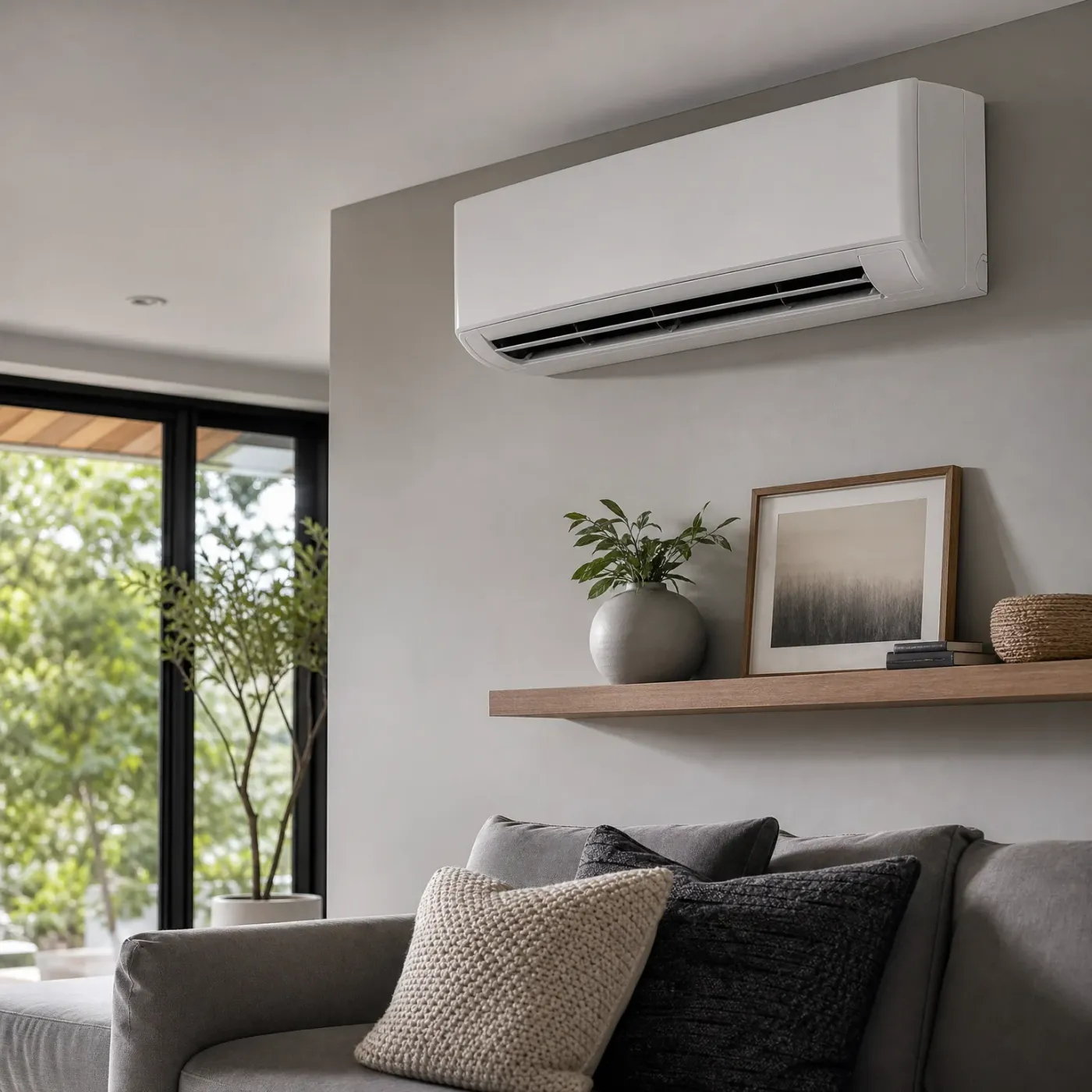
A white wall-mounted mini-split air conditioner near the ceiling of a living room with a gray sofa, knit cushions, a wooden floating shelf holding a plant in a round vase, a framed print and a woven basket, and a large window showing green trees.

Hand off the search today

Your request goes to one pro, not a list of companies.

Send the request today and let a mini split pro reach out to you.

Get a licensed local pro

You're not committing to anything by asking.

A white wall-mounted mini-split air conditioner unit installed high on a beige interior wall below white crown molding, with a window and woven shade at the left edge showing green foliage outside.
A clean mini split like this pulls air in and pushes it back out cold, keeping up even when the afternoon sun hits that window.
A dusty, stained white wall-mounted mini-split air conditioner indoor unit installed high on a plain off-white interior wall near the ceiling.
A coil this dusty can't give up its heat the way it should, so the unit runs and runs while the room stays warm.

A mini split doesn't make cold air. It picks up heat from inside the room and moves it outside through refrigerant running between the indoor coil and the outdoor compressor. That outdoor unit has to let go of the heat it's carrying, and when it can't keep up, the compressor just runs longer without the room actually cooling down. Refrigerant charge matters here. If the charge is low, each cycle carries less heat out, so the compressor keeps working while the thermostat barely moves. The indoor fan and the outdoor compressor are supposed to run at a pace that matches how much heat the room is gaining. A compressor that's losing capacity can't hold that pace once the afternoon sun is on the house. In a lot of Maryland homes, the mini split is the only thing cooling the place, so a system that's slipping shows up fastest on the hottest, stickiest days, not the mild ones. A frozen indoor coil makes it worse. Once ice builds up on it, air can't move across it right, and the unit can run for hours pushing air that never gets properly cold.

How a mini split moves heat

  • A mini split cools by pulling heat out of the room and carrying it outside through refrigerant moving between the indoor coil and the outdoor compressor.
  • The outdoor unit has to dump that heat into the outside air, so a compressor struggling to do that runs longer without the room catching up.
  • A low refrigerant charge means less heat gets carried out per cycle, so the compressor keeps running while the house stays warm.
  • The indoor fan speed and the outdoor unit's compressor have to match the load in the room, and a failing compressor can't keep that pace on a hot afternoon.
  • Many Maryland homes run the mini split as the only source of cooling, so a system that's losing capacity shows up fastest on the hottest, stickiest days.
  • A frozen indoor coil blocks airflow entirely, and the unit can run for hours blowing air that never gets properly cold.
A woman with shoulder-length graying brown hair, wearing a beige cardigan over a white top, sits in a light upholstered armchair and looks off to the side, with a curtained window, bookshelf, and lamp shade behind her.
A woman and a child with closed eyes sit wrapped together in a cream knitted blanket on a couch, with a lit lamp and shelves blurred in the background.
A two-story house with beige horizontal vinyl siding, gray shingled gables and dormer, white-framed windows, a central entry door, and an outdoor air conditioning unit, set on a partly dry lawn under a clear blue sky.

A mini split cools your home by pulling moisture out of the air along with the heat. Here, the air it's working against holds a lot of that moisture. Summer dew points across Maryland average 64°F, according to NOAA climate data, which is the range where air starts to feel heavy and sticky rather than just warm. A mini split pulling moisture out of air that wet runs longer to get the same result. You'll feel it as a room that cools down but still feels damp, or a unit that seems to run nonstop through the afternoon without ever quite catching up.

NASA POWER T2MDEW county cells weighted by homes

A white wall-mounted mini-split air conditioner indoor unit with dark louvered vents, installed near the ceiling on a beige wall below white crown molding.
Before you get your mini split repair
A white wall-mounted mini-split air conditioner on a beige interior wall, with a window at left showing trees and a wooden fence, and dark wood flooring below.
After you get your mini split repair

What this comes down to

  • A mini split that runs long and still leaves the room warm is almost always losing the fight against heat, not just struggling to keep pace with it.
  • A dirty coil, a low refrigerant charge, or a compressor working harder than it should will all show up as weak cooling on a muggy Maryland afternoon.
  • Maryland's humid summer air makes a struggling system work harder than the same problem would in a drier climate.
  • The right fix depends on which of those is actually happening, and that takes someone opening the unit up to check.
  • A local contractor who services mini splits all summer has likely already seen whatever is causing yours to fall short.
  • Getting matched with one licensed local contractor means a single qualified call instead of several companies competing for your number.

A mini split that keeps running without cooling the room isn't broken in some mysterious way. It's losing a fight it should be winning, and Maryland's thick summer air makes that fight harder than it would be almost anywhere else. The coil might be too dirty to give up heat. The charge might be low. The compressor might be working past what it can actually deliver. Each of those looks the same from your couch: warm air, a unit that won't shut off, a room that never quite gets there. Telling them apart means opening the unit up, checking the coil, checking the pressures, watching how the compressor behaves under load. That's not something to guess at from the specs on the unit or how old it is.

What matters now is getting the right person on it. A contractor who services mini splits through a Maryland summer has already run into whatever is holding yours back, whether that's a coil caked with dust or a slow refrigerant leak that's been getting worse since spring. You get matched with one licensed local contractor, not a handful of companies calling to bid on the job. One qualified person looking at your actual unit, in your actual house, is worth more than a list of possibilities. The muggy air isn't going anywhere this summer. The sooner someone who knows this equipment gets eyes on it, the sooner the room cools the way it's supposed to.

Interior corner showing a white painted column with paneled trim and chair rail meeting a wall with baseboard, beside light wood cabinetry with black bar pulls and a ceramic vase, over dark hardwood flooring.
Interior corner with a white-framed window showing green foliage, a pale wall with baseboard, light oak plank flooring, and a wooden cabinet with a dark ceramic vase on top.
A rustic wooden bench against a pale wall holds a weathered ceramic vase with leafy branches, below a black cone wall sconce, beside a window with sunlight falling on the wood floor.
A bathroom vanity with wood cabinets and a white marble countertop, black widespread faucet and undermount sink, a wood-framed mirror, a fabric-shaded wall sconce, a ceramic vase with green branches, and a window with white blinds.
Empty room corner with taupe walls, white wainscot paneling, crown molding, dark wood floor, and a double-hung window showing green foliage outside.

Stop chasing a mini split pro

The pro who reaches out is licensed in Maryland.

Reach a local pro

It costs nothing to send, and you don't have to hire anyone.