





A white wooden picket fence curves along a mown lawn in front of a row of similar gray clapboard houses with gabled roofs, backed by large leafy trees.

AC Installation in Hagerstown, MD

Tell us about the job

Takes about a minute. No obligation.

New system or replacementCentral ACWashington County, MD
Step 1 of 2

What ZIP code is the job in?

Maryland households paid 17.86 cents per kilowatt-hour in 2024, among the higher rates homeowners deal with. A new AC unit runs on that rate for years, so how efficiently it cools your home matters more here than somewhere power is cheap. Two systems can cost the same to install and still cost very differently to run every summer after that. The SEER2 rating on the unit tells you which one it will be. Ask the contractor sizing your system what rating they are proposing and why it fits a home like yours.

3 months
June through August, your air conditioner is on duty
85°F
the average summer afternoon it cools against
31 hail events
in ten years, and hail bends the fins on outdoor coils
13.4 SEER2
the federal minimum any new unit must meet
Isometric cutaway illustration of a house showing interior ductwork, an air handler, and an outdoor condenser unit connected by lines, with simple furniture in the rooms.
Your air conditioner works hardest from June through August.

NOAA nClimDiv, 1991–2020 normals

Cooling in Washington County runs June through August.

May is when a new system should go in, before the heat gives you no choice.

Electric heats most homes here, and AC installs follow the wiring already in place

54.1% of homes heat with electricity
Cooling runs June through August
Summer afternoons average 85°F

Summers here are short, three months of real cooling load, with afternoons settling in around 85°F. That's enough to size for, not enough to size up for. A straight load calculation on your house, the kind any licensed contractor should walk through room by room, gets you the right tonnage. Going bigger than that number doesn't cool your home faster. It short cycles, pulls less moisture out of the air, and wears the compressor on and off more than it would running a normal cycle. Standard efficiency, correctly sized, is the right call for a county that doesn't push cooling past August.

A correctly sized system is all this county asks for

Washington County sees its share of hail, wind and winter storms, but none of that changes what your AC needs to be. A standard system, sized to your home's actual load, holds up fine here. Get it in before the heat settles in and let it run the summer it's built for.

Find a contractor
A man in a cap, dark long-sleeved shirt and tan work pants climbs wooden porch steps toward an orange front door, carrying a canvas tool bag with tools in it, beside a potted shrub in a terracotta planter.
An outdoor air conditioning condenser unit mounted on a concrete pad beside a house, with electrical conduit running to a wall-mounted disconnect box.

Built in different decades, sized the same way

Half the homes in Washington County were built in 1974 or earlier, half in 1974 or later. That split doesn't tell a contractor what size unit your house needs. A load calculation on the house itself does that, not the year it went up. What the age of the housing stock does mean is that whatever goes in now will be running summers for a long time after. A standard system, sized correctly, is built to do exactly that.

The old unit comes out first

A contractor disconnects the refrigerant lines, the electrical, and the condensate drain before the new condenser goes in. The refrigerant gets recovered into a tank, not released into the air. That's the law, and any licensed contractor has the equipment to do it.

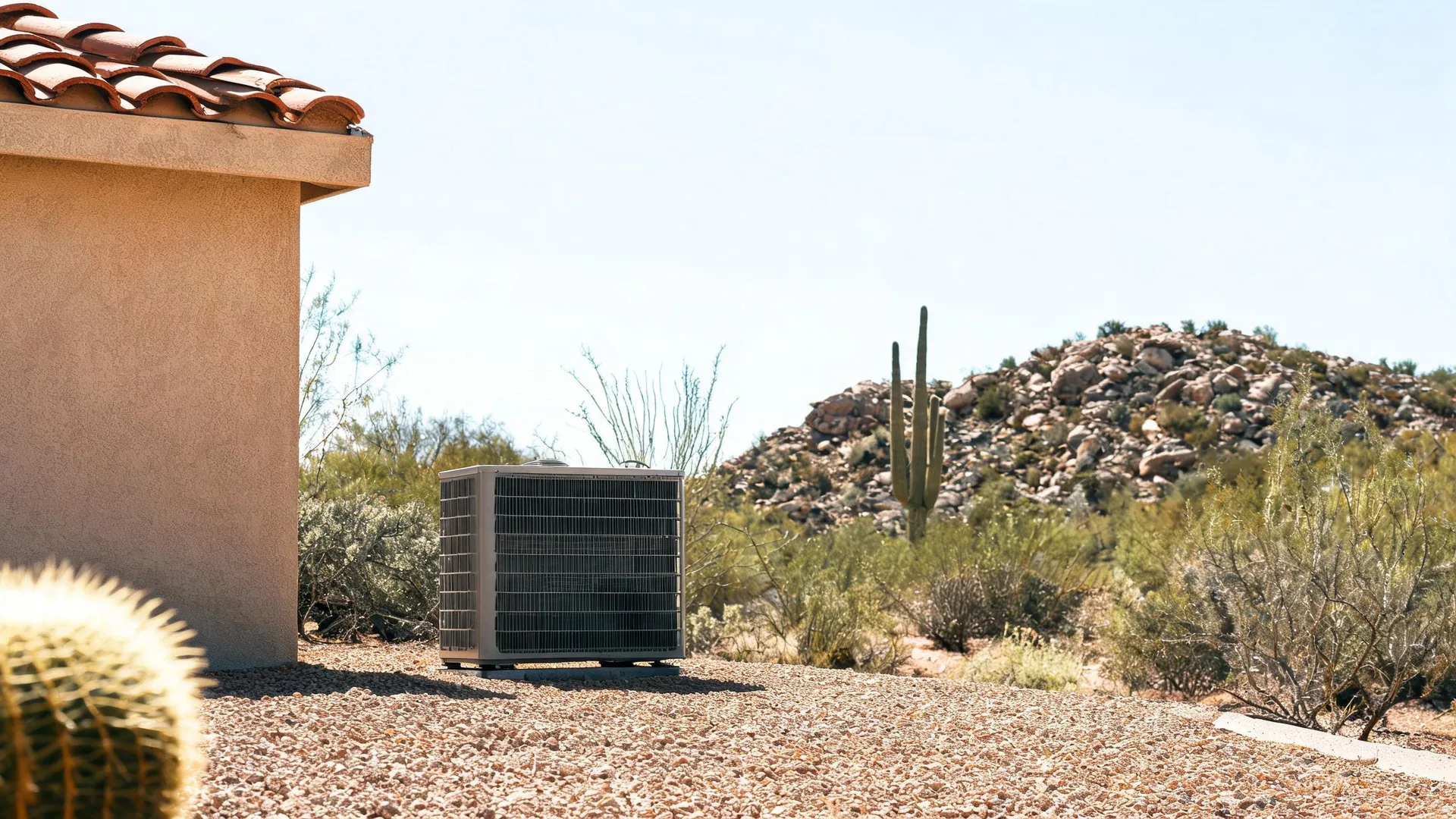
The pad and lines often stay

If the concrete pad is still level and in good shape, the new unit can usually sit on it. Same with the line set running to the indoor coil, if it's the right size and not corroded. Reusing what still works keeps the job simpler. Replacing what doesn't is still part of a proper install.

Aerial view of a gray central air conditioning condenser unit on a concrete pad next to a house with vinyl siding.

Going above the federal minimum saves little here, about $20 a year.

  • A higher-efficiency unit$220 a year
  • A new unit at the federal minimum, 14.3 SEER2$240 a year

Estimates for a typical Washington County home, from EIA household energy data, Maryland fuel prices and NOAA climate normals. Your home will differ.

A full day covers the outdoor unit, the indoor coil, and everything that connects them. If the coil is being swapped too, the contractor opens the plenum, pulls the old one, and seals the new one back in with mastic or tape rated for ductwork, not the hardware store kind. Every joint in the line set gets brazed, then the whole system gets pulled down to a vacuum to drive out moisture and air before any refrigerant goes in. Skip that step and moisture sits in the lines, and it shows up later as a compressor problem, not a day one problem. Once it's charged, a contractor checks refrigerant level against the manufacturer's spec for that outdoor temperature, not just a gauge reading. Then the system runs long enough to check supply air temperature at a register, confirm the thermostat is talking to it, and walk through the controls before anyone leaves.