






A two-story red brick house with dark shutters and a dark roof sits behind a manicured lawn and large deciduous trees, viewed over a dry-stacked stone wall in the foreground under an overcast sky.

AC Maintenance in Cumberland, MD

Tell us about the job

Takes about a minute. No obligation.

Tune-up, service, or cleaningCentral ACAllegany County, MD
Step 1 of 2

What ZIP code is the job in?

A dirty coil or a low charge makes the compressor work harder to cool the same air, and that extra work shows up on the meter. Maryland homes paid 17.86 cents per kilowatthour in 2024, well above what a lot of the country pays, so a system losing efficiency here costs more to run than the same neglect would somewhere cheaper. The unit doesn't stop cooling the house when something's off. It just pulls more power to do it, month after month, all summer. A tune-up catches the kind of wear that drives that number up before it does.

3 months
June through August, your air conditioner is on duty
84°F
the average summer afternoon it cools against
7 hail events
in ten years, and hail bends the fins on outdoor coils
106 wind events
in ten years, and wind drives debris into outdoor units
Isometric cutaway illustration of a house interior showing ducted HVAC piping, an indoor air handler unit, and an outdoor condenser with fan connected by a line, rendered in grey tones on a white background.
Your air conditioner works hardest from June through August.

NOAA nClimDiv, 1991–2020 normals

Half the homes in Allegany County were built in 1959 or earlier.

A house that old has had its AC replaced at least once, maybe more, so a yearly check matters no matter how new this one is.

Three months a year is all this system has to earn its keep

Cooling runs June through August
Summer afternoons average 84°F
106 damaging wind events from 2015 to 2024

Cooling here starts in June and runs through August. May is the month to get the system checked, before it has to work. A capacitor or a refrigerant leak can weaken slowly without showing any sign of it, and the first hot day is what finds it, right when the compressor has to work hardest. Have it looked at in May and a contractor can fix it on their own schedule. Wait until June and it's your house that sits warm while you wait for one.

Fix the inefficiency before it shows up on the meter

A tune-up costs a service call. A compressor working harder than it needs to costs more than that, on every bill, at 17.86 cents a kilowatt-hour. Get the check done before the system has to carry the extra load.

Find a contractor
A man in a dark jacket and brown work pants, seen from behind, climbs wooden porch steps toward an orange door while carrying a canvas tool bag, with a potted shrub in a terracotta urn to the right.
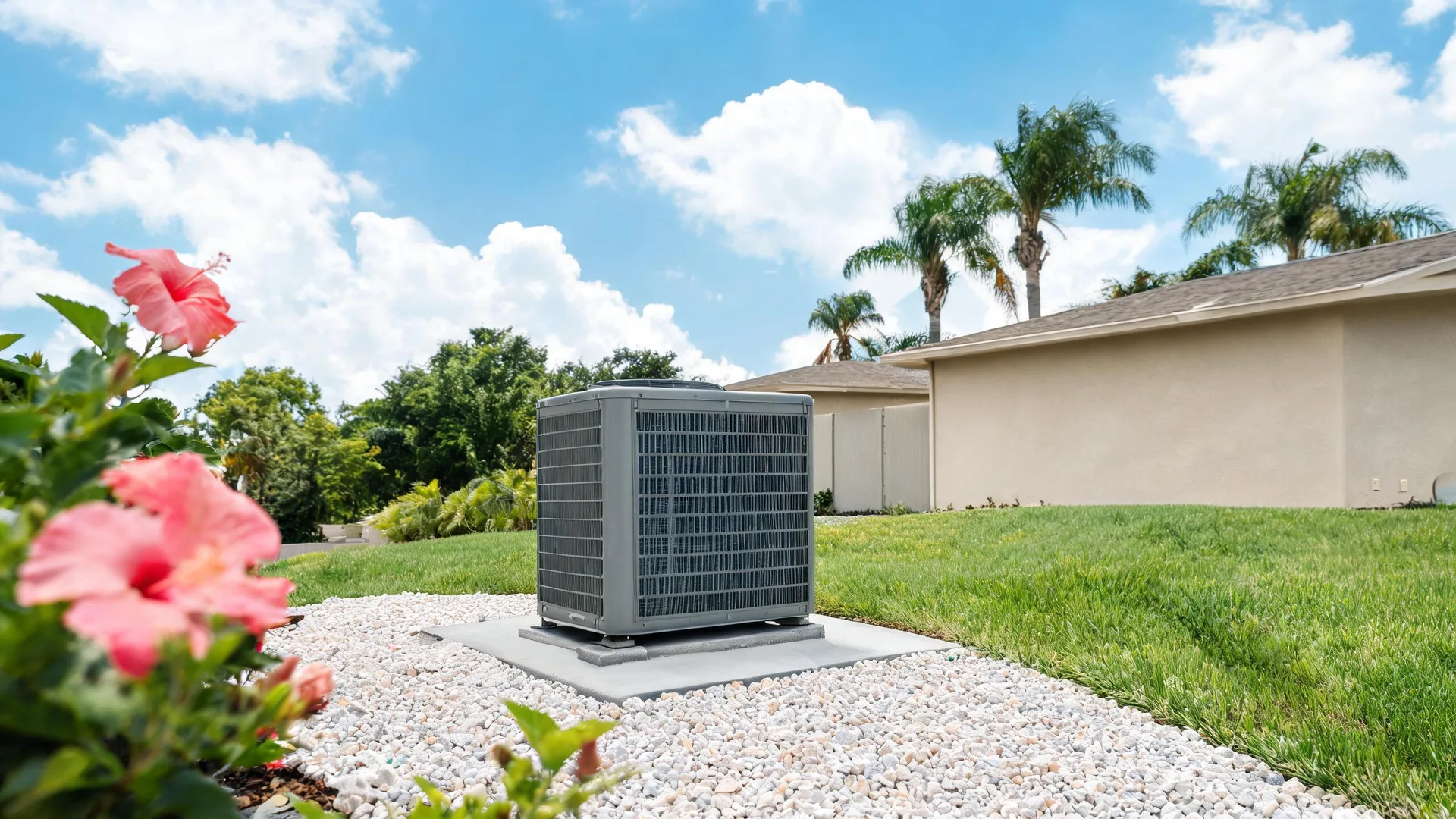
An outdoor air conditioning condenser unit mounted on a concrete pad surrounded by gravel, photographed against a partly cloudy blue sky.

It doesn't fail quietly, it fails slowly

A system that never gets checked still shows signs before it quits. Warm air from the vents when the thermostat is set well below room temperature. Ice on the copper line running to the outdoor unit, which means the charge is low or airflow across the indoor coil is blocked. A hard clunk or a hum from outside when the compressor tries to start and can't. Short cycles, where the unit kicks on, runs a few minutes, and shuts off again before the house cools at all. Any one of these means something is already failing, not about to. A yearly check exists so the compressor never gets to that point.

Gauges on, panels off

A thorough check means hooking up gauges to read refrigerant pressure and pulling the panel to look at the capacitor, the contactor and the wiring. A quick one is a glance at the outdoor unit and a rinse of the coil. Pressure readings catch a slow leak or a weak charge long before the unit stops cooling. Without them, the tech is guessing.

What a real check changes

Clearing debris from the coil fins and confirming the refrigerant charge means the compressor pulls the amount of power it was built to pull, nothing more. Skip that and the compressor keeps running, just harder, trying to cool the same air through a dirty coil or a weak charge. The unit does not announce the difference. It just runs that way until something in it gives out.

An outdoor air conditioning condenser unit positioned beside a blue-sided house at sunset.

Book your AC tune-up in May, before homes here start needing cooling in June.

  1. Jan
  2. Feb
  3. Mar
  4. Apr
  5. May
  6. Jun
  7. Jul
  8. Aug
  9. Sep
  10. Oct
  11. Nov
  12. Dec

A tune-up checks the refrigerant charge, cleans the coils, tests the capacitor and tightens the electrical connections.

A tune-up starts outside at the condenser. The tech clears leaves and grass clippings away from the cabinet, then checks that the fan spins freely and the motor isn't grinding or running hot. Inside the panel, the capacitor gets tested under load, not just looked at, because a capacitor can read fine sitting still and still fail the moment the compressor tries to start. The contactor gets checked too, since its contacts pit and burn a little every time the unit cycles on. Refrigerant charge gets confirmed against what the system was built to run, not topped off by guess, because too much or too little both make the compressor strain. Last, the tech checks that the drain line isn't clogged, since a blocked line backs up and can shut the system down on its own before the compressor ever fails.