







An outdoor air conditioning condenser unit positioned on a concrete pad next to a blue-sided house, surrounded by green shrubs and flowering hydrangeas at sunset.

AC Repair in Annapolis, MD

Tell us about the job

Takes about a minute. No obligation.

RepairCentral ACAnne Arundel County, MD
Step 1 of 2

What ZIP code is the job in?

Summers in Annapolis run June through September, with afternoons averaging around 86 degrees. That is a real stretch of work for an air conditioner, but it is not extreme heat, and nothing about this area runs a system harder than it was built to handle. When an AC here starts short cycling, blows warm air, or trips its breaker, the cause is usually one of the same handful of things that go wrong in any home. A weak capacitor. A low charge. A filter so clogged it chokes off airflow. Wind and hail do pass through the county, so it's worth a look at the outdoor unit if there's been a recent storm. Otherwise the fix is usually ordinary, and finding the actual cause matters more than guessing at it.

4 months
June through September, your air conditioner is on duty
86°F
the average summer afternoon it cools against
22 hail events
in ten years, and hail bends the fins on outdoor coils
248 wind events
in ten years, and wind drives debris into outdoor units
Isometric line illustration of a cutaway single-story house showing interior rooms, attic ductwork and an air handler, connected by a line to an outdoor condenser unit on a pad.
Your air conditioner works hardest from June through August.

NOAA nClimDiv, 1991–2020 normals

Cooling here runs June through September.

May is the time to get a weak capacitor or low charge found, before the first hot week finds it instead.

Call for a repair quote, not a replacement one

Half the homes here were built by 1983
Cooling runs June through September
Summer afternoons average 86°F
Electricity here costs you every day this runs roughMaryland homes paid 17.86 cents per kilowatt-hour in 2024, above the national average.

Storms do pass through Anne Arundel County, and the outdoor unit sits outside where wind and hail can reach it. Damaging wind has hit the county 248 times in the past decade, so a dented fin or a bent fan blade after a bad storm is worth ruling out. Hail and tornadoes are rare here by comparison, and a well built condenser is made to sit outside through ordinary wind. If the power went out during a storm, the AC should come back on by itself once it's restored. If it doesn't, the problem is more likely a tripped breaker or a stuck contactor than anything the storm did to the unit itself.

A system running rough costs more here than it should

At 17.86 cents a kilowatt-hour, a bad capacitor or a dirty filter making your AC run longer than it needs to shows up on every bill until it's fixed. Get the actual cause found and the cost of running it stops climbing.

Find a contractor
A man in a cap, dark shirt and tan work pants walks up concrete steps toward a red front door, carrying a canvas tool bag with tools in its side pocket.
A gray residential air conditioning condenser unit mounted on a concrete pad outdoors, surrounded by green grass under a partly cloudy blue sky.

A newer system is worth the repair call

If your AC came with the house and the house was built anywhere near 1983 or later, that system has likely had a fair amount of ordinary life ahead of it before this problem showed up. A capacitor or a low charge doesn't mean the unit is done. It means one part failed, and a contractor can replace that part without touching the rest of the system.

A weak capacitor doesn't stay a small problem

A capacitor that's starting to go still gets the compressor started, just slower and with more strain each time. The compressor motor windings take the heat from that extra strain, cycle after cycle, until the capacitor fails outright or the compressor goes with it. What was a simple part swap turns into a compressor job.

Low refrigerant runs the compressor dry

A system low on charge still cycles on and still tries to cool. But the compressor depends on refrigerant to carry oil through it, and with the charge low it ends up running on less lubrication than it needs. That wear doesn't undo itself once the leak is found and the charge is set right.

Overhead view of a gray residential air conditioning condenser unit mounted on a concrete pad beside a house with asphalt shingle roofing.

A new air conditioner would cut about $60 a year off cooling for a typical Anne Arundel County home.

  • A new one at the federal minimum, 14.3 SEER2$340 a year
  • An older air conditioner$400 a year

Estimates for a typical Anne Arundel County home, compared with an older unit built to the previous federal minimum, from EIA household energy data, Maryland fuel prices and NOAA climate normals. Your home will differ.

Repair makes sense when a part like a capacitor or contactor has failed.

Replacement makes sense when the compressor has failed or the system uses R-22 refrigerant, which is no longer made.

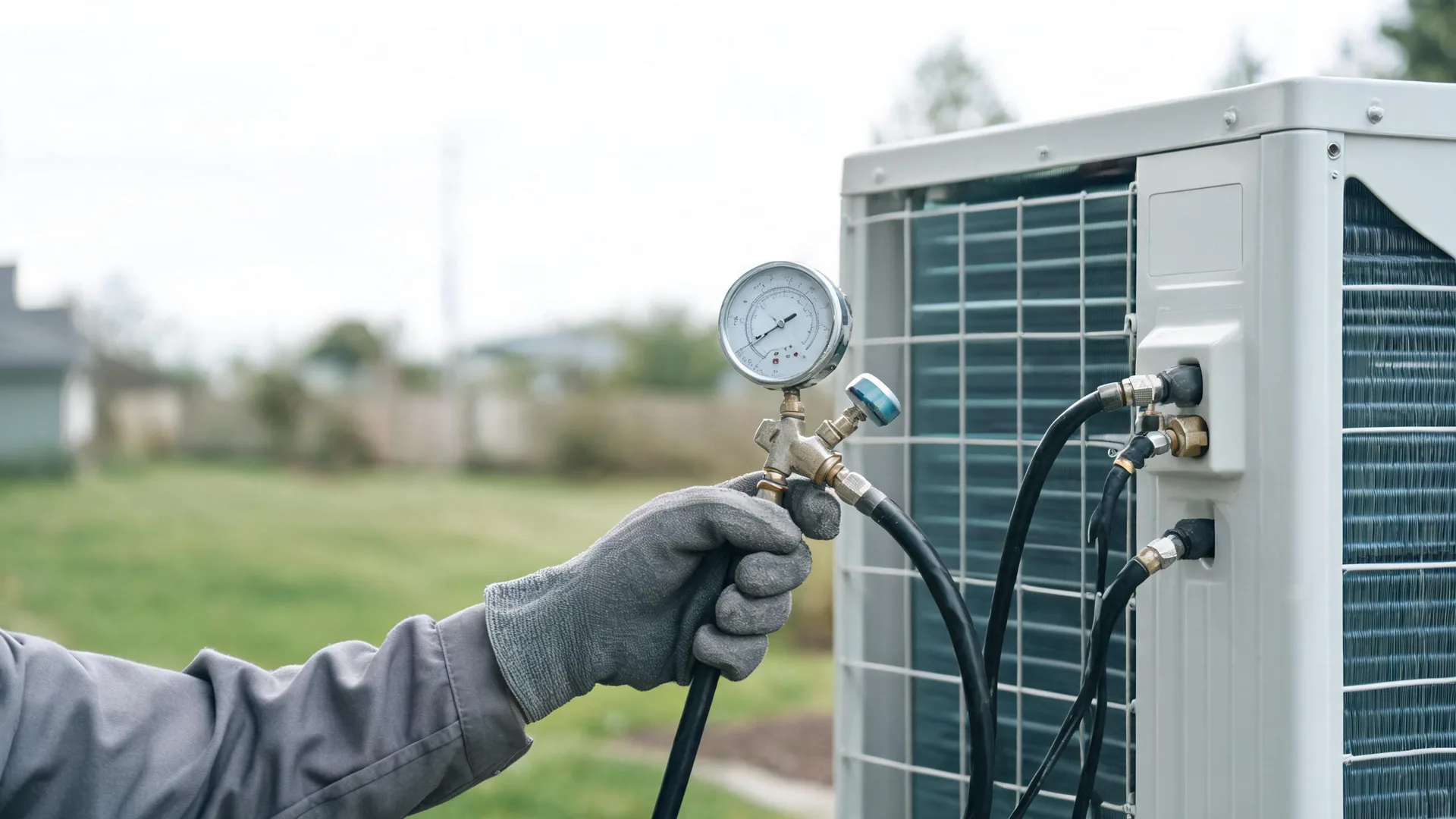
A diagnostic visit starts outside at the condenser, checking that the fan spins freely and the coil isn't caked with dirt or pressed against by bent fins. From there a contractor checks the capacitor, since a weak one is a common reason a system won't start or trips the breaker trying. Refrigerant pressure gets checked too, because a system low on charge still runs, just not the way it should, and gauges show that fast. Inside, the filter and the blower get a look, since restricted airflow can mimic other problems and rule itself out just as quick. None of this involves guesswork or replacing parts to see what helps. The point is to find the one thing that's actually wrong before anything gets opened up or swapped out.