





White colonial houses with lit windows photographed at dusk along a tree-lined residential street.

AC Repair in Centreville, MD

Tell us about the job

Takes about a minute. No obligation.

RepairCentral ACQueen Anne's County, MD
Step 1 of 2

What ZIP code is the job in?

Centreville runs its AC about four months a year, June through September, with afternoon highs averaging 86 in the thick of summer. That's a normal cooling load for a mixed, humid climate like this one. Nothing about the weather here is pushing your system harder than it was built for. So if it's struggling or short cycling or not cooling like it should, the cause is probably something straightforward. A weak capacitor. A low refrigerant charge. A dirty coil or a failing contactor. These are the kinds of problems a tech sees all the time and knows how to track down.

4 months
June through September, your air conditioner is on duty
86°F
the average summer afternoon it cools against
10 hail events
in ten years, and hail bends the fins on outdoor coils
104 wind events
in ten years, and wind drives debris into outdoor units
Isometric grayscale illustration of a cutaway house with the roof lifted, showing interior rooms, ductwork, an indoor air handler, and an outdoor condenser unit beside the building.
Your air conditioner works hardest from June through August.

NOAA nClimDiv, 1991–2020 normals

June is when cooling starts here, and May is when a weak part is still getting by.

Have it looked at in May, before the first hot stretch asks more of it than it can give.

A broken AC costs more to ignore here, at 17.86 cents a kWh

Power costs 17.86 cents a kWh statewide
Cooling runs June through September
Summer afternoons average 86°F

Half the homes in Queen Anne's County were built in 1990 or later. If yours is one of them, your AC hasn't had decades of wear to work against it. A unit that age with a real, fixable problem is usually worth fixing. The parts a tech replaces, a capacitor, a contactor, a low charge, don't care how old the house is. They fail the same way in a new system as an old one, and they're repaired the same way too.

A newer system is worth repairing

Get the actual problem diagnosed before you decide anything about replacing it. A capacitor or contactor failing on a newer system has nothing to do with the age of the house, and it gets fixed the same way.

Find a contractor
An outdoor air conditioning condenser unit mounted on a concrete pad surrounded by gravel, photographed against a partly cloudy blue sky.

What a struggling AC sounds and feels like before it quits

An AC that is starting to fail usually gives warning before it quits. It runs longer than it used to without getting the house as cool. It cycles on and off in short bursts instead of settling into a steady run. Warm air comes from a vent that used to blow cold. Ice forms on the line outside when nothing should be freezing in the middle of summer. The outdoor unit might hum without the fan starting, or click over and over instead of catching. Any of these means a part is struggling before it gives out completely. Caught early, it is usually one part. Ignored, the compressor is often the next thing to go, and that is a bigger job.

What actually wears out

A capacitor gives the compressor and fan motor the jolt they need to start, and it weakens with age until it can't do the job. That happens on its own timeline, not because a system ran hard one summer. Contactors burn and pit from switching current, over and over, until the points stop closing reliably. Refrigerant doesn't get used up by running. If the charge is low, there's a leak somewhere in the coil or line set, and it needs finding, not just topping off.

What upkeep changes

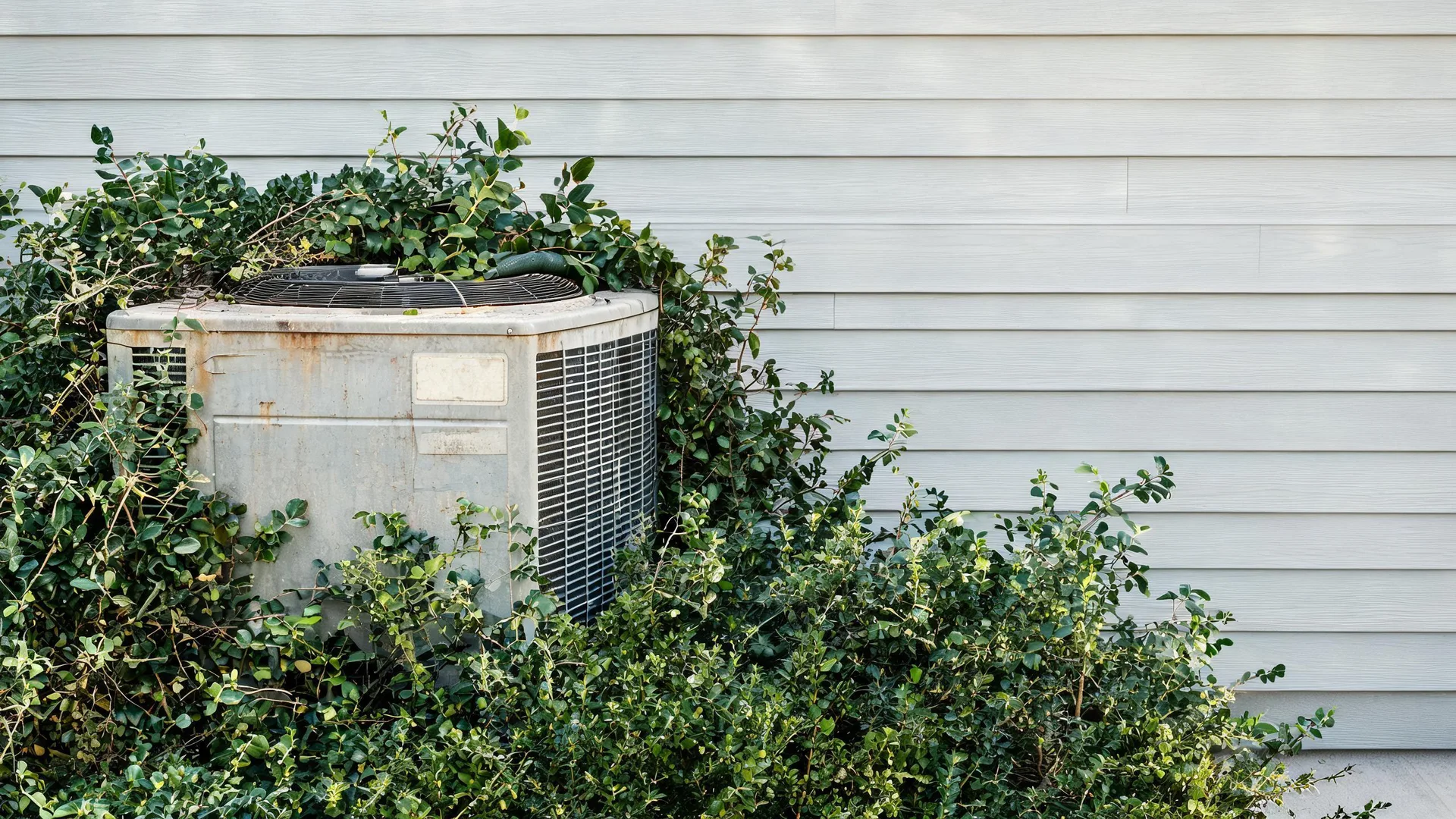
A dirty coil can't shed heat well, so the system runs longer to do the same job, and that extra runtime is hard on the parts around it. A clogged filter starves the system of airflow, which shows up later as a frozen coil or a motor working harder than it should. A clogged drain line backs up condensate until a float switch shuts the system down outright. None of this is the system wearing out. It's upkeep that got missed, and it's the same fix whether the system is new or old.

Overhead view of an outdoor AC condenser unit on a concrete pad next to a house with a dark shingle roof.

A new air conditioner would cut about $40 a year off cooling for a typical Queen Anne's County home.

  • A new one at the federal minimum, 14.3 SEER2$320 a year
  • An older air conditioner$360 a year

Estimates for a typical Queen Anne's County home, compared with an older unit built to the previous federal minimum, from EIA household energy data, Maryland fuel prices and NOAA climate normals. Your home will differ.

Repair makes sense when a part like a capacitor or contactor has failed.

Replacement makes sense when the compressor has failed or the system uses R-22 refrigerant, which is no longer made.

A good rule is this. If the compressor itself is still sound, almost everything else is worth fixing. The compressor is the one part with no cheap substitute. It's sealed inside the outdoor unit and expensive to replace on its own. A capacitor, a contactor, a fan motor, even a leaking coil, a tech can repair or swap out and the system runs like new. What changes things is a compressor that's failing, or a refrigerant leak nobody can find. At that point you're paying to keep feeding a problem that isn't going away. Ask the tech directly which kind of problem you have before deciding anything.