






A two-story red brick house with black shutters and a gray roof sits behind a mowed lawn, framed by large deciduous trees, with a dry-stacked stone wall in the foreground.

AC Repair in Gaithersburg, MD

Tell us about the job

Takes about a minute. No obligation.

RepairCentral ACMontgomery County, MD
Step 1 of 2

What ZIP code is the job in?

Warm air coming out of the vents when the thermostat is set low is the clearest sign something is wrong. So is an outdoor unit that runs and runs without the house ever feeling cool. Listen for it too. A new rattle, a hard clunk when it starts, or a hiss near the lines usually means a part is failing or the refrigerant charge is low. Water pooling near the indoor unit points to a clogged condensate line, and left alone it can damage the floor or trigger a safety switch that shuts the system off entirely. Short cycling, where the unit kicks on and off every few minutes instead of running a full cooling cycle, wears out the compressor faster and is worth calling in before it stops cold.

4 months
June through September, your air conditioner is on duty
85°F
the average summer afternoon it cools against
58 hail events
in ten years, and hail bends the fins on outdoor coils
443 wind events
in ten years, and wind drives debris into outdoor units
Isometric illustration of a cutaway house showing interior ductwork, an indoor air handler and furniture, connected by lines to an outdoor condenser unit on a pad.
Your air conditioner works hardest from June through August.

NOAA nClimDiv, 1991–2020 normals

A capacitor weakens slowly, then the compressor just won't start one afternoon.

The sudden failure feels random, but the wear behind it usually built up for months.

Gaithersburg sees its share of storms, but what's wrong with your AC is probably not the weather

541 severe weather events from 2015 to 2024
11% of homes statewide lost power a day or more in 2024
443 damaging wind events from 2015 to 2024

Half the homes in Montgomery County were built in 1980 or later, so a lot of the AC systems in Gaithersburg are running in houses that aren't old themselves. If your system came with a newer house, it probably hasn't been asked to do anything unreasonable. A capacitor or a contactor failing at that age is a normal part wearing out, not a sign the system is near the end. That makes repair the straightforward call in most cases. Replacing a system that still has years in it rarely makes sense when the fix is one part.

A broken AC costs more to ignore in Maryland

Maryland electricity runs 17.86 cents per kilowatthour, and a unit that's short cycling or low on charge is pulling power without doing its job. Every day it runs like that adds to the next bill. A one-part fix now is cheaper than paying for a system that's struggling.

Find a contractor
A man in a dark long-sleeved shirt and brown work pants, seen from behind, climbs porch steps toward an orange front door while carrying a canvas tool bag.
An outdoor air conditioning condenser unit mounted on a concrete pad beside a house, with electrical conduit running to a wall-mounted disconnect box.

Run it anyway and a small problem becomes a bigger one

A refrigerant leak is the clearest case. Run the system low on charge and the compressor has to work harder to move heat with less refrigerant doing the job. That raises the pressure and heat inside it well past what it was built for. Keep that up and a line that could have been patched turns into a failed compressor. A failing capacitor does similar damage in a different part. It makes the compressor and fan motor strain on every start, and every strained start shortens what's left of their life. A clogged condensate line gets worse the longer it sits because the water still has to go somewhere. Left alone it can trip a float switch and shut the whole system down, or work its way into the ceiling or floor below. None of these get better with time. A system that's struggling and still running is doing damage with every hour, not just failing to cool the house.

Check the filter and the thermostat first

Pull the filter and hold it up to a light. If you can't see through it, air can't get through it either, and the system will struggle to cool no matter what else is right. While you're at it, check the thermostat is set to cool and the setting is actually below room temperature. It sounds obvious until it's the whole problem.

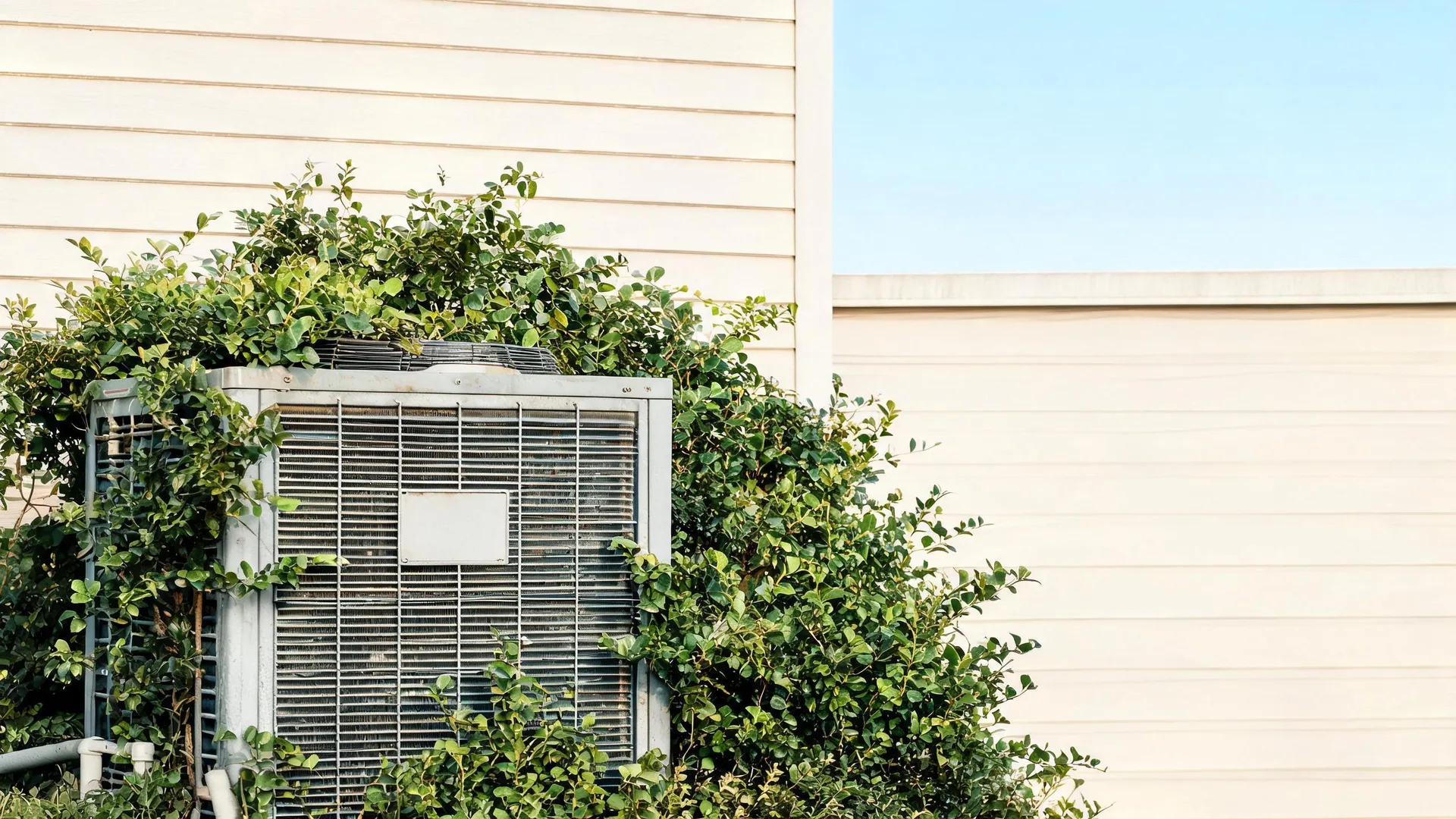
Look at the outdoor unit before you call

Walk outside and look at the condenser. Clear away leaves, grass clippings or anything stacked against it, since it needs airflow on all sides to dump heat. Check that the fan on top is spinning when the system is running. If it's iced over, switch the system off and let it thaw completely before anyone touches it, running it iced up only hides what's actually wrong underneath.

An outdoor air conditioning condenser unit positioned on a concrete pad next to a blue-sided house, surrounded by green shrubs and flowering hydrangeas at sunset.

A new air conditioner would cut about $50 a year off cooling for a typical Montgomery County home.

  • A new one at the federal minimum, 14.3 SEER2$270 a year
  • An older air conditioner$320 a year

Estimates for a typical Montgomery County home, compared with an older unit built to the previous federal minimum, from EIA household energy data, Maryland fuel prices and NOAA climate normals. Your home will differ.

Repair makes sense when a part like a capacitor or contactor has failed.

Replacement makes sense when the compressor has failed or the system uses R-22 refrigerant, which is no longer made.

A tech can usually tell fast whether a part is worth fixing or the whole system is wearing out at once. One failed capacitor or contactor is a repair, plain and simple, even if it's the second one in a few years. What changes the math is several things failing around the same time. The compressor is weak. The coil is leaking. The blower motor is on its way out too. Fixing each one alone might be reasonable, but paying for all of them in the same year usually isn't, especially on a system that's already old for its kind. Age matters less than what's actually failing. A unit that's old but has only ever needed a part here and there is different from one that's young but was never sized or installed right for the house. Ask what's actually wrong and whether it's likely to be the last thing that goes wrong for a while, or just the next in a line.