






White colonial houses with lit windows photographed at dusk along a tree-lined residential street.

AC Repair in Hagerstown, MD

Tell us about the job

Takes about a minute. No obligation.

RepairCentral ACWashington County, MD
Step 1 of 2

What ZIP code is the job in?

Cooling runs June through August here, and May is when a weak part usually gets found out. An AC that sat idle most of the year gets asked to run flat out on the first hot day, and whatever was already marginal, a capacitor losing its charge, a contactor with pitted points, tends to give out right then. If your system struggled last August, the same weak spot is probably still there. Getting it looked at before June means a repair done on your schedule instead of a breakdown on the hottest day of the week.

3 months
June through August, your air conditioner is on duty
85°F
the average summer afternoon it cools against
31 hail events
in ten years, and hail bends the fins on outdoor coils
148 wind events
in ten years, and wind drives debris into outdoor units
Isometric line illustration of a cutaway single-story building showing interior rooms, ceiling ductwork and an air handler, connected by lines to an outdoor condenser unit beside the exterior wall.
Your air conditioner works hardest from June through August.

NOAA nClimDiv, 1991–2020 normals

Warm air from every vent usually means the compressor isn't cooling the refrigerant, not that the fan quit.

A system blowing but not cooling still needs a tech out soon, because that compressor is running hot the whole time it's on.

At 17.86 cents a kWh, a system running wrong costs you all summer

Power costs 17.86 cents a kWh statewide
Cooling runs June through August
Summer afternoons average 85°F

Washington County sees its share of weather, 148 damaging wind events and 31 hail events over the past decade, with one tornado in the mix. None of that is what usually takes down an AC. Wind and hail hit the cabinet and the fan blades, and most units shrug it off unless a branch comes down on the unit directly. If your system is blowing warm air or short cycling, that's wear, not storm damage. Worth a look outside anyway, just to rule it out before the real cause gets found.

Your house's age isn't the problem. The part that failed is

Half the homes in Washington County were built in 1974 or earlier, half in 1974 or later. Neither one wears out an AC. What matters is the part that's actually gone bad, and that's found by someone looking at your system, not by guessing at the house around it.

Find a contractor
A man in a cap, dark long-sleeve shirt and tan work pants walks up wooden porch steps toward an orange front door, carrying a canvas tool tote; an orange planter with ornamental grass stands to the right.
A gray cylindrical air conditioning condenser unit mounted on a concrete pad next to a light-colored vinyl-sided house exterior.

Running it while it's broken rarely buys you anything

A system that's struggling still moves air, so it's easy to let it ride until someone has time to deal with it. That's usually the wrong call. A compressor working against a low charge is running hotter than it should, every minute it's on, and heat is what kills a compressor. A capacitor that's already weak degrades faster once it's under strain, not slower. Ice on a coil, if that's what you're seeing, means airflow is restricted somewhere, and a system icing over will keep icing over until it's shut down and the cause is fixed. None of these get better with more run time. The fix tomorrow is usually the same fix as today, just on a part that's closer to failing completely, or taking another part down with it.

What you can check from the thermostat and the vents

Set the thermostat a few degrees below room temperature and listen for the system to kick on. Check a vent near you for airflow and feel whether it's actually cold. Change the filter if you can't remember the last time it was done. A clogged filter chokes airflow and can mimic a bigger problem that isn't actually there.

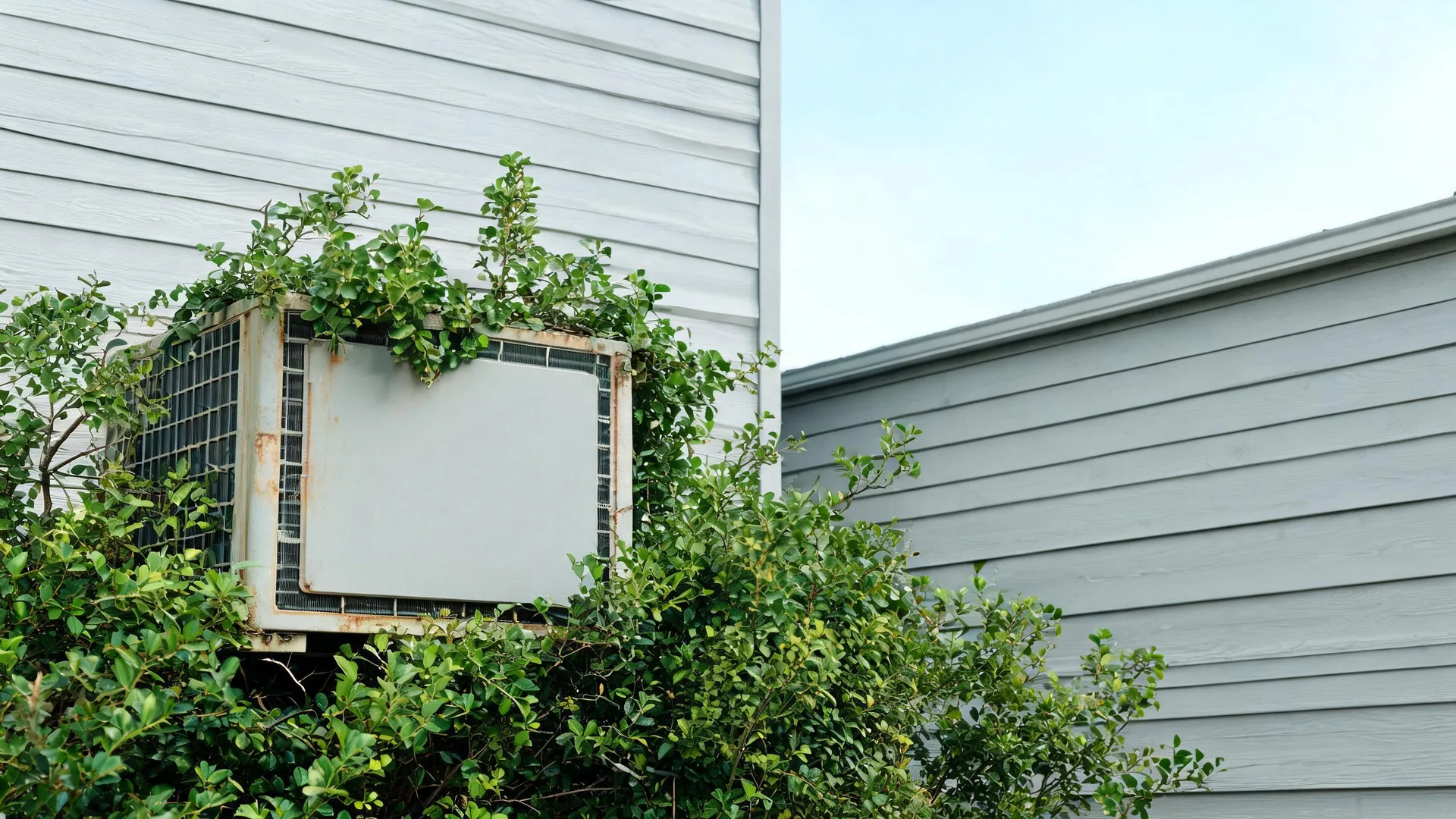
What's worth a look outside before anyone comes out

Walk out to the outdoor unit and check that the fan is spinning and nothing is pressed against the cabinet. Clear away leaves or grass clippings blocking the sides. If the unit is dead silent with the thermostat calling for cooling, check the breaker panel for a tripped switch. None of this fixes a bad capacitor or a refrigerant leak, but it rules out the simple stuff first.

An outdoor central air conditioning unit mounted on a concrete pad beside a blue-sided house at sunset.

A new air conditioner would cut about $30 a year off cooling for a typical Washington County home.

  • A new one at the federal minimum, 14.3 SEER2$240 a year
  • An older air conditioner$270 a year

Estimates for a typical Washington County home, compared with an older unit built to the previous federal minimum, from EIA household energy data, Maryland fuel prices and NOAA climate normals. Your home will differ.

Repair makes sense when a part like a capacitor or contactor has failed.

Replacement makes sense when the compressor has failed or the system uses R-22 refrigerant, which is no longer made.

Repair makes sense when one part has failed and the rest of the system is sound. A bad capacitor, a failed contactor, a blown fan motor, these are isolated failures in a system that otherwise still has life in it. Replacement starts to make more sense when the compressor itself is failing, since that's the part that moves refrigerant and does the actual work of cooling, and it's not something that gets swapped out on its own. Age matters less than what's actually wrong and what else is likely to go next. A system that's needed a few different repairs in a couple of years is telling you something different than one that's run clean for a decade and just had its first failure. Either way, the part that's broken gets diagnosed first. What it is and what it would take to fix decides the rest.