Two white multi-story colonial houses with lit windows and black shutters photographed at night, fronted by a stone wall.

AC Repair in La Plata, MD

Tell us about the job

Takes about a minute. No obligation.

RepairCentral ACCharles County, MD
Step 1 of 2

What ZIP code is the job in?

Summer here is ordinary work for an AC

La Plata runs its air conditioner about four months a year, June through September. Afternoon highs average 86°F across the summer. That is a normal cooling load for a system built for this climate zone. A unit struggling with that is not being asked to do anything unusual.


So the cause is likely a common one

When an AC here stops cooling or starts short-cycling, it is usually one part failing, not the whole system. A weak capacitor, a low charge, a dirty coil. These are the things a tech checks first because they are the things that actually go wrong, in La Plata or anywhere else.

4 months
June through September, your air conditioner is on duty
86°F
the average summer afternoon it cools against
26 hail events
in ten years, and hail bends the fins on outdoor coils
188 wind events
in ten years, and wind drives debris into outdoor units
Isometric line illustration of a cutaway house showing interior rooms with ductwork, an indoor air handler, and an outdoor condenser unit connected by lines, on a white background.
Your air conditioner works hardest from June through August.

NOAA nClimDiv, 1991–2020 normals

June is when Charles County air conditioners go back to work after sitting most of the year.

A part that was already weak in May often fails in the first hot week of June.

At 17.86 cents a kWh, a struggling AC runs up the bill all summer

Power costs 17.86 cents a kWh statewide
Climate zone 4A
Cooling runs June through September

Charles County gets its share of severe weather, mostly wind. Damaging wind hit the county 188 times between 2015 and 2024, and wind can knock out power or rattle a unit without doing any real damage to it. Hail and tornadoes happen here too, but far less often, so storm damage is rarely the reason an AC in La Plata stops working. If the power went out for a while during a storm, that's worth checking first. Otherwise this is probably a straightforward repair, the same kind of failure that shows up anywhere a unit runs hard through the summer.

A newer home usually means a newer system worth fixing

Half the homes in Charles County were built in 1991 or later. If your house falls on that side, your AC isn't fighting age on top of a Maryland summer. A unit like that is usually worth repairing rather than replacing.

Find a contractor
A man in a cap, dark long-sleeved shirt and brown work pants carries a worn leather duffel bag up porch steps toward an orange front door, with a potted shrub in a terracotta planter to the right.
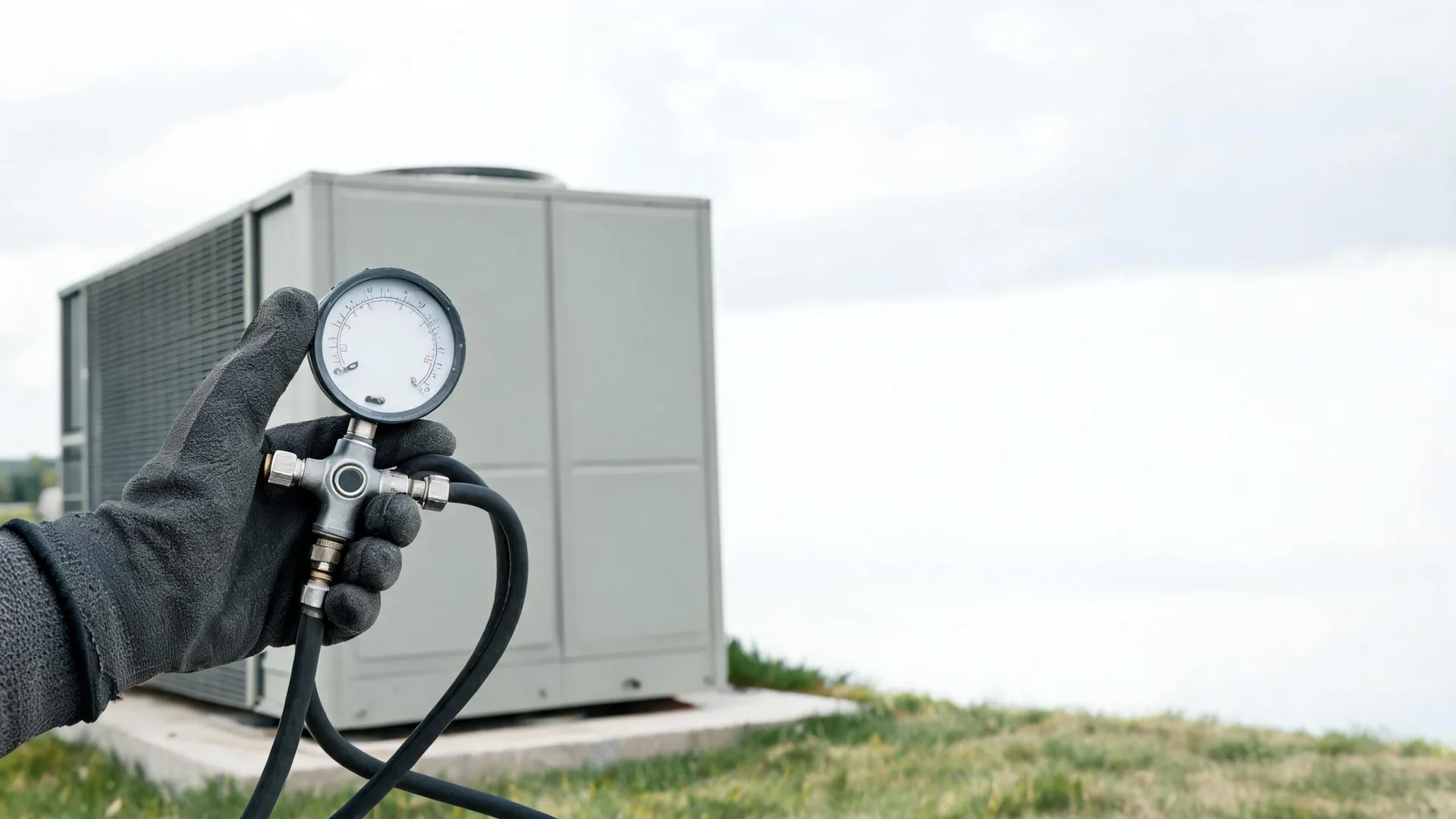
A gray metal air conditioning condenser unit mounted on a concrete pad in a flat grassy field under a partly cloudy sky.

What actually wears out

Most AC failures start small and electrical, not big and mechanical. A capacitor weakens over months, giving the compressor and fan motor a harder start each time, until one morning it can't start them at all. A contactor's contacts pit and burn from years of making and breaking the circuit, until it sticks or stops conducting. Refrigerant doesn't get used up, so a system that's low has a leak somewhere, often at a fitting or a coil, and it will keep running low until the compressor wears from poor lubrication. Dirty coils make the whole system work harder to move the same heat, and that extra strain is what pushes a weak part over the edge. None of this is random. It's the same handful of parts wearing out the way they always do, faster in a unit that runs hard for months at a stretch.

What you'll actually notice first

Warm air out of the vents, or air that barely moves at all. The unit running longer than it used to, or shutting off and on every few minutes instead of holding a steady cycle. Sometimes a smell when it kicks on. Sometimes a sound that wasn't there before, a hum, a click that repeats, a rattle from the outdoor unit. None of these tell you the part by themselves. They're what sends most people looking for a repair.

Why waiting usually makes the fix bigger

A capacitor that's starting to go won't fix itself. It gets weaker until the compressor can't start at all. A low charge works the same way. Small leaks stay small for a while, then the compressor runs low on lubrication and wears out before it should. A tech who looks at it early is usually dealing with one worn part. Wait long enough and the part that fails next is the compressor itself.

Overhead view of an air conditioning condenser unit on a concrete pad next to a house with asphalt shingle roofing and vinyl siding.

A new air conditioner would cut about $50 a year off cooling for a typical Charles County home.

  • A new one at the federal minimum, 14.3 SEER2$340 a year
  • An older air conditioner$390 a year

Estimates for a typical Charles County home, compared with an older unit built to the previous federal minimum, from EIA household energy data, Maryland fuel prices and NOAA climate normals. Your home will differ.

Repair makes sense when a part like a capacitor or contactor has failed.

Replacement makes sense when the compressor has failed or the system uses R-22 refrigerant, which is no longer made.

What decides this is the part that failed and what else is close to failing, not how old the unit feels. A capacitor, a contactor, a blower motor, those are worth replacing on almost any system, because the rest of the unit is fine and that one part just wore out. A compressor is different. It sits in the middle of the system, and swapping it costs enough that a tech will often tell you straight that putting a new system in makes more sense. The question worth asking a tech is whether the repair fixes the problem or just gets the unit running again until the next part goes. Someone who has actually looked at the unit can usually tell you which one it is.