White colonial houses with lit windows and dark shutters line a tree-lined street at dusk, bordered by dry-stacked stone walls.

AC Repair in Leonardtown, MD

Tell us about the job

Takes about a minute. No obligation.

RepairCentral ACSt. Mary's County, MD
Step 1 of 2

What ZIP code is the job in?

Summers here are warm, not extreme

Leonardtown gets about four months of real cooling weather, June through September, with afternoons averaging around 86°F. That is enough to run an AC hard, but it is not the kind of heat that burns out a system on its own.


So look for the usual cause

When a unit struggles here, it is rarely the climate's fault. A weak capacitor, a low charge, a clogged filter or a dirty coil explain most breakdowns, in Leonardtown same as anywhere else. Finding which one it is matters more than guessing.

4 months
June through September, your air conditioner is on duty
86°F
the average summer afternoon it cools against
25 hail events
in ten years, and hail bends the fins on outdoor coils
146 wind events
in ten years, and wind drives debris into outdoor units
Isometric cutaway illustration of a small house showing interior rooms with furniture, ceiling ductwork and an air handler, plus an outdoor condenser unit connected by refrigerant lines beside the building.
Your air conditioner works hardest from June through August.

NOAA nClimDiv, 1991–2020 normals

June is when cooling starts here, after May sits idle.

The first hot stretch is when a weak part finally gives out, so a repair in May catches it before June does.

A struggling AC costs more hereMaryland electricity ran 17.86 cents per kilowatthour in 2024

St. Mary's County gets its share of rough weather, including damaging wind and the occasional tornado passing through. None of that is aimed at your AC, but a power blink during a storm can trip a unit's breaker or confuse its thermostat, and a near miss from hail or wind debris can bend a fin or knock a line loose without leaving obvious damage. If your system quit working around a storm, that is worth mentioning to whoever comes to look at it. Otherwise the cause is almost always something ordinary inside the unit itself.

The longer it runs bad, the more it costs you

At 17.86 cents a kilowatt-hour, a unit that's low on charge or fighting a dirty coil runs longer than it should and shows up on every bill until someone fixes the actual problem. Get the cause diagnosed and the cost stops.

Find a contractor
An outdoor air conditioning condenser unit mounted on a concrete pad beside a house, with electrical conduit running to a wall-mounted disconnect box.

Your house is newer, and so is your AC

Half the homes in St. Mary's County were built in 1992 or later. If your house is one of them, your AC has likely spent fewer years outside than you'd think, and probably has real life left in it. A system that age breaking down is usually a part worth fixing, not a sign the whole unit is done.

A low charge gets lower

A system low on refrigerant doesn't run out further on its own, but the compressor keeps working against the same pressure problem every cycle. That extra strain is what wears a compressor down early, and a compressor is not a part worth replacing on its own.

A dirty coil makes the motor work for it

When the coil is caked with dirt, the system can't shed heat the way it's supposed to, so it runs longer to reach the same temperature. That longer runtime falls on the fan motor and the compressor, and either one can fail outright if the coil stays dirty long enough.

An overhead view of a residential air conditioning condenser unit mounted on a concrete pad next to a house with vinyl siding.

A new air conditioner would cut about $50 a year off cooling for a typical St. Mary's County home.

  • A new one at the federal minimum, 14.3 SEER2$340 a year
  • An older air conditioner$390 a year

Estimates for a typical St. Mary's County home, compared with an older unit built to the previous federal minimum, from EIA household energy data, Maryland fuel prices and NOAA climate normals. Your home will differ.

Repair makes sense when a part like a capacitor or contactor has failed.

Replacement makes sense when the compressor has failed or the system uses R-22 refrigerant, which is no longer made.

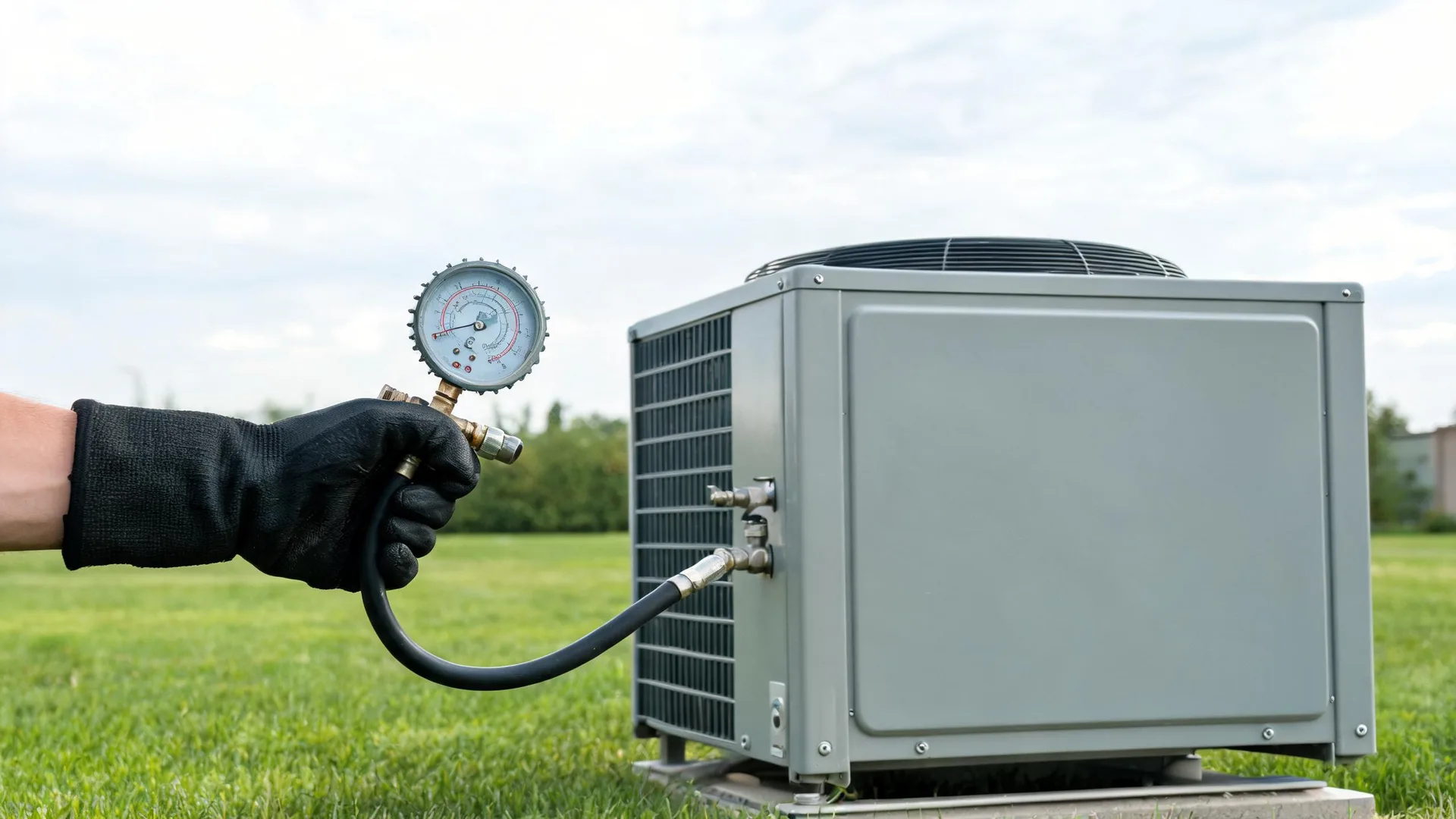
A diagnostic visit starts outside, at the condenser, checking the refrigerant pressure and watching whether the compressor and fan are both running the way they should. From there it moves inside to the air handler, checking the filter, the coil and the blower, since a problem in any one of those shows up as weak cooling even when the outdoor unit is fine. A tech will also check the capacitor and the electrical connections, because a capacitor that's starting to go can still run the unit, just poorly, until the day it doesn't. The thermostat gets checked too, since a system that seems dead sometimes just isn't getting the signal to turn on. None of this is guesswork. Each check rules something out until what's left is the actual cause, and that's what gets fixed.