A row of gray-sided houses with porches and gabled roofs behind a white picket fence, with mown grass in the foreground and leafy tree branches overhead.

AC Repair in Mountain Lake Park, MD

Tell us about the job

Takes about a minute. No obligation.

RepairCentral ACGarrett County, MD
Step 1 of 2

What ZIP code is the job in?

Dirty coils make the system work harder

When the outdoor condenser coil is caked with dirt or the indoor evaporator coil is coated in dust, the system can't shed heat the way it should. It runs longer to do the same job, and that strain is what burns out a compressor before its time.


A failing capacitor stops the system cold

The capacitor gives the compressor and fan motor the jolt they need to start. When it weakens, the unit may hum without starting, or the fan may spin slow. This is one of the more common reasons an AC quits outright, and it's usually a straightforward fix if caught early.

2 months
July through August, your air conditioner is on duty
78°F
the average summer afternoon it cools against
8 hail events
in ten years, and hail bends the fins on outdoor coils
63 wind events
in ten years, and wind drives debris into outdoor units
Isometric cutaway illustration of a house interior showing ducted air handling equipment, ceiling ducts, furniture in two rooms, and an outdoor condenser unit connected by lines outside the wall.
Your air conditioner works hardest from July through August.

NOAA nClimDiv, 1991–2020 normals

Your AC only has to work about two months a year here, with afternoon highs around 78 in June, July and August.

A unit that isn't straining all summer tends to hold up, so a repair is usually a better bet than a replacement.

Nothing here runs this system into the ground, so a repair should hold

Power costs 17.86 cents a kWh statewide
Cooling runs July through August
Summer afternoons average 78°F
Cooling starts in July hereJune is the month to get it checked, before the first hot week finds the weak part.

Half the houses in Garrett County were built in 1982 or later, which puts a lot of the AC systems here well inside their working life. If the system came with your house, that age is worth checking against the paperwork, since a unit that age usually just needs a part replaced, not a replacement outright. Mobile homes are a small share of the housing stock here, so most of what gets repaired is a standard split system, the kind a contractor can source parts for without trouble. None of that changes what's wrong with your AC today, but it does mean the odds favor fixing it over starting over.

A system that's had it easy is worth fixing

Two months of real work a year doesn't wear a system down. If yours is acting up now, the odds are it's one part, not the whole unit. Get it looked at before the next hot week shows you which part that is.

Find a contractor
A man in a cap, gray t-shirt and brown work pants climbs porch steps toward an orange front door, carrying a canvas and leather tool bag.
An outdoor residential air conditioning condenser unit mounted on a concrete pad, surrounded by gravel with a blue sky in the background.

What to check before you call anyone

Before anyone comes out, check the thermostat first. Make sure it's set to cool and set below room temperature, and swap the batteries if it uses them. Next, look at the air filter. A filter clogged with dust chokes off airflow, and that alone can make a system blow warm or freeze up the evaporator coil. If you can get to the outdoor unit, check that nothing is pressed against it. Leaves, mulch or a fence line too close to the condenser block the airflow it needs to release heat. Check the breaker panel too. A tripped breaker will shut the whole system down and is safe for anyone to reset once. If it trips again right away, stop and leave it off, since that usually means an electrical fault worth having a tech look at. Last, look under the indoor air handler for water. A wet floor or a full drain pan points to a clogged condensate line, and some of those have a shutoff switch that kills the system on purpose to stop an overflow. None of this fixes a bad capacitor or a dirty coil, but it rules out the easy stuff first.

Warm air from the vents means the system can't keep up

If the air coming out is cool but not cold, or the house never gets to temperature, the system is running but losing the fight. That can point to a refrigerant leak, a failing compressor, or a coil so dirty it can't pull heat out of the air anymore. It's not a reason to wait, since a low refrigerant charge gets worse, not better, on its own.

Short cycling wears out the parts that start the system

A unit that kicks on, runs briefly, then shuts off and starts again is short cycling. Every start puts a load on the capacitor and the compressor, so a system doing this over and over is burning through the parts that get it running each time. Left alone, it tends to end in one of those parts failing for good instead of just needing a repair.

Aerial view of a residential air conditioning condenser unit mounted on a concrete pad next to a house with vinyl siding and a sliding glass door.

A new air conditioner would save little on running costs in Garrett County, so the repair decision comes down to the unit's condition.

  • A new one at the federal minimum, 14.3 SEER2$90 a year
  • An older air conditioner$100 a year

Estimates for a typical Garrett County home, compared with an older unit built to the previous federal minimum, from EIA household energy data, Maryland fuel prices and NOAA climate normals. Your home will differ.

Repair makes sense when a part like a capacitor or contactor has failed.

Replacement makes sense when the compressor has failed or the system uses R-22 refrigerant, which is no longer made.

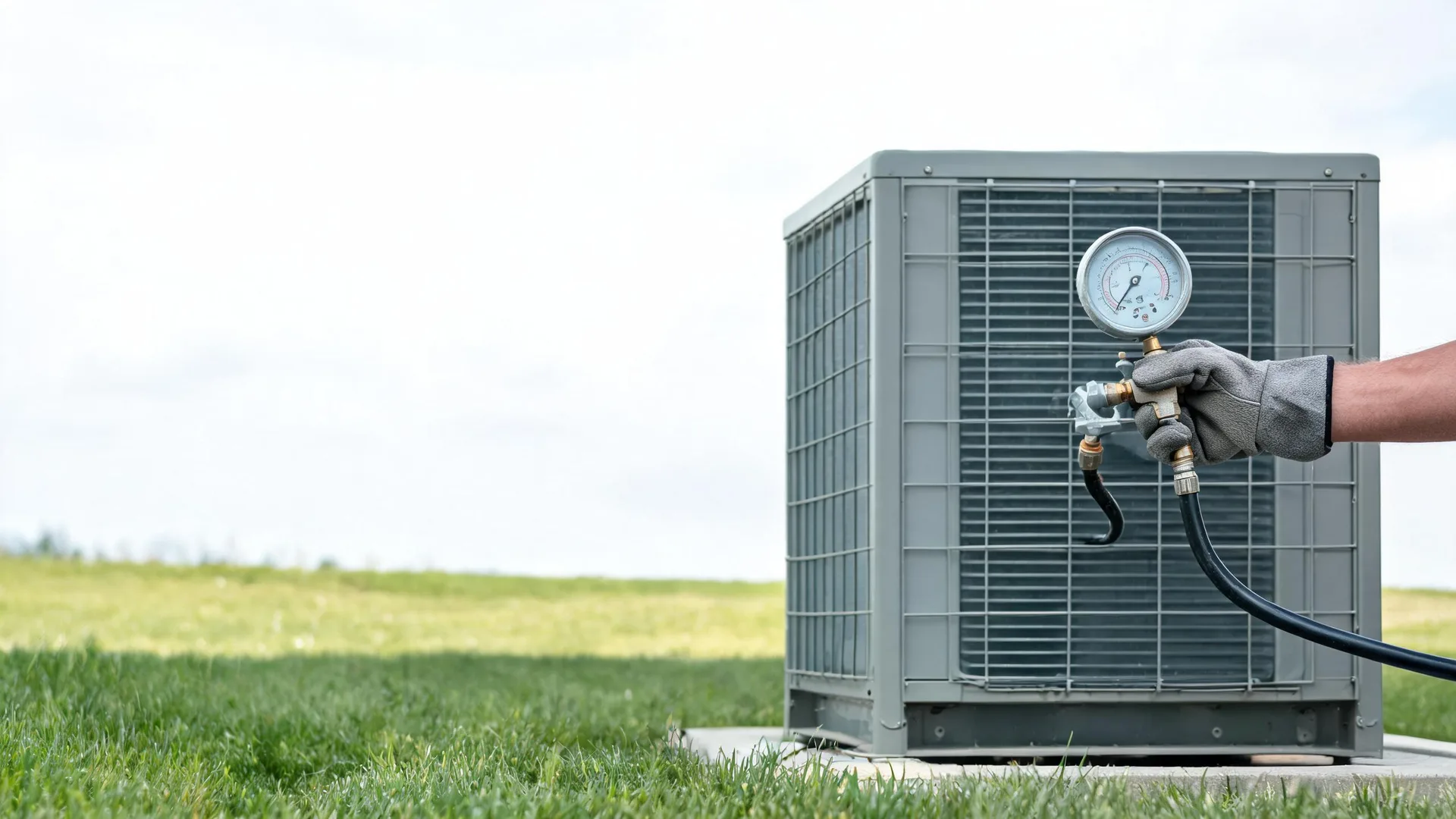
A diagnostic starts outside at the condenser. The tech checks that the fan spins freely and looks at the coil for dirt or debris caked on the fins. Gauges go on the lines next to check refrigerant pressure, since a system low on charge usually means a leak somewhere, not just a top off. Inside, the tech checks the evaporator coil and the condensate line, since a clog there can shut the whole system down on purpose. Electrical testing comes after that. The capacitor, the contactor and the wiring at the disconnect all get checked for the weak link that's making the compressor struggle to start or the fan run slow. Airflow gets checked too, since a return that's too small or a duct that's crushed can look like a bad part when the equipment itself is fine. By the end, the tech should be able to point to the one part that's failing instead of guessing at the whole system.