





A row of illuminated white colonial houses with black shutters and a stone wall along a road at dusk.

AC Repair in Ocean City, MD

Tell us about the job

Takes about a minute. No obligation.

RepairCentral ACWorcester County, MD
Step 1 of 2

What ZIP code is the job in?

AC here runs June through September, with afternoon highs averaging 85°F. That's four months of steady work, but nothing out of the ordinary for the unit. Worcester County is a mixed climate, so the system earns its keep in winter too, not just summer. Whatever's going wrong with yours right now is probably the same thing that goes wrong with any AC after a few years of regular use. A weak capacitor, a dirty coil, a low charge. The fix is finding out which one it is, not assuming the weather pushed it past what it was built for.

4 months
June through September, your air conditioner is on duty
85°F
the average summer afternoon it cools against
3 hail events
in ten years, and hail bends the fins on outdoor coils
45 wind events
in ten years, and wind drives debris into outdoor units
Isometric cutaway illustration of a house interior showing ducted HVAC piping, an indoor air handler unit, and an outdoor condenser with fan connected by a line, rendered in grey tones on a white background.
Your air conditioner works hardest from June through August.

NOAA nClimDiv, 1991–2020 normals

AC season here starts in June.

If yours is acting up in May, get it checked before that first hot stretch hits.

At 17.86 cents a kWh, a broken AC gets expensive fast

Power costs 17.86 cents a kWh statewide
Cooling runs June through September
Summer afternoons average 85°F

Half the homes in Worcester County were built in 1985 or later, so there's a good chance yours is one of the newer ones. A newer house doesn't mean a newer AC, since a system can be swapped out at any point, but if yours is the one that came with the house, it's probably not old enough to be worn out. Age narrows down what's likely wrong. A unit with years of life left still breaks down over a bad capacitor or a low charge, the same as any machine does. That's a repair, not a reason to start pricing a replacement.

A newer system is worth repairing

If your AC came with the house, it's probably got years left in it. Worth getting a repair quote before anyone talks you into a new system.

Find a contractor
A gray metal air conditioning condenser unit mounted on a concrete pad in a flat grassy field under a partly cloudy sky.

What to check before you call

Before anyone comes out, check the thermostat first. Make sure it's set to cool and set below room temperature, and swap the batteries if it's been a while. Next, go look at the outdoor unit. If the fan isn't spinning at all, that's worth noting. If it's spinning but the air coming out isn't cold, that's a different problem. Check the air filter while you're at it. A filter clogged with dust chokes off airflow and can ice up the coil, and that alone can look like a much bigger failure than it is. Look at the vents inside too. If some rooms are getting air and others aren't, that points one way. If nothing anywhere is blowing cold, that points another. Check the breaker panel. A tripped breaker on the AC circuit means the system lost power, and it won't start again until someone resets it. None of this tells you exactly what's wrong, but it tells the tech what's already been ruled out before they ever open the panel.

Warm air instead of cold

The system runs, the fan moves, but what comes out of the vents is room temperature or close to it. This usually points to the refrigerant side, a low charge or a failing compressor, or it can mean the coil is iced over and blocking airflow entirely. Either way the unit is working harder and cooling less.

Short cycling

An AC that shuts off a few minutes after starting, then kicks back on soon after, is short cycling. It can mean a failing capacitor, a dirty sensor telling the system the air is already cold, or a unit that was oversized for the space from the start. Short cycling wears down the compressor fast, so it's worth getting looked at before it leads to a bigger failure.

Overhead view of a gray outdoor AC condenser unit on a concrete pad beside a mulched garden bed and a house with vinyl siding.

A new air conditioner would cut about $50 a year off cooling for a typical Worcester County home.

  • A new one at the federal minimum, 14.3 SEER2$320 a year
  • An older air conditioner$370 a year

Estimates for a typical Worcester County home, compared with an older unit built to the previous federal minimum, from EIA household energy data, Maryland fuel prices and NOAA climate normals. Your home will differ.

Repair makes sense when a part like a capacitor or contactor has failed.

Replacement makes sense when the compressor has failed or the system uses R-22 refrigerant, which is no longer made.

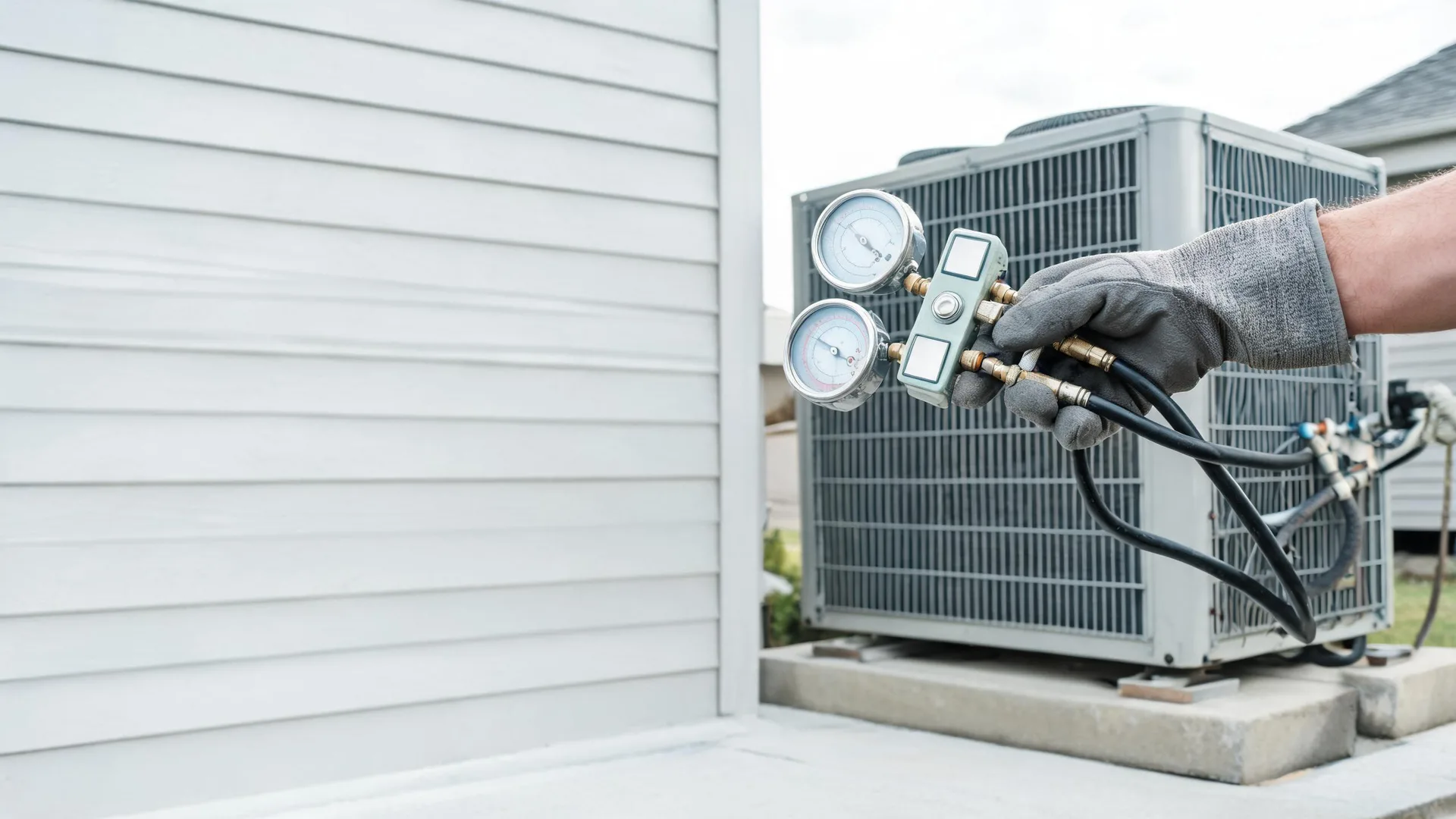
A diagnostic starts with gauges, not guesses. The tech hooks up to the system and checks refrigerant pressure first, since that number rules things in or out fast. From there it's the capacitor and the contactor, the parts that get the compressor and fan running in the first place. A multimeter tells the tech if the capacitor is holding its charge or if it's weak, which is a common reason a unit hums but doesn't start. The coil gets checked for ice or buildup, and the condenser fan gets watched to see if it's moving the air it should. Most of this takes less time than it does to describe, because a trained eye knows what normal looks like and spots the part that isn't.