




A single-story light gray house with dark shingled roof and black shutters sits on a mown lawn, framed by overhanging tree branches and blurred grass and shrubs in the foreground.

AC Repair in Salisbury, MD

Tell us about the job

Takes about a minute. No obligation.

RepairCentral ACWicomico County, MD
Step 1 of 2

What ZIP code is the job in?

Summer here runs June through September, with afternoon highs averaging 86 through most of it. That's a normal stretch of work for an air conditioner, not an unusual one. The system was sized for weather like this, so if it's short cycling, blowing warm air, or tripping its breaker, something has actually failed. It's rarely the heat itself at fault. A weak capacitor, a low refrigerant charge, a dirty condenser coil, or a clogged filter will all show the same symptoms on a mild day as a hot one. Finding which one it is matters more than how hot it's been outside.

4 months
June through September, your air conditioner is on duty
86°F
the average summer afternoon it cools against
4 hail events
in ten years, and hail bends the fins on outdoor coils
68 wind events
in ten years, and wind drives debris into outdoor units
Isometric grayscale illustration of a cutaway house showing interior rooms, ceiling ductwork connected to an indoor air handler, and an outdoor condenser unit linked by lines along the exterior wall.
Your air conditioner works hardest from June through August.

NOAA nClimDiv, 1991–2020 normals

June through September is when AC runs here.

May is the month to get a weak part checked, before the first hot day asks it to run all day.

Electricity here isn't cheapMaryland households paid 17.86 cents per kilowatthour in 2024, so a struggling AC costs more every month it runs broken.

Half the homes in Wicomico County were built in 1984 or later. If yours is one of them, the AC might still be the one it came with, or close to it, and that changes what a repair call should look like. A system within its working life is worth fixing when something fails. A bad capacitor or a low charge doesn't mean the unit is done, it means one part failed and needs replacing. Ask whoever comes out what's actually wrong before you let anyone talk replacement.

A broken AC costs you every day you leave it running

A capacitor or a low charge doesn't fix itself, and at 17.86 cents a kilowatt-hour, a unit fighting to cool your house is spending more than it should every time it kicks on. Get the part that's failed found and replaced.

Find a contractor
A man seen from behind in a dark jacket, tan work pants and boots climbs wooden porch steps toward an orange front door, carrying a waxed canvas tool bag, with a potted shrub beside the entry.
An outdoor air conditioning condenser unit mounted on a concrete pad beside a house, with electrical conduit running to a wall-mounted disconnect box.

What long runs reveal

An air conditioner that runs for months straight wears in specific places, and those places tend to announce themselves before they fail outright. A capacitor that's weakening will make the outdoor unit hum and try to start without catching, sometimes needing a few attempts before the fan spins up. A condenser fan motor on its way out gets loud, a grinding or rattling that wasn't there before. Refrigerant doesn't get used up, so if the system is low, something is leaking, and you'll notice the air from the vents getting warmer over time rather than all at once. Ice on the indoor coil or the refrigerant line is never a good sign, even though it seems backward for a cooling problem. None of this is about how hard the unit has been running. A system that cycles on and off correctly can run all day every day for its whole working life. One that short cycles, trips the breaker, or blows warm air has a specific part that failed, and running it in that state only stresses whatever else is still working.

A failing part pulls down the ones around it

A weak capacitor forces the fan motor to draw more current trying to start, and a motor that keeps drawing extra current wears out faster than it should. A compressor running on a low charge works harder to move what little refrigerant is left, and that heat has nowhere to go. The part that failed first is rarely the only part still working by the time someone gets out to look at it.

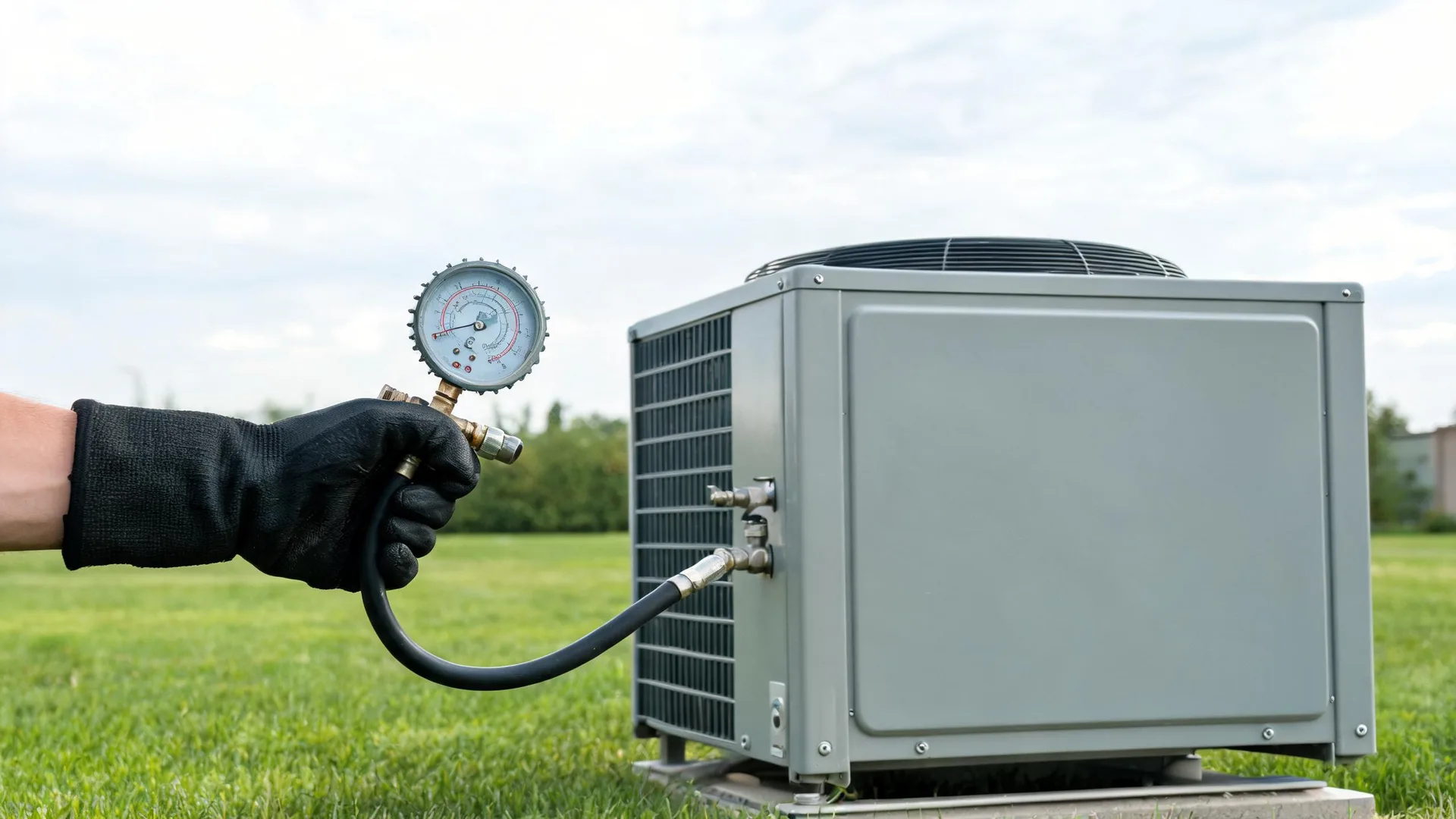
A frozen coil cannot fix itself

A coil icing over from low airflow or a low charge blocks the airflow it needs to thaw on its own. Left running, the ice only builds, and the compressor behind it keeps trying to do a job the system can no longer do. Once that ice melts, the water goes somewhere it was never meant to go.

An outdoor air conditioning condenser unit on a concrete pad next to the gray vinyl siding of a residential home.

A new air conditioner would cut about $50 a year off cooling for a typical Wicomico County home.

  • A new one at the federal minimum, 14.3 SEER2$330 a year
  • An older air conditioner$380 a year

Estimates for a typical Wicomico County home, compared with an older unit built to the previous federal minimum, from EIA household energy data, Maryland fuel prices and NOAA climate normals. Your home will differ.

Repair makes sense when a part like a capacitor or contactor has failed.

Replacement makes sense when the compressor has failed or the system uses R-22 refrigerant, which is no longer made.

Age matters more than any single repair when you're deciding whether to fix or replace. A system a few years into its working life is worth repairing almost every time, whatever the part. The same failure on a much older unit is worth a second look, not because the repair is wrong, but because the next part to go is probably close behind it. Refrigerant leaks are worth weighing carefully either way, since a leak means finding where the line or coil failed, not just adding charge back. A compressor replacement is the one repair worth comparing against a new system outright, since the compressor is most of what makes the unit work. Everything else, a capacitor, a fan motor, a control board, is a normal repair on a system that still has years in it.