A row of illuminated white colonial houses along a road photographed at dusk.

Mini Split Installation in Annapolis, MD

Tell us about the job

Takes about a minute. No obligation.

New system or replacementMini-splitAnne Arundel County, MD
Step 1 of 2

What ZIP code is the job in?

Electricity here runs 17.86 cents per kilowatthour

Maryland's power costs more than in most states, and a mini split that runs on electricity feels that rate on every bill. The efficiency rating on the unit you pick matters more here than it would somewhere with cheaper power.

Efficiency is a spec to compare, not assume

Mini splits vary a lot in how much heat or cooling they get out of each kilowatt they use. When you're comparing units for installation, put the efficiency rating next to the price, since the cheaper unit up front can cost more every month after.

7 months
October through April, your system heats
4 months
June through September, it cools
29°F
the average winter night it heats against
86°F
the average summer afternoon it cools against
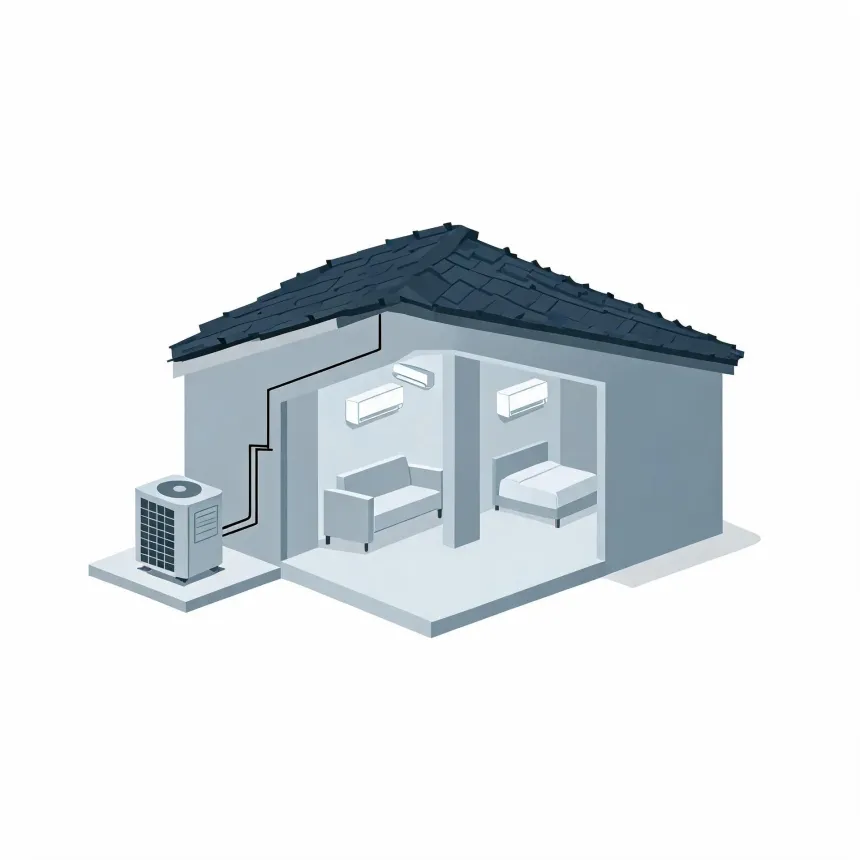
Isometric illustration of a cutaway single-story house with a dark shingled roof, showing three wall-mounted indoor air conditioning units in two rooms connected by lines to an outdoor condenser unit on a pad outside.
Your system heats October through April and cools June through September.

NOAA nClimDiv, 1991–2020 normals

The cost of a mini split job comes from the number of zones, the length of the line set, and where the outdoor unit has to go.

Homes wanting the same comfort can end up with different installs, because the layout decides the work, not the brand on the unit.

Half of Anne Arundel County already heats with electricity, so a mini split fits what's already there

49.9% of homes heat with electricity
Cooling runs June through September
Summer afternoons average 86°F
A standard mini split handles Annapolis fineNothing about the weather or the grid here calls for sizing up or spending more

Cooling in Anne Arundel County runs June through September, four months a year. May is the month before it starts, and that's the window to get a mini split installed. Wait until June and the job gets booked the same week the heat does, with whatever schedule a contractor has left. Installing ahead of the season also means the unit gets tested and running before it has to work every day. Nothing about the install gets easier once the heat sets in. It just gets more urgent.

Any mini split installed here has to clear 14.3 SEER2 and 7.5 HSPF2

Anne Arundel County sits in climate zone 4A, with real heating and cooling demand both. A ductless mini split counts as a split system under the federal standard, so any unit manufactured from 2023 on has to meet the same minimums as the rest of the category. That's 14.3 SEER2 for cooling and 7.5 HSPF2 for heating. A federal tax credit is available on top of that for equipment that qualifies.

Find a contractor
A white outdoor air conditioner condenser unit mounted on metal wall brackets against gray horizontal siding, with a blue sky and white clouds behind it.

The old unit doesn't get reused. It gets removed.

An old system being replaced tells you something before it comes out. If it's a window unit or a wall unit propped into an opening, it's been cycling on and off with no real control over humidity, and whatever it's cooling has probably never been comfortable in the way a properly sized mini split can make it. If it's an older heat pump or electric resistance setup, the compressor or heating elements have been carrying the full load alone for every degree of heating and cooling, with none of the modulation a mini split's inverter compressor does. Pulling an old unit out usually means patching the opening it sat in or capping a line set that ran somewhere. None of that is hard, but it's worth asking the contractor what happens to the hole once the new system doesn't need it. Refrigerant in old systems has to be recovered, not vented, so that part of the removal is already accounted for in how a contractor handles the job. The old equipment itself just gets hauled off. Nothing about it goes back into the new install.

Ask how many zones a unit can run, not just how many it has ports for

Every outdoor compressor has a limit on how many indoor heads it can run well. Push past what it's rated for and each zone gets a smaller share of capacity, especially when more than one room is calling for heating or cooling at the same time. The spec sheet lists the maximum combination for a reason.

Ask what happens to capacity when it's coldest outside

A heat pump's rated output is measured at a mild outdoor temperature. Colder air holds less heat to pull from, so every heat pump puts out less as the temperature drops, and below a certain point it leans on backup heat to make up the difference. The unit that looks identical on paper to another can fall off a cliff at a lower temperature, or hold steady much further down. That number is worth asking for directly.

Sizing a mini split comes down to a heat loss and heat gain calculation on the actual room, not a rule of thumb based on square footage. A contractor measures the walls, the windows, the ceiling height, and figures out how much heat that room loses in winter and picks up in summer. Too big and the unit short cycles, reaching the set temperature fast and shutting off before it's pulled any humidity out of the air, so the room feels cool but damp. Too small and it runs flat out without ever catching up on the hottest or coldest stretches. Either way you feel it, in comfort or in how often the system is turning on and off. The room matters more than the brand here, since the same unit sized right in one space and wrong in another gives different results.

Install day starts with the walk through, confirming where the indoor heads go and where the outdoor unit will sit, since that was decided ahead of time but gets checked once more before anyone drills anything. The indoor unit gets mounted high on the wall, on a bracket, and a small hole gets drilled through to the outside for the line set. That line set, the refrigerant lines, the power wire and the condensate drain, all run through that one hole and get routed to the outdoor unit. The outdoor unit sits on a pad or brackets, somewhere with clearance on all sides so air can move through it. Once everything's connected, the lines get pressure tested to make sure there are no leaks, then the system gets evacuated to pull moisture and air out before refrigerant is released into the lines. Only after that does the unit get powered on and run through its paces, heating and cooling, checking the temperature split at the vents and making sure every zone responds the way it should. A clean install leaves one hole in the wall, not several, and a line set that's hidden or covered, not just run bare down the siding.