Electricity here runs 17.86 cents a kilowatt-hour
Maryland's power costs more than most states. A mini split that runs on a weak SEER2 rating turns that rate into a bigger bill every month it runs.
Takes about a minute. No obligation.
Maryland's power costs more than most states. A mini split that runs on a weak SEER2 rating turns that rate into a bigger bill every month it runs.
When you compare units for this job, look at the SEER2 rating before anything else. A higher rated system pulls fewer watts for the same heating or cooling, and at Maryland's rate that difference shows up on the bill.
NOAA nClimDiv, 1991–2020 normals
Cooling runs June through September here.
A mini split put in during May is ready before that first hot month, installed on your schedule instead of during a breakdown.



Queen Anne's County falls in climate zone 4A, which asks real work of both heating and cooling through the year. Any mini split installed here has to meet the federal minimum for that climate. For cooling that means 14.3 SEER2, and for heating it means 7.5 HSPF2. That rule applies to ductless systems the same as any other split-system heat pump. There is no separate, lower bar for going ductless. A unit priced below that standard is not a cheaper option, it is not a legal one to install new. Checking the SEER2 and HSPF2 numbers on a quote tells you whether it clears the line.
Four months of cooling and a mixed climate the rest of the year is normal work for a mini split. Nothing about Queen Anne's County pushes you toward a bigger unit or a higher tier than the job needs. Size it for the space, check the SEER2 and HSPF2 on the quote, and that covers what this county asks of it.
Find a contractorA mini split runs every time the room calls for heat or cooling, so the parts that matter most are the ones doing that work day after day, the compressor and the indoor coil. Ask what compressor is in the outdoor unit and how long the maker backs it. That part is sealed inside the cabinet and is not something a tech swaps out on a service call, so its warranty is worth more than the warranty on anything else in the system. Beyond the equipment, ask how the installer handles the line set between the indoor and outdoor units. The refrigerant lines have to be pulled down to a real vacuum before the charge goes in, and that step is what lets the system hit the efficiency rating on its label. Skip it or rush it and the system still turns on, still blows air, and still falls short of what it was sized to do. A contractor who can explain that process in plain terms is telling you something about every other step they take too.
A mini split is sized by working out how much heat a room gains in summer and loses in winter, based on things like window area, insulation and what's on the other side of each wall. That calculation points to a specific capacity for each indoor head. Going by square footage alone skips all of that and guesses.
An oversized head cools the room fast, shuts off, and leaves the air damp because it never ran long enough to pull moisture out. An undersized one runs constantly and still can't hold the temperature on the hottest or coldest days. A correctly sized head cycles on, does the work, and shuts off with the room actually comfortable.
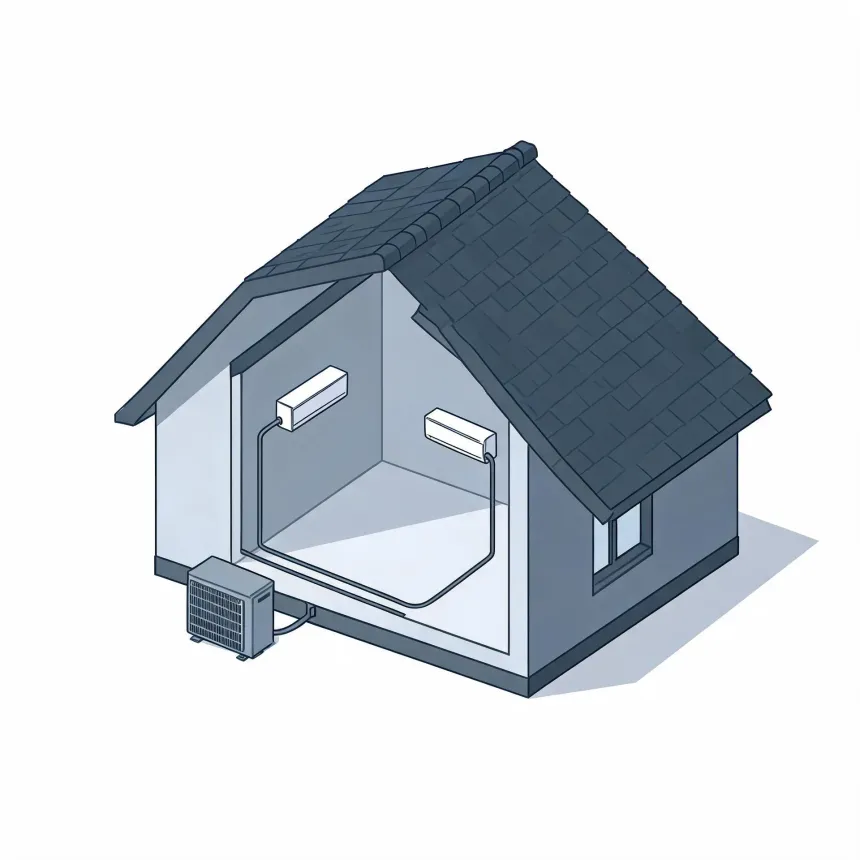
The quote covers more than the equipment sitting on the wall. A big piece of the cost is how many indoor heads the job needs and where each one goes. A single head cooling a single room is a straightforward run of line set and one spot on an outdoor unit. Multiple heads off one outdoor condenser means more line set, more wall penetrations, and a condenser sized to run all of them at once without any one room falling behind. Where that outdoor unit sits matters too. A short, direct run to the indoor head costs less than one that has to snake through a chase or up a wall to reach a second floor. Electrical work plays into it as well, since the outdoor unit needs its own dedicated circuit, and whether that means running new wire from the panel or tying into something already in place changes the job. None of this is padding. Each piece is labor and material the installer has to account for before the system ever turns on.
SEER2 and HSPF2 are both ratings of output against power drawn, one for cooling and one for heat, and neither tells you what a unit costs to run on its own. What they're good for is comparing units sized for the same room. Between systems built for the same capacity, the one with the higher rating moves the same heat or cooling using less electricity to do it. That rating is measured under set conditions in a lab, with the refrigerant charge and airflow exactly where the manufacturer wants them. A unit only earns that number in the field when it's installed the way it was tested, line set pulled to a proper vacuum, charge weighed in correctly, the indoor head sized for the room it serves. Install it wrong and the number on the label stops meaning anything, because the system underneath it isn't the one that was tested.