A gray cat sleeps curled up on a dark-made bed in a moody, minimalist bedroom with a wall-mounted air conditioning unit and warm accent lighting.

Mini Split Installation in Chesapeake Beach, MD

Tell us about the job

Takes about a minute. No obligation.

New system or replacementMini-splitCalvert County, MD
Step 1 of 2

What ZIP code is the job in?

The rating tells you the ratio, not the bill

The efficiency number on a mini split measures how much heat it moves for the energy it uses. A higher number means the compressor and coil are doing more work per unit of power. It does not tell you what the system will cost to run in any given room, because that depends on the size of the space, how well it holds heat, and how the system gets set.

Match the rating to how you'll actually run it

A unit with a high rating only delivers on that rating when it runs the way it was designed to, cycling steadily rather than shutting on and off. If a contractor sizes the system too big for the room, it will satisfy the thermostat fast and shut off, and you lose the efficiency the label promised. The rating is only worth what the installation lets it do.

7 months
October through April, your system heats
4 months
June through September, it cools
29°F
the average winter night it heats against
85°F
the average summer afternoon it cools against
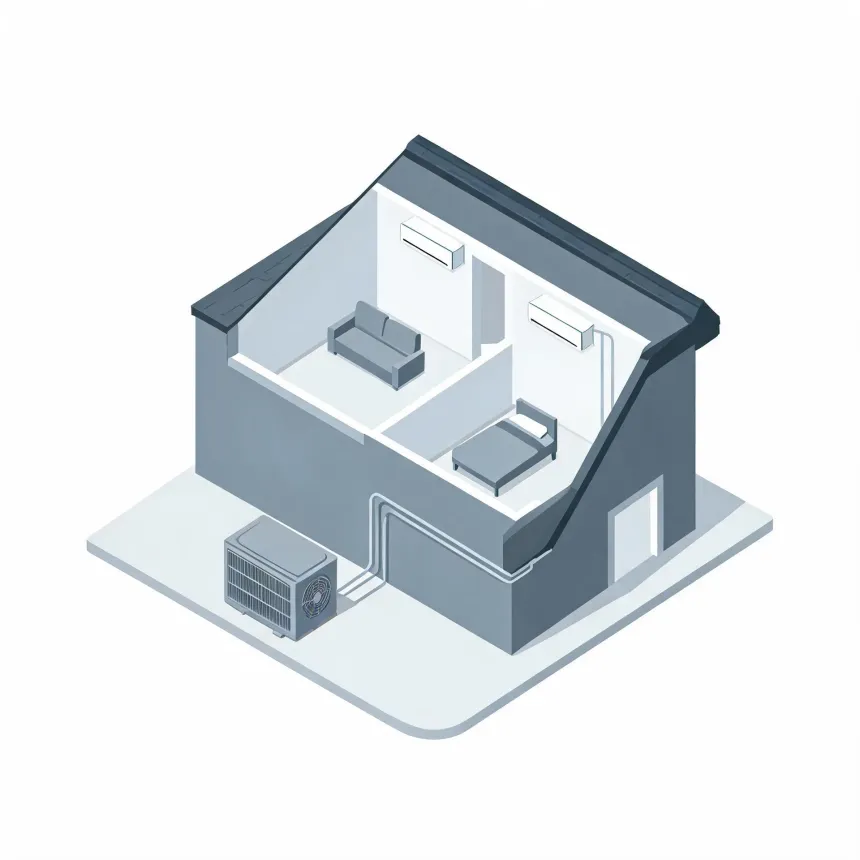
Isometric cutaway illustration of a two-room house showing two wall-mounted indoor air conditioning units connected by line sets to an outdoor condenser unit on the ground outside.
Your system heats October through April and cools June through September.

NOAA nClimDiv, 1991–2020 normals

Electricity heats 73.1% of the homes in Calvert County.

A mini split works with that, since it runs on electricity and needs no gas line to the house.

Four months of real cooling, nothing that calls for more than a standard system

Cooling runs June through September
Summer afternoons average 85°F
120 damaging wind events from 2015 to 2024
Get it in before JuneCooling runs June through September here, so May is the month to have it ready.

That's worth weighing when you're picking the unit itself, not just confirming it clears the zone minimum. Mini splits are sold across a real range above that floor, and every step up in rating is electricity you're not buying at Maryland's rate. The gap in price between a baseline unit and a higher-rated one tends to close faster here than in a state paying less per kilowatthour. The federal tax credit mentioned earlier applies to these higher-efficiency units too, which narrows that gap further before you've run it a single season.

Efficiency pays here

Power costs more here, so an efficient system pays you back on every bill.

Find a contractor
A beige split-system air conditioner outdoor condenser unit mounted on metal wall brackets atop a stucco wall.

The box on the wall is the easy part

What drives the price of a mini split installation has less to do with the indoor unit on the wall and more to do with everything around it. The length of line hidden between the outdoor compressor and the indoor head matters, since longer runs need more refrigerant line, more wall penetration, and more mounting hardware. Where the outdoor unit can sit matters too. A spot close to the electrical panel and close to the indoor unit costs less to connect than one that needs a long conduit run or a line set routed around the house. The number of indoor heads also changes the job. A single-zone system is a simpler install than a multi-zone setup feeding several rooms off one outdoor compressor, since each added head needs its own line set, its own mount, and its own spot on the electrical circuit. The condition of the electrical panel plays a part as well. If the panel has room for a new dedicated circuit, that's straightforward. If it's already full, the job now includes upgrading the panel before the mini split can even go in. None of this shows up on the unit's spec sheet, but it's most of what a contractor is pricing when they walk the site.

Whatever heated or cooled the place before still has to go

A window unit gets pulled and the opening gets sealed or trimmed out. A furnace or central air system gets disconnected from its ductwork and removed. Refrigerant in an old AC system has to be recovered, not vented, so that part of the job falls to a licensed contractor rather than a hauling crew.

Ductwork from the old system can stay right where it is

Ducts run through walls and floors and don't come out just because the equipment attached to them does. A mini split doesn't use ducts at all, so existing ductwork can sit capped and unused, or stay in service for a separate zone if the house still needs it to.

Sizing a mini split is about matching the compressor's output to the heat gain and heat loss of the room it's serving, not just floor area. A contractor works that out with a load calculation, which weighs the window area, the insulation, the ceiling height, and which way the room faces against what the compressor can deliver. Too big and the unit blasts the room to temperature and shuts off before it's run long enough to pull moisture out of the air, so the space feels cold and damp rather than comfortable. Too small and it runs flat out without ever catching up on the hottest or coldest days. Either way you lose the steady, low-speed cycling these systems are built to run on, which is where they do their best work. The right size is the one that lets the compressor settle in and hold, not the one that matches the room on paper.

Install day starts outside and in, at the same time. One crew member mounts the indoor head and runs the line set through the wall while another sets the outdoor compressor on its pad or brackets. The hole through the wall is small, just enough for the refrigerant lines, the condensate drain, and the electrical whip to pass through together, and it gets sealed once they're in. Before any refrigerant moves, the line set gets pulled down to a vacuum to clear out air and moisture, since either one left in the lines will cause problems later. Once it holds vacuum, the system gets charged and the contractor checks the line pressures against what the manufacturer specifies for that line length. Only after that does the indoor head get powered on and tested through a full cooling and heating cycle. A clean install leaves one neat line hidden along the wall outside, a small drain running to daylight, and a unit that's quiet from across the room.