A tabby cat sleeps on a large bed in a dark, modern bedroom equipped with a wall-mounted air-conditioning unit.

Mini Split Installation in Chestertown, MD

Tell us about the job

Takes about a minute. No obligation.

New system or replacementMini-splitKent County, MD
Step 1 of 2

What ZIP code is the job in?

Electricity here runs 17.86 cents per kilowatt-hour

Maryland households pay more for power than most of the country. A mini split that moves heat instead of generating it will cost less to run than electric resistance heat, and that gap shows up every month on the bill.

Efficiency is part of the sizing decision

A mini split sized and installed correctly for the rooms it serves will hold that efficiency for as long as you own it. One sized wrong, or installed with bad line set work, loses it right away and keeps costing you at that higher rate.

7 months
October through April, your system heats
4 months
June through September, it cools
28°F
the average winter night it heats against
86°F
the average summer afternoon it cools against
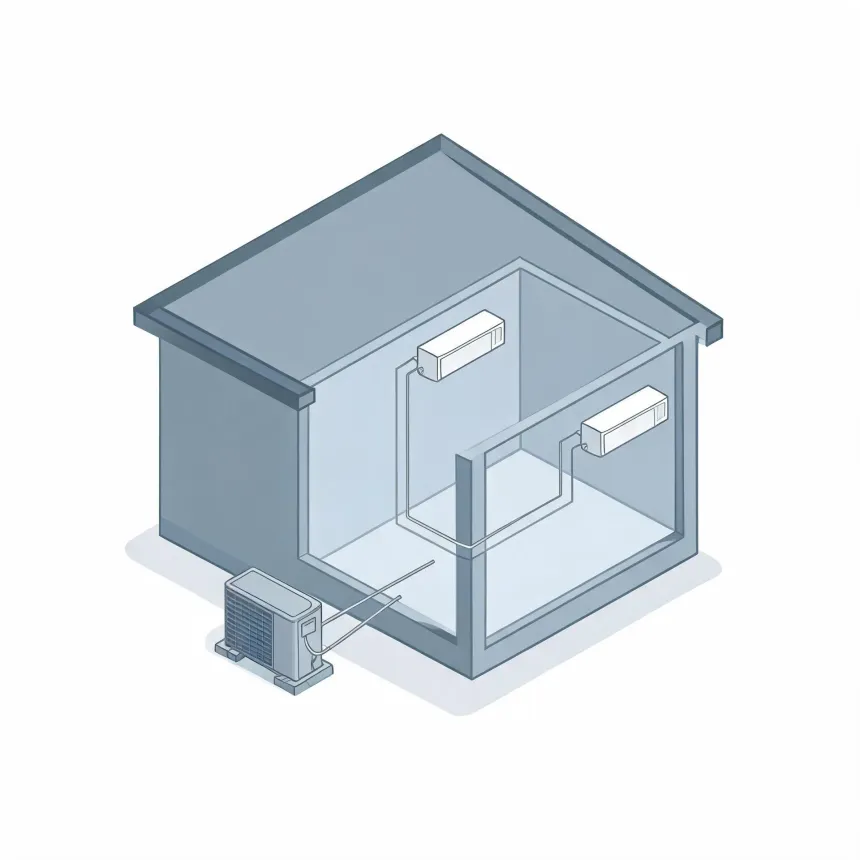
Isometric line illustration of a cutaway building interior with two wall-mounted indoor air conditioning units connected by piping to an outdoor condenser unit on the ground outside.
Your system heats October through April and cools June through September.

NOAA nClimDiv, 1991–2020 normals

Electricity heats 62.3% of homes in Kent County, more than gas and oil combined.

A mini split runs on electricity already, so it replaces what's there now instead of fighting the wiring you have.

A standard mini split fits this house fine

Half the homes here were built by 1978
Cooling runs June through September
Summer afternoons average 86°F
May is the month to get it inCooling in Kent County runs June through September. Install before June and it's ready on day one.

Cooling runs June through September here, about four months, with afternoon highs averaging 86°F. That's real work for a mini split, but it's not extreme heat, and nothing about it calls for a bigger unit or a higher-tier one than the room actually needs. Kent County sits in zone 4A, a mixed climate that asks for solid heating performance too, and a standard mini split is built to handle both sides of that without being oversized for either. Get the room measured and the unit matched to it, and the standard model does the job for as long as you own it.

A new mini split here has to meet zone 4A's efficiency standard

Kent County falls in climate zone 4A, and any mini split installed here has to meet 14.3 SEER2 and 7.5 HSPF2 at minimum, the federal standard for split-system heat pumps. A correctly sized standard unit clears that bar without trouble. Installations may also qualify for a federal tax credit, worth checking before you settle on a system.

Find a contractor
A white outdoor air conditioner condenser unit mounted on metal wall brackets against gray horizontal siding, with a blue sky and white clouds behind it.

What the install involves, not just the unit

A single zone with a short line set run is the simplest job a contractor does. Add zones, and the cost climbs with each indoor head and each run of line hidden in the wall or routed through conduit. Distance matters too. The farther the line set has to travel between the outdoor unit and the indoor heads, the more labor it takes to run it clean. Where the outdoor unit sits counts as well. A pad on open ground is quick work. A wall bracket, or a spot needing extra support or clearance, takes longer. Electrical is its own piece of it. A mini split needs its own dedicated circuit, and whether the panel has room for it changes the job. An open slot is a straightforward tie-in. A full panel means an upgrade before the mini split goes in, and that's separate work on top of the unit itself. None of this is about the equipment being better or worse. It's about how much work it takes to get refrigerant, power and mounting to exactly where the rooms need them.

Sizing is a room by room measurement, not a guess

A contractor works out heat loss and heat gain for each room a head will serve. Square footage, ceiling height, window area, how many exterior walls all factor in. That math sets the BTU rating for each indoor head. Skip it and go by the size of the old system or a rule of thumb, and the number is wrong before the unit even ships.

Oversized fails differently than undersized

A unit too big for the room cools or heats it fast, then shuts off, then kicks back on a few minutes later. That short cycling never lets the system run long enough to pull moisture out of the air, so the room feels cold and damp instead of just comfortable. A unit too small runs constantly and still can't catch up on the hottest or coldest days. Either way the fix was deciding the size before install, not after.

If this is replacing a system tied into ductwork, the old equipment doesn't disappear on its own. A contractor disconnects the indoor and outdoor units, recovers the refrigerant from the line set, and hauls the equipment away. Abandoned ductwork can often stay in place and get capped off, but that's worth asking about directly rather than assuming. If the old system ran on gas or oil, that line or tank needs its own shutoff, separate from anything electrical. None of this is hard, but it's work a contractor has to plan for, not something that happens for free on install day.

Install day starts with the outdoor unit and the indoor heads going in first, mounted and set in place before any line set connects them. Once both ends are set, the contractor runs the line set between them, then pulls a vacuum on it to clear out air and moisture before refrigerant ever moves through. That vacuum test matters more than it looks. A line set that holds vacuum is sealed right. One that doesn't means a joint needs redoing before anything gets charged. After that comes the electrical tie-in to the dedicated circuit, then the system gets powered on, tested in both heating and cooling, and checked head by head for airflow and temperature. A clean install ends with the contractor walking the system with you, not just packing up and leaving.