A two-story red brick house with black shutters and a dark roof stands behind a mowed lawn framed by large deciduous trees, viewed over a dry-stacked stone wall in the foreground under an overcast sky.

Mini Split Installation in Columbia, MD

Tell us about the job

Takes about a minute. No obligation.

New system or replacementMini-splitHoward County, MD
Step 1 of 2

What ZIP code is the job in?

Electricity here runs 17.86 cents a kilowatthour

Maryland's power costs more than in most states, and a mini split that runs on electricity will draw on that rate every time it cycles on. How efficiently it does that work matters more here than it would somewhere with cheaper power.

Efficiency is worth checking before you buy

Mini splits vary in how much heating or cooling they deliver for the electricity they use. Since the rate per kilowatthour is fixed and high, the unit's efficiency rating is one of the few things in this purchase you still have control over.

7 months
October through April, your system heats
4 months
June through September, it cools
26°F
the average winter night it heats against
85°F
the average summer afternoon it cools against
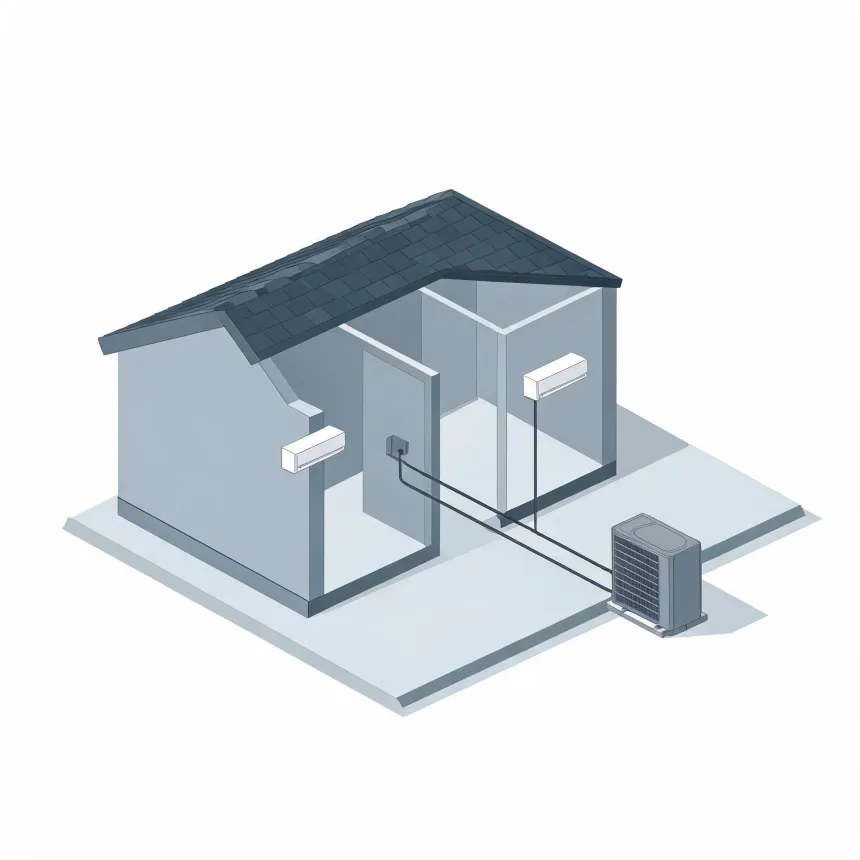
Isometric illustration of a cutaway gray house with a dark shingled roof, showing two wall-mounted indoor air handlers connected by line sets to an outdoor condenser unit on a pad outside.
Your system heats October through April and cools June through September.

NOAA nClimDiv, 1991–2020 normals

Cooling in Columbia runs June through September.

Have the mini split installed before June, so the job happens on your schedule, not during the first hot week.

Columbia sees its share of storms, but that's a power question, not a sizing one

223 severe weather events from 2015 to 2024
11% of homes statewide lost power a day or more in 2024
177 damaging wind events from 2015 to 2024

Cooling runs four months here, June through September, with afternoon highs averaging 85°F across the summer. That is a normal cooling load, not a heavy one. A mini split sized to the room it serves will keep up fine. Howard County falls in climate zone 4A, which asks real work of both heating and cooling, but nothing about that calls for an oversized unit or a premium model. The right size for the space is the right size, full stop.

The system has to meet the minimum. Here's what that rules in.

Any mini split installed here has to clear 14.3 SEER2 and 7.5 HSPF2, the federal minimum for split-system heat pumps. That's not a Columbia rule, it's what every unit sold now is built to meet, so it narrows what a contractor can offer you to begin with.

Find a contractor
A beige split-system air conditioner outdoor condenser unit mounted on metal wall brackets atop a stucco wall.

Compare how they run at low output, not just full blast

A mini split runs longer than most people expect, since it doesn't cycle off the way a central system does once the room reaches temperature. It modulates down and keeps running at low output, which is part of how it holds a steady temperature. That changes what's worth comparing between models. Ask what each system does at partial load, not just at full output, since that's where it spends most of its time. Ask what the compressor is rated for in terms of duty cycle and how the manufacturer backs that over years of that kind of use. A unit that only performs well at full blast isn't built for how a mini split actually operates once it's installed.

The old system doesn't have to go first

A mini split installation can happen alongside whatever is heating and cooling the space now. Nothing requires the old equipment to be disconnected before the new lines get run or the indoor units get mounted. That sequencing is worth asking the contractor about directly, since it affects how many days the home is without conditioned air.

What's left depends on what it was

A furnace or central air condenser gets disconnected and hauled off by whoever installs the new system. If the old setup included ductwork that won't be used anymore, that stays in place unless someone is paid separately to remove it. A window unit or old wall unit being replaced is usually just unplugged and carried out.

The unit itself is only part of what you're paying for. Running refrigerant line between the outdoor compressor and each indoor head takes real labor, and that cost climbs with distance and with how many walls or floors the line has to pass through. A single zone cooling one room is a different job than a multi-zone setup feeding several rooms off one outdoor unit, since every indoor head needs its own line set, its own mounting, and its own spot on the wall or ceiling that actually works for airflow. Where the outdoor unit can go matters too. A condenser with clear space around it and an easy path for the line set costs less to place than one that has to go on a roof or get fished through finished walls. Electrical work adds to it as well, since a mini split needs its own dedicated circuit, and if the panel doesn't have room for that, the panel work becomes part of the job.

Install day starts outside and in, at the same time. One crew member mounts the indoor head and runs the line set from inside while another sets the outdoor unit on its pad or brackets. The wall needs a hole bored straight through for the refrigerant lines, the drain line, and the electrical whip, and that penetration gets sealed once everything passes through it. Before any refrigerant moves, the whole line set gets pulled down to a vacuum to clear out air and moisture, since either one left in the lines will cause problems later. Once it holds vacuum, the system gets charged, and the contractor checks the line set connections for leaks before closing anything up. The indoor head doesn't run at full capacity until the electrical work is tied in and tested, so that gets checked before anyone calls the job done.