





A dark, minimalist bedroom featuring a sleeping cat on a grey-quilted bed, a wall-mounted air-conditioning unit, warm cove ceiling lighting, and a pendant lamp illuminating the bedside table.

Mini Split Installation in Cumberland, MD

Tell us about the job

Takes about a minute. No obligation.

New system or replacementMini-splitAllegany County, MD
Step 1 of 2

What ZIP code is the job in?

Maryland households paid 17.86 cents per kilowatthour in 2024, well above the national average. A mini split earns its keep against that number. It moves heat instead of burning fuel or resisting current to make it, so it gets more warmth or cooling out of every kilowatthour than a furnace or baseboard heat can. Cumberland sees both hard winters and humid summers, which means this system runs for most of the year, not just a few weeks. That makes the efficiency rating on the unit you choose worth reading closely, because at these electric rates the difference between models shows up on every bill, not just the first one.

8 months
October through May, your system heats
3 months
June through August, it cools
24°F
the average winter night it heats against
84°F
the average summer afternoon it cools against
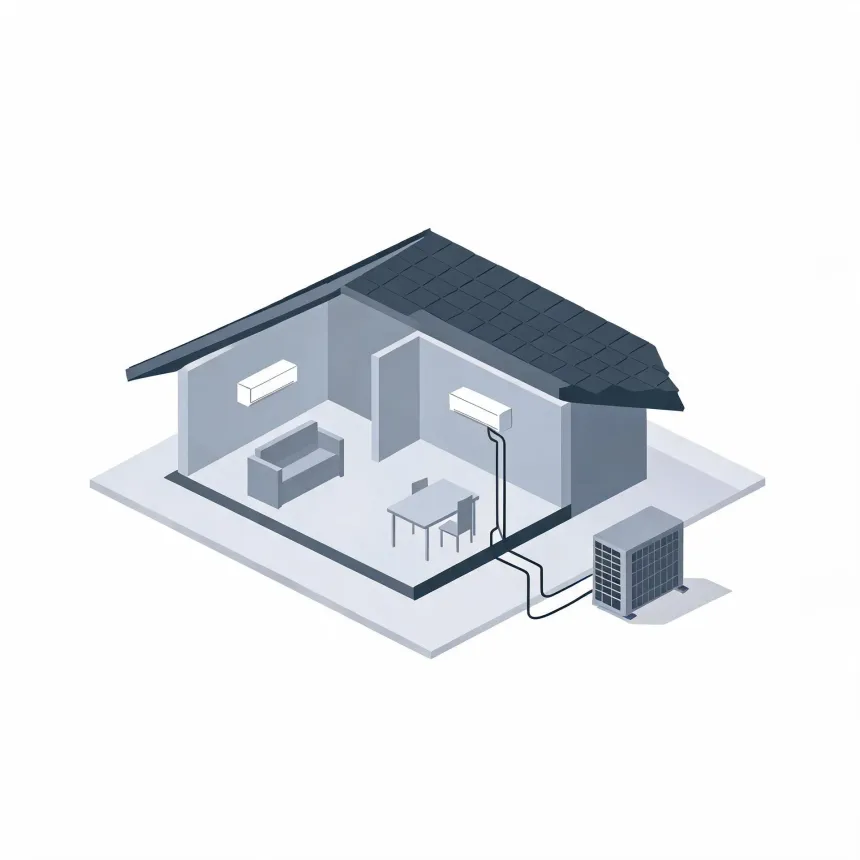
Isometric illustration of a cutaway house interior with sofa, table and chair, two wall-mounted indoor air conditioning units connected by lines to an outdoor condenser unit beside the building.
Your system heats October through May and cools June through August.

NOAA nClimDiv, 1991–2020 normals

Cooling here runs June through August.

May is the time to get a mini split in, before the first hot stretch puts it to work.

Half these homes were built by 1959. A mini split still has to match the one you've got.

Half the homes here were built by 1959
Cooling runs June through August
Summer afternoons average 84°F

Look at the SEER2 and HSPF2 numbers before you pick a unit, not just the price tag. A mid-range mini split and a high-efficiency one can cost close to the same to install, but they won't cost the same to run in a house that uses this system most of the year. Ask what the number means for a zone the size of your room, not just the whole-house average on the brochure. The installer sizing your system should be able to tell you the expected load for your space in Cumberland's climate, not just the national rule of thumb.

A mini split here has to meet zone 5A's minimum, and the credit can help cover it

Allegany County falls in climate zone 5A, where winters set the bigger load. Any mini split installed here has to clear 14.3 SEER2 and 7.5 HSPF2, the federal minimum for split-system heat pumps. A federal tax credit is available on qualifying equipment, so the unit that meets the standard can also cost less to put in than the sticker price suggests.

Find a contractor
A man in a cap, dark T-shirt and work pants carries a worn canvas tool bag up wooden porch steps toward a red front door.
A beige split-system air conditioner outdoor condenser unit mounted on metal wall brackets atop a stucco wall.

The rating on the box isn't the whole story

A heat pump's rating tells you how much heat or cooling it moves per unit of power, but that number comes from lab conditions at one set point. Run it colder or hotter than that and the output and the efficiency both shift. That's why the spec sheet alone won't tell you how a unit behaves at the coldest stretch of the year, when the system is working hardest and has the least to give. Ask for the capacity at a low outdoor temperature, not just the rated capacity, because that's the number that tells you whether the unit keeps up or starts leaning on backup heat. A unit that looks evenly matched to another on paper can perform very differently once the temperature drops.

Sizing comes from a room by room heat loss and gain calculation

A contractor measures each room, checks window area, wall exposure and insulation, and works out what it takes to heat and cool that specific space. Square footage alone does not tell you the load. Rooms of the same size can need different sized heads depending on how many walls face outside and how much glass they carry.

Oversized and undersized units both fail, in different ways

A mini split sized too big cools the room fast and shuts off before it pulls the moisture out of the air, so the room feels cold and damp. One sized too small runs constantly and never quite catches up on the coldest or hottest days. The right size cycles on, runs long enough to condition the space evenly, and shuts off.

The price of a mini split installation comes down to more than the equipment on the truck. How many zones you're running changes the labor and the material both, since each indoor head needs its own line set and its own spot on the wall or ceiling. Where the outdoor unit can go matters too. A long run between the compressor and the farthest indoor head costs more in refrigerant line and mounting than a short, simple one. The electrical side plays a part as well. Some systems need a dedicated circuit, and if the panel doesn't have room or capacity for it, that's its own job before the mini split goes in at all. None of this shows up on a price tag at the store. It shows up when a contractor walks the space and figures out what it actually takes to get the system running the way it's supposed to.

Install day starts with the outdoor unit and works inward. The compressor gets mounted on a pad or bracket outside, far enough from the wall to pull air through the coil without blocking it. Indoor heads go up next, each one needing a clear path through the wall for the line set, the drain, and the electrical whip that connects it to the compressor. That wall penetration is the part most people don't picture when they think about install day. It's a core drilled through framing and siding, then sealed against weather once the lines are run. After the lines are connected, the system gets evacuated with a vacuum pump to pull out air and moisture before refrigerant goes in, because either one left in the lines will keep the system from working right. Once it's charged, the contractor checks airflow and temperature split at each head before calling the job done.