





A new wooden picket fence runs along a grass lawn in front of a row of similar two-story houses with gabled roofs and light siding, under large leafy trees.

Mini Split Installation in Denton, MD

Tell us about the job

Takes about a minute. No obligation.

New system or replacementMini-splitCaroline County, MD
Step 1 of 2

What ZIP code is the job in?

Maryland electricity ran 17.86 cents per kilowatthour in 2024. A mini split runs on that rate every time it cycles on, so the efficiency rating on the unit you pick matters more here than it would somewhere with cheaper power. Mini splits move heat instead of generating it, which is why they use less power than baseboard or furnace heat to begin with. Look for the SEER2 and HSPF2 numbers when you compare units, not just the price tag on the install. A higher rating costs more up front and less on every bill after that.

7 months
October through April, your system heats
4 months
June through September, it cools
28°F
the average winter night it heats against
86°F
the average summer afternoon it cools against
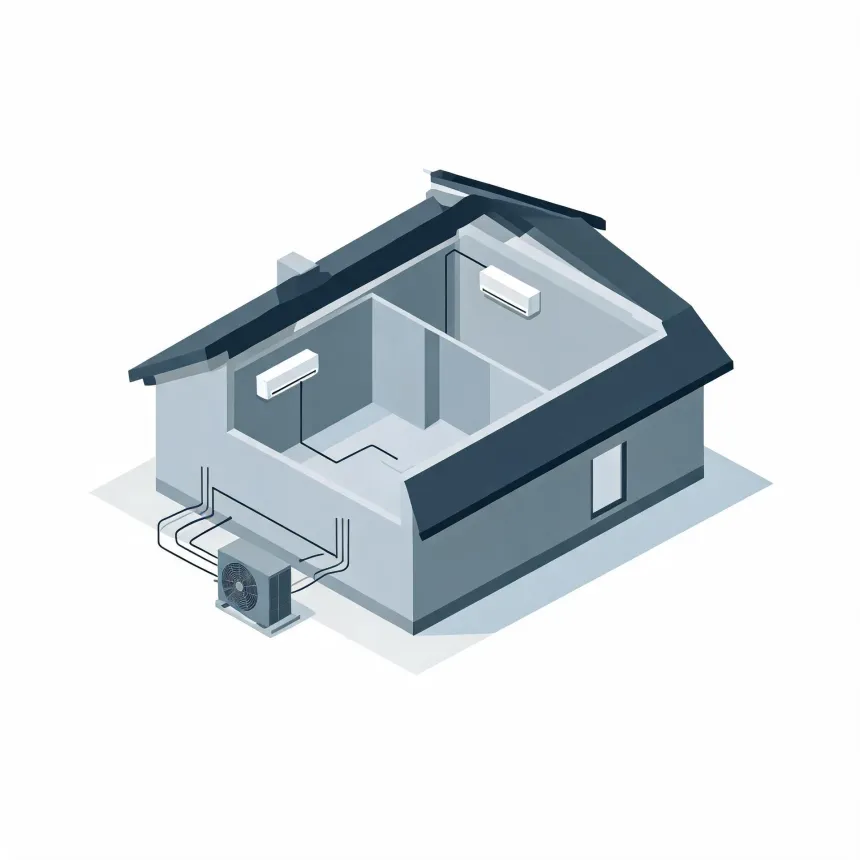
Isometric illustration of a cutaway house showing two wall-mounted indoor air conditioning units connected by line sets to an outdoor condenser unit on the ground outside.
Your system heats October through April and cools June through September.

NOAA nClimDiv, 1991–2020 normals

Electricity heats 57.6% of homes in Caroline County, more than gas, propane, and oil combined.

A mini split that runs on electricity fits a job most homes here are already set up for.

May is the month to put in a mini split, before June asks it to work

Cooling runs June through September
Summer afternoons average 86°F
75 damaging wind events from 2015 to 2024

Caroline County falls in climate zone 4A, a mixed climate that asks real work of both the heating and cooling side. A mini split sold new here has to meet a federal floor to match that work, 14.3 SEER2 for cooling and 7.5 HSPF2 for heating. That floor applies to the ductless unit itself. The standard treats it as a split system and names no separate ductless class. A unit rated below those numbers is not one you can have installed new. Beyond that floor, a new mini split may also qualify for a federal tax credit, worth checking before you settle on a model.

A standard mini split is built for exactly what this county asks of it

Cooling runs four months here, June through September, with afternoon highs averaging 86. That's real work for a mini split, but not unusual work. A unit sized and rated to the code floor already covers it. Nothing about this county calls for going bigger or paying for more than that.

Find a contractor
A man in a dark cap, gray long-sleeved shirt and brown work pants, carrying a canvas tool bag with pens and tools in its pockets, steps up onto a porch toward an orange-red paneled front door, with gray horizontal siding and a potted shrub in a terracotta planter to the right.
A white mini-split air conditioner outdoor condenser unit mounted on metal brackets against a beige stucco exterior wall, with a blue sky and scattered clouds in the background.

What decides what you pay, before anyone names a number

Installation price mostly comes down to how many indoor heads the job needs and how far each one sits from the outdoor unit. One zone with a short line run to an outdoor unit near the wall penetration is the simple end of the job. Add a zone and you add a line set, wiring, and another spot on the outdoor unit's board for that head to answer to. A longer line run costs more too, since it takes more time to install and more refrigerant to charge correctly. Where the outdoor unit can sit matters as well. The compressor needs open air on every side to pull air through its coil, and if the only clear spot is far from the indoor heads, that distance gets built into the price. The electrical panel plays a part too. A mini split needs its own dedicated circuit, and a panel with no open slot for one means an electrician adds a circuit before the install can finish. None of that is about the brand on the unit. It comes down to how many rooms you're conditioning, how far the lines travel, and what the panel can already carry.

Ask for the SEER2 and HSPF2 numbers before the quote

A contractor can quote a mini split by price alone, but the rating is what decides what it costs you to run. Get the SEER2 and HSPF2 numbers for any unit you're considering, in writing, before you compare quotes.
The higher rating is worth more here than elsewhere

The same jump in SEER2 or HSPF2 saves more on a Maryland bill than it would somewhere power runs cheap. At 17.86 cents a kilowatt-hour, a unit that sips less power on every cycle earns back its higher price faster than it would in a low-cost state.

Most installers disconnect the old system rather than leave it in place, since a leftover unit on the wall or a dead condenser outside just sits in the way. If the old system used ducts and the mini split won't, those ducts usually get capped off, not torn out. A window unit or an old ductless head comes off the wall, and the bracket and line set behind it come down too, not just the visible box. If refrigerant is still in the old lines, a tech has to recover it properly rather than vent it, since releasing refrigerant to the air is against the law. Whatever's left, the metal cabinet, the compressor, the coils, is mostly recyclable scrap, and a lot of contractors haul it off as part of the job rather than leaving it for the homeowner to deal with.

Install day starts outside, with the outdoor unit set on its pad or brackets and the refrigerant lines run from there to each indoor head. The indoor units mount high on a wall or ceiling, over a small hole drilled through to the outside for the line set, the drain, and the wiring. Those lines get connected and then the whole system gets pressure tested, usually with nitrogen, to make sure there are no leaks before any refrigerant goes in. Once the test holds, the tech pulls a vacuum on the lines to clear out air and moisture, since either one left behind will ruin the system's efficiency or damage the compressor over time. Only after that does the refrigerant get charged to the exact weight the system calls for. The last steps are electrical, wiring the outdoor unit to its dedicated circuit and confirming each indoor head talks to the outdoor unit and responds to its thermostat or remote before anyone calls the job done.