





A row of illuminated white colonial houses with black shutters and a stone wall along a road at dusk.

Mini Split Installation in Easton, MD

Tell us about the job

Takes about a minute. No obligation.

New system or replacementMini-splitTalbot County, MD
Step 1 of 2

What ZIP code is the job in?

Maryland households paid 17.86 cents per kilowatthour in 2024. A mini split runs on electricity, so that rate applies every time it cycles on. The efficiency of the unit you choose matters more here than it would somewhere with cheaper power. A unit with a high SEER2 rating moves more heat per watt, and over a year of regular use that difference shows up on the bill. Easton homeowners comparing systems are really comparing how much of that 17.86 cents per kilowatthour goes to waste.

7 months
October through April, your system heats
4 months
June through September, it cools
29°F
the average winter night it heats against
86°F
the average summer afternoon it cools against
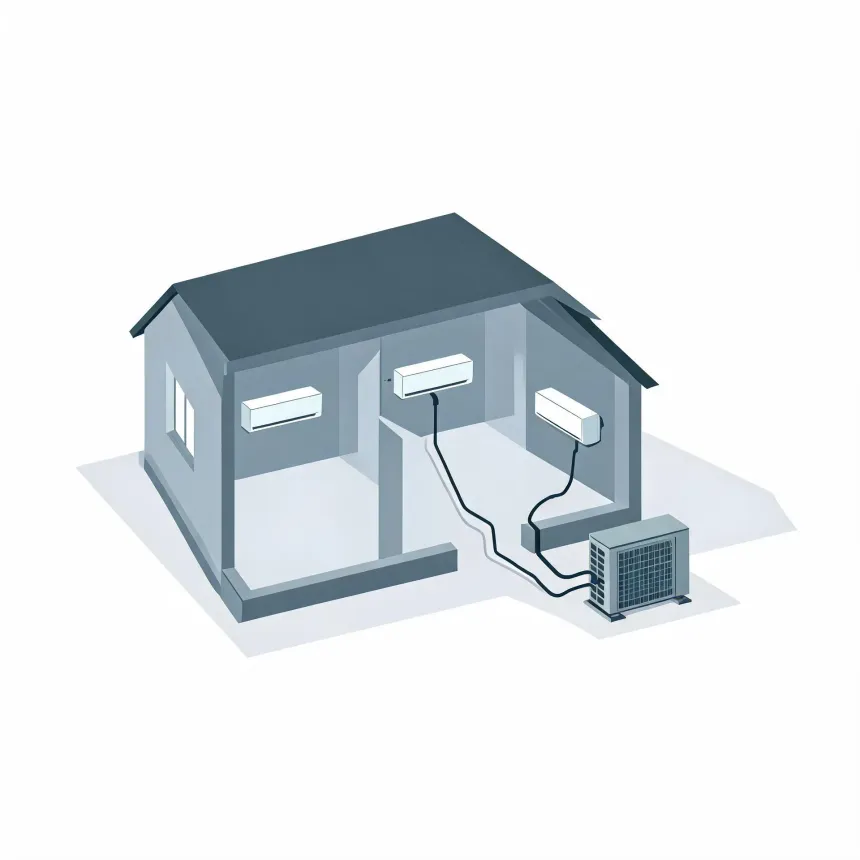
Isometric illustration of a cutaway single-story house with three wall-mounted indoor air conditioning units connected by lines to an outdoor condenser unit on the ground outside.
Your system heats October through April and cools June through September.

NOAA nClimDiv, 1991–2020 normals

The SEER2 number on the label is a ratio, not a size.

A higher rating means the compressor uses less power to move the same amount of heat, so systems cooling the same room can land on very different bills.

Most Talbot County homes already run on electricity

61.5% of homes heat with electricity
Cooling runs June through September
Summer afternoons average 86°F

Talbot County sits in climate zone 4A, a mixed zone. Summers ask real cooling work and winters ask real heating work, with humidity pushing against the system both ways. Any mini split installed here has to clear the federal minimum for split-system heat pumps. That's 14.3 SEER2 for cooling and 7.5 HSPF2 for heating, since the standard doesn't set a separate rule for ductless units. That number is a floor, not a ceiling. A unit that just clears it will cost more to run than one built well past it, and in a zone that works the system hard in both directions, that gap shows up all year.

Have it installed before June, not during it

Cooling starts in June here and runs through September. Installed in May, the system is tested and running on its own schedule before the first hot week, not pulled together in the middle of one.

Find a contractor
A man in a cap, dark long-sleeve shirt and tan work pants walks up wooden porch steps toward an orange front door, carrying a canvas tool tote; an orange planter with ornamental grass stands to the right.
A white outdoor air conditioner condenser unit mounted on metal wall brackets against gray horizontal siding, with a blue sky and white clouds behind it.

The unit is the easy part to price

What drives the cost has less to do with the unit than with what it takes to get refrigerant line from the outdoor compressor to the indoor head. A short, straight run through an exterior wall is the easy case. A run that has to travel between floors, around framing, or across a longer distance means more line set, more labor, and more places where a bad braze joint can leak refrigerant years later. Every indoor head needs its own line, so a system serving several rooms multiplies that work by however many heads it has. The electrical side matters too. A heat pump needs a dedicated circuit sized for it, and if the panel is already full, that circuit has to come from somewhere. Mounting plays into it as well. A wall-mounted head is the simplest job to hang. A ceiling cassette, or a concealed unit tied into any ducted sections, takes longer to set and level. None of this shows up on the label. Homes buying the identical unit can end up with very different jobs once a contractor sees the walls, the panel, and where the line actually has to run.

Sizing comes from a room, not a guess

A contractor works out heating and cooling load by looking at the square footage, the windows, the insulation, and which walls face outside. Rooms the same size can need different sized heads if one has more glass or catches more sun. Picking a unit off its tonnage alone skips that work.
Oversized fails differently than undersized

A mini split that's too big cools the room fast, shuts off, and starts again before it's pulled the moisture out of the air, so the room feels cool but damp. One that's too small runs constantly and never quite catches up on the hardest days. Right-sized is the one that runs long steady cycles and keeps up without straining.

Replacing a central system usually means dealing with what's already in the walls and the yard. An old ducted furnace or air handler gets disconnected and hauled out, and if nothing else is going to use that ductwork, it either gets capped off or torn out along with it. An old outdoor condenser gets unbolted from its pad, and the refrigerant inside has to be recovered first, not vented, since venting refrigerant is against the law. Old line sets usually aren't reused. They're sized and routed for the old equipment, and a new mini split runs its own line to each indoor head. If the old system ran on a fuel line, that gets capped by whoever handles that trade. None of this is the part that determines whether the new system works well. It just has to be cleared out of the way so the new line set, new wiring, and new heads have a clean path in.

Install day starts outside, with the compressor set on its pad and leveled, then moves to wherever each indoor head is going up. The installer mounts the bracket, drills through the wall for the line set, and runs refrigerant line, wiring and a condensate drain through that same opening. Once a head is hung and connected, the line gets pulled down to a vacuum before any refrigerant moves into it. That step matters more than it looks. Any moisture or air left in the line turns into a problem months later, not that day, so a contractor who skips it leaves something behind that only shows up as a slow loss of cooling down the road. After the vacuum holds, refrigerant is released into the line, the system gets powered up, and the installer checks that each head is actually pulling the temperature down and draining condensate the way it should before calling the job done.