A row of similar two-story houses with gray siding and dark shingled roofs stands behind a long white vinyl fence, with mown grass in the foreground and large trees behind.

Mini Split Installation in Elkton, MD

Tell us about the job

Takes about a minute. No obligation.

New system or replacementMini-splitCecil County, MD
Step 1 of 2

What ZIP code is the job in?

Electricity here runs 17.86 cents per kilowatt-hour

Maryland's electric rates are higher than most of the country, and a mini split draws power every time it cycles on. What a unit costs to run depends on how efficiently it turns that power into heat or cooled air.

Efficiency rating is worth comparing

Two mini splits can heat or cool the same room and use different amounts of power doing it. At Maryland's rates, that difference shows up on every bill, not just the first one.

7 months
October through April, your system heats
4 months
June through September, it cools
27°F
the average winter night it heats against
85°F
the average summer afternoon it cools against
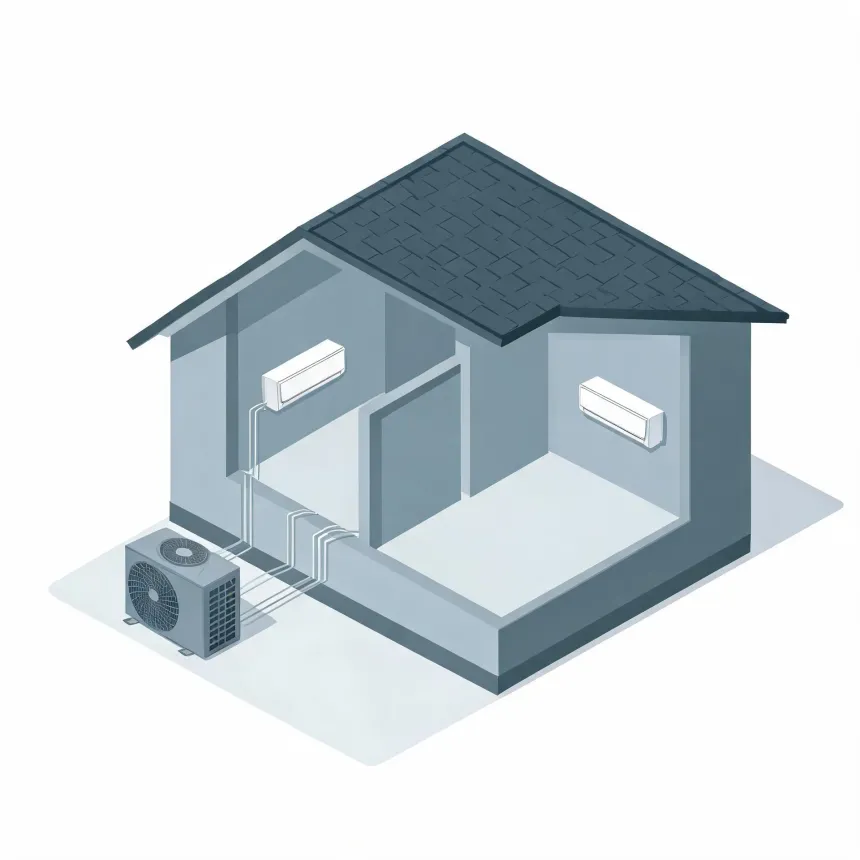
Isometric cutaway illustration of a small house showing two wall-mounted indoor air conditioning units connected by refrigerant lines to an outdoor condenser unit on the ground outside.
Your system heats October through April and cools June through September.

NOAA nClimDiv, 1991–2020 normals

Cecil County logged 175 damaging wind events and 8 winter storms over the past decade.

A mini split mounted and wired the way the manufacturer specifies holds up through that without special equipment.

May is the month to put in a mini split, before June asks it to work

Cooling runs June through September
Summer afternoons average 85°F
175 damaging wind events from 2015 to 2024

No single fuel dominates heating in Cecil County. Electricity leads at 39.4 percent, then LP gas, then fuel oil, then utility gas close behind. That spread means a lot of homes here already run some kind of electric system, whether it's baseboard heat, a heat pump, or electric furnace backup. A mini split fits into that picture without asking for a gas line or an oil tank. For a home already on electric heat, swapping in a mini split is mostly a matter of where to mount the indoor units and running the line set to an outdoor compressor.

A standard mini split is the right call here

Cooling runs about four months a year in Cecil County, with afternoon highs averaging 85°F through the summer. That's real work, but it's not extreme work. A properly sized mini split at a standard efficiency rating handles it without needing an oversized unit or a premium model to keep up.

Find a contractor
A beige split-system air conditioner outdoor condenser unit mounted on metal wall brackets atop a stucco wall.

What happens to the unit being replaced

Whatever is being replaced keeps running right up until the day the new system goes in. Shutting off heat or cooling isn't an option while the work gets done, so the old compressor often logs its last cycles the same week it comes out. Once it's disconnected, it's scrap. A compressor that has spent years cycling on and off doesn't get a second life in another home. For a mini split, removal usually means unmounting the indoor head and the outdoor compressor without touching anything else serving the house, since each zone runs its own dedicated line. The refrigerant in those lines has to be recovered, not vented, which is one reason this job goes to a licensed contractor. Before the old unit comes off the wall, it's worth checking whether the line set or the mounting bracket is still sound. If it is, the new unit may be able to use it instead of starting from bare wall.

The rating measures one thing

The efficiency rating on a mini split tells you how much heat it moves per unit of power it draws. It says nothing about how big a room it can handle or how well it was installed. A high rating on a unit that's the wrong size for the room, or hung with a line set that's kinked or undercharged, won't deliver the number on the label.

Compare the rating, not just the price tag

Mini splits that look nearly identical on the showroom floor can carry different ratings, and the one with the higher rating usually costs more up front. That gap shows up in the power draw every time the compressor cycles on, for as long as the system runs. Whether the higher rating is worth the extra cost depends on how much the system actually runs, which is worth weighing against the install cost rather than assuming the premium model always wins out.

A mini split installation isn't one price point, because it isn't one job. Mounting a single indoor head on an exterior wall near the planned compressor location is straightforward work. Running a line set up through a floor, around a chimney chase, or out to a compressor placed well away from the house because of setback rules adds labor the simple job never sees. Electrical matters too. If a dedicated circuit is already in place and the panel has room, hookup is quick. If the panel is full or a circuit has to be added, that's its own piece of work before the mini split itself goes in. A multi-zone system adds another layer, since every indoor head needs its own line set run back to the outdoor unit, so more zones means more penetrations through the wall and more refrigerant line to set and insulate. None of this shows up in a brochure price for the equipment. It shows up once someone's looked at the walls, the panel, and where the compressor has to sit.

The crew starts outside, picking the compressor spot and the wall location for each indoor head before anything gets mounted. A hole gets drilled through the exterior wall for the line set, sized for the refrigerant lines, the wiring, and the drain. The line set connects the indoor head to the outdoor compressor, gets evacuated to pull out moisture and air, then charged with refrigerant once everything's sealed. The indoor head mounts to a bracket on the wall, not directly to it, so it can come off again for cleaning without redoing the whole installation. Once the compressor's set on its pad and the electrical hookup is finished, the system gets tested running both heat and cooling before anyone calls it done. A single zone can wrap up in a day. A multi-zone system with several indoor heads and line sets takes longer, since every one of those gets run and sealed on its own.