A gray tabby cat sleeps curled up on a dark gray bed in a dimly lit modern bedroom with warm ceiling cove lighting and a wall-mounted air conditioning unit.

Mini Split Installation in Frederick, MD

Tell us about the job

Takes about a minute. No obligation.

New system or replacementMini-splitFrederick County, MD
Step 1 of 2

What ZIP code is the job in?

Electricity here runs 17.86 cents a kilowatthour

Maryland households paid that rate in 2024. A mini split that moves heat instead of generating it costs less to run than baseboard or resistance heat at that price, and the gap shows up every month the system runs.

Efficiency is worth paying for in Frederick

When you're comparing units for this job, the efficiency rating matters more here than it would somewhere with cheaper power. A higher rated system costs more up front but the difference on your bill keeps paying you back for as long as you run it.

7 months
October through April, your system heats
4 months
June through September, it cools
26°F
the average winter night it heats against
84°F
the average summer afternoon it cools against
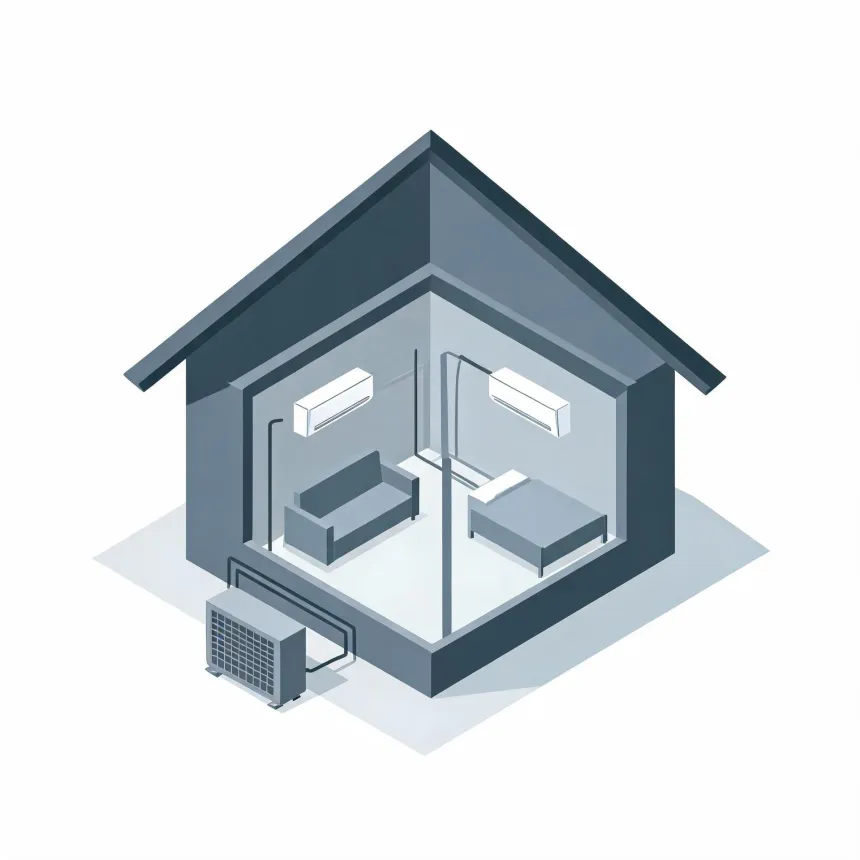
Isometric cutaway illustration of a small gray house showing two rooms, one with a sofa and one with a bed, each with a wall-mounted indoor air conditioning unit connected by line sets to an outdoor condenser unit on the ground outside.
Your system heats October through April and cools June through September.

NOAA nClimDiv, 1991–2020 normals

A mini split sized too big cools the room fast and shuts off before it pulls the moisture out of the air.

The room feels clammy no matter how low you set it, so the installer has to work out the load room by room, not guess from square footage.

May is the month to put this in, before June asks it to work

Cooling runs June through September
Summer afternoons average 84°F
276 damaging wind events from 2015 to 2024

Electricity heats 51.2% of homes in Frederick County, more than any other fuel. Utility gas is next at 33.8%, then fuel oil at 8.3%. A mini split fits an electric home without the rewiring or gas line work a switch in fuel would need. If your house already runs on electric heat, baseboard or a heat pump, the mini split just takes over that job with a lot less waste. Homes still on oil or gas can add one too, usually to a room or addition the main system doesn't reach well.

In zone 4A, a mini split has to clear 14.3 SEER2 and 7.5 HSPF2

Frederick County falls in climate zone 4A, which asks real work of both heating and cooling. Any mini split installed here, since it counts as a split-system heat pump under the federal standard, has to meet at least 14.3 SEER2 for cooling and 7.5 HSPF2 for heating. That sets the floor for what an installer can put in. A federal tax credit is available for qualifying equipment, on top of whatever the efficiency saves on your bill.

Find a contractor
A white outdoor air conditioner condenser unit mounted on metal wall brackets against gray horizontal siding, with a blue sky and white clouds behind it.

The old system doesn't have to go anywhere

Whatever is heating and cooling the space now doesn't have to come out. If it's a window unit or electric baseboard, it can usually stay in place and keep working, or get pulled later on its own schedule. The mini split doesn't need the old system gone to go in, since the indoor head and the line set run independent of whatever's already there. If the old equipment is a furnace or boiler tied into ductwork elsewhere in the house, that system keeps running too. The mini split just takes over the room it's installed in. Nothing about adding one forces a decision about the rest of the house before it's ready to be made.

Ask what each contractor's quote actually includes

One bid might cover just the indoor head and outdoor unit. Another might include the line set, the electrical whip, a disconnect box, and the condensate drain. Get a list of what's in the number before comparing numbers. A lower bid that leaves out the mounting bracket or the pad for the outdoor unit isn't actually lower.

Ask how they arrived at the size

A contractor who sizes off a room's square footage alone is guessing. The real load depends on the windows, the ceiling height, which way the room faces, and what's on the other side of its walls. Ask what they measured and what they're basing the unit size on. If the answer is just a number per square foot, keep asking.

What drives the cost on one of these jobs is mostly the distance between the indoor head and the outdoor unit, and what's in the way. A short, straight line set through an exterior wall is the easy case. Run it up through a second floor, around corners, or across a long stretch of siding, and that's more refrigerant line, more mounting hardware, and more time on the ladder. The electrical work matters too. A dedicated circuit back to the panel is a different job depending on how far the panel is and whether there's room left in it. Multi-zone systems, where one outdoor unit feeds several indoor heads, cost more than a single zone because the outdoor unit has to be sized for all of them and each head needs its own line set and drain run. None of this shows up on a tape measure of the room. It shows up when the installer walks the house and figures out where the lines actually have to go.

Installation day starts with the walk the installer already did on the estimate visit, so the crew shows up knowing where the lines run and where the outdoor unit sits. The indoor head gets mounted first, usually high on an interior wall, with a small hole drilled through to the outside for the line set, the drain, and the wiring to pass together. Outside, the condenser sits on a pad or wall brackets, leveled so condensate drains the way it should and nothing vibrates loose later. The refrigerant lines get connected, then the whole system gets evacuated with a vacuum pump to pull out air and moisture before any refrigerant moves through it. That step matters more than anything else that day. A line charged with moisture still in it will corrode from the inside, and that failure doesn't show up for months. Once the vacuum holds and the charge is set, the installer runs it, checks the temperature split between the air going in and the air coming out, and confirms the drain actually carries water away instead of pooling.