





A row of illuminated white colonial houses photographed at twilight along a tree-lined road with a stone wall in the foreground.

Mini Split Installation in Hagerstown, MD

Tell us about the job

Takes about a minute. No obligation.

New system or replacementMini-splitWashington County, MD
Step 1 of 2

What ZIP code is the job in?

Maryland electricity ran 17.86 cents per kilowatt-hour in 2024. That's the rate a mini split is working against every time it cycles on. A mini split handles both heating and cooling, so it's drawing power across most of the year, not just a few months. The efficiency printed on its label only holds if the unit is sized right for the room and installed with a correct charge. A unit too big or too small for the space won't hit those numbers, no matter what the label says.

7 months
October through April, your system heats
3 months
June through August, it cools
25°F
the average winter night it heats against
85°F
the average summer afternoon it cools against
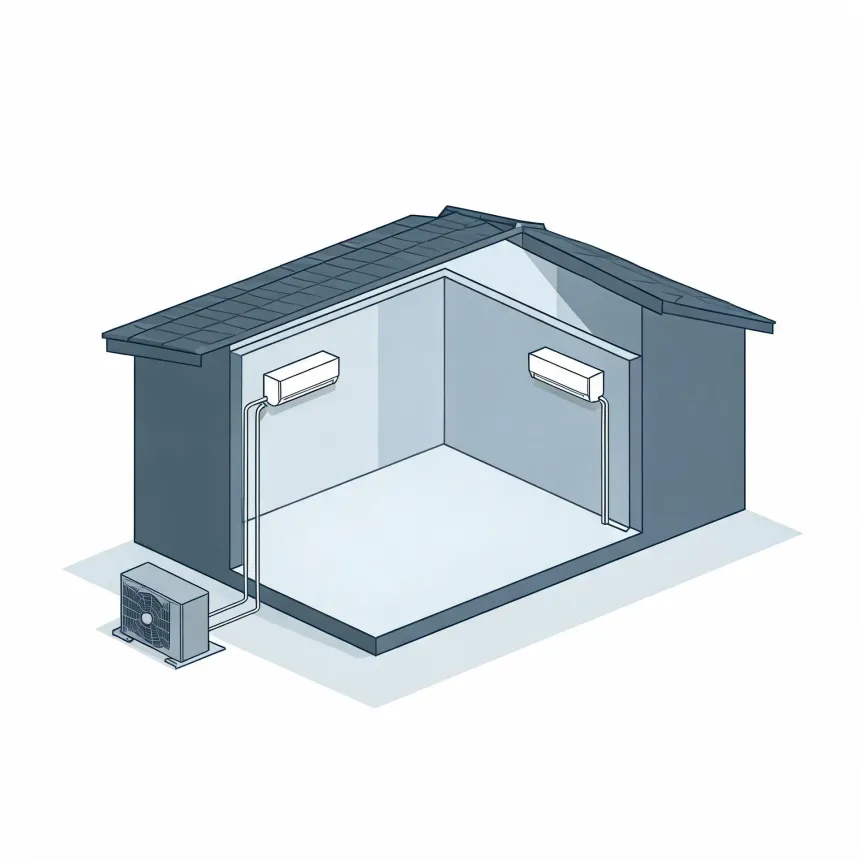
Cutaway isometric illustration of a small building interior showing two wall-mounted indoor air conditioning units connected by line sets running down to a single outdoor condenser unit on the ground outside.
Your system heats October through April and cools June through August.

NOAA nClimDiv, 1991–2020 normals

Cooling runs June through August here.

May is the month to have the new system in and running, not the month to start shopping for it.

Pick the efficiency rating that holds, since you're the one paying 17.86 cents a kWh to find out

Power costs 17.86 cents a kWh statewide
Cooling runs June through August
Summer afternoons average 85°F
A standard mini split fits this countyCooling runs June through August here, with afternoons near 85.

Electricity heats 54.1% of homes in Washington County, more than gas, oil and propane combined. Fuel oil accounts for 15.8%, utility gas for 20.8%. A mini split fits naturally where electric heat is already the norm, since it runs on the same fuel the house already uses. Swapping electric baseboard or an electric furnace for a mini split doesn't mean adding a new fuel line or rethinking how the home is set up. It means replacing one electric system with a more efficient one.

Efficiency pays here

Power costs more here, so an efficient system pays you back on every bill.

Find a contractor
A white mini-split air conditioner outdoor condenser unit mounted on metal brackets against a beige stucco exterior wall, with a blue sky and scattered clouds in the background.

What you're really paying for

What the installer has to do changes the price more than the equipment does. Every mini split needs a line set running between the outdoor unit and the indoor head, carrying refrigerant, a drain line, and a power run. A short, straight path through an exterior wall costs less labor than a run that has to go up through an attic, across a chase, or around framing to reach the spot that makes sense for the room. More indoor heads means more line sets, more mounting work, and more time charging each one to the right level. The outdoor unit's location matters too. It needs clearance for airflow and a surface that can hold its weight and dampen vibration, and getting it there sometimes takes more than setting it on the ground. None of this shows up on the spec sheet. It shows up in how long the job takes.

How many zones, and what controls each one

One outdoor unit can run several indoor heads, each with its own thermostat. Ask whether a room is getting its own zone or sharing one with another space. Rooms on the same zone hold one temperature together, so a sunny room and a shaded one on the same line will fight each other.
What happens if one part fails later

Ask whether the indoor heads are matched to that specific outdoor unit or sold as a wider lineup. Some manufacturers let you add or swap a head years later. Others tie the whole system to the exact combination installed on day one, so a failed head means matching discontinued parts instead of a straightforward swap.

The old system doesn't need to come out before the new one goes in. Most installers pull it once the mini split is mounted, charged, and running, so there's no gap without heat or cooling. If it's a window unit or electric baseboard, it unplugs or unwires and goes. If it's a ducted system tied to a furnace, the ductwork can sometimes stay for a secondary zone or get capped off and abandoned, depending on what the rest of the house still needs. Refrigerant in the old outdoor unit has to be recovered properly, not vented, so that part of the removal follows the same rules as any AC teardown. None of this changes how the mini split itself gets installed.

Sizing a mini split comes down to matching the unit's output to the heat gain and heat loss of the specific room, not the square footage alone. A room with west-facing windows holds heat differently than one with none, and a vaulted ceiling changes the math too. Too big and the unit short cycles, reaching the thermostat setting fast and shutting off before it finishes pulling moisture out of the air, so the room feels cool but damp. Too small and it runs flat out on the hottest and coldest days and never quite catches up. The manufacturer's sizing chart is a starting point, not the answer. A contractor works out the actual load room by room, accounting for insulation, window area, and ceiling height, then picks the head that matches what that room needs rather than rounding up for safety.