




A row of small single-story houses with gray shingled roofs and light siding behind a white picket fence, with mown lawns and leafy trees.

Mini Split Installation in La Plata, MD

Tell us about the job

Takes about a minute. No obligation.

New system or replacementMini-splitCharles County, MD
Step 1 of 2

What ZIP code is the job in?

Maryland homes paid 17.86 cents per kilowatt-hour in 2024, and that rate applies every time a mini split cycles on. These systems run on electricity, so how efficiently one moves heat or cold decides what it costs you to run. A unit with a higher SEER2 rating uses less power to do the same job. At Maryland's rates, that difference shows up on the bill month after month. Ask what SEER2 rating you're being quoted before comparing two systems on price alone.

7 months
October through April, your system heats
4 months
June through September, it cools
29°F
the average winter night it heats against
86°F
the average summer afternoon it cools against
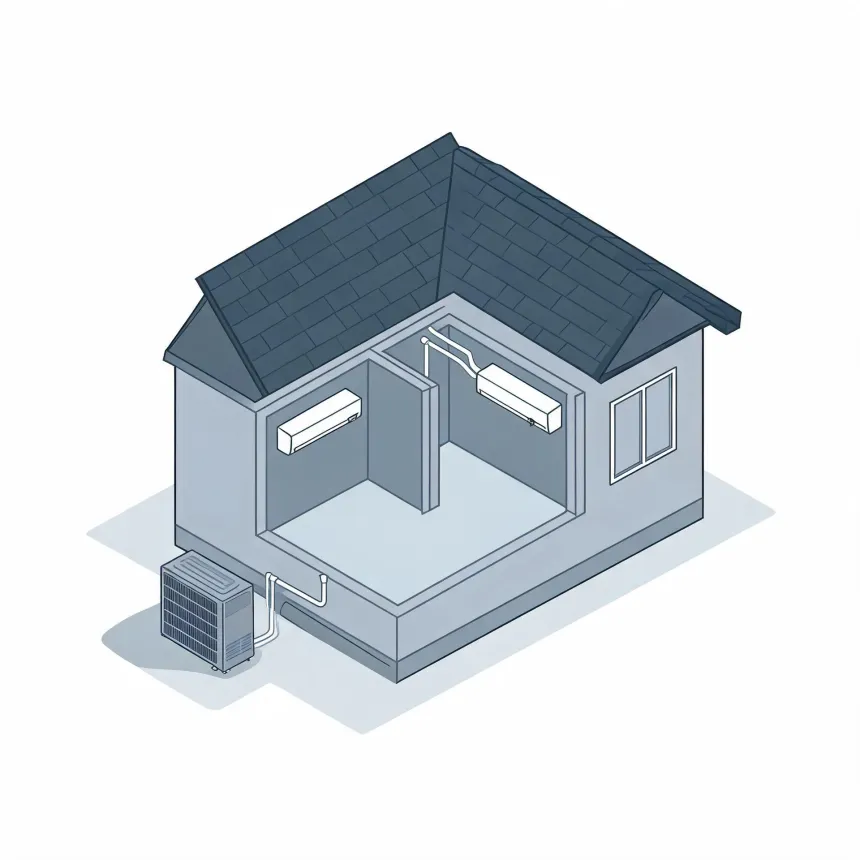
Isometric line illustration of a cutaway house with a shingled gable roof, showing two wall-mounted indoor air conditioning units connected by piping to an outdoor condenser unit on the ground outside.
Your system heats October through April and cools June through September.

NOAA nClimDiv, 1991–2020 normals

La Plata gets a real summer and a real winter, zone 4A, humid enough that both seasons ask something of the system.

A standard mini split built for this zone handles both without needing to be oversized.

230 severe weather events, and a standard system still holds up

230 severe weather events from 2015 to 2024
11% of homes statewide lost power a day or more in 2024
188 damaging wind events from 2015 to 2024

Charles County falls in climate zone 4A, which asks real work of a system in both directions. Any mini split installed here is a split system under federal rules, so it has to clear 14.3 SEER2 for cooling and 7.5 HSPF2 for heating. That floor applies whether you're adding one zone or replacing a whole system. Ask what SEER2 and HSPF2 a quoted unit carries and check it against those minimums before you compare prices.

Get it installed before June, not after

Cooling here starts in June and runs through September. Have a mini split installed before May closes out and it's running on the first hot day, not the first day it's possible to get someone out.

Find a contractor
A white mini-split air conditioner outdoor condenser unit mounted on metal brackets against a beige stucco exterior wall, with a blue sky and scattered clouds in the background.

The rating is a season, not a moment

SEER2 and HSPF2 are not a reading off one hot afternoon or one cold morning. The rating is an average built from a system running all year, cycling lightly in mild weather and working hard on the extremes. A mini split only earns that number if it's sized right for the room it's heating or cooling and kept clean. A clogged filter or a dirty outdoor coil makes the unit work harder to move the same amount of heat, and the system stops performing at the number on its label. Low refrigerant charge does the same thing. The unit runs longer to do the same job, no matter what rating it carries.

The old system has to come out first

A mini split installation includes removing what's there now. If the old system used ducts, those stay or go depending on whether the new mini split replaces the whole setup or adds to it. If it's another mini split being swapped out, the old indoor head, outdoor unit, and the line set running between them all come down before the new one goes up.
Refrigerant has to be recovered, not vented

The refrigerant in the old system can't just be released into the air. A tech has to recover it into a tank with the right equipment before disconnecting anything. This is a legal requirement, not an optional step, and it's part of why removal takes real time on install day, not just the hours spent mounting the new unit.

Sizing a mini split comes down to matching the unit's output to the heat gain and heat loss of the room it's serving, not the square footage alone. A tech works this out with a load calculation, which weighs the room's windows, its insulation, which way it faces, and what's generating heat inside it. Skip that step and guess by floor area instead, and the unit is almost always wrong for the space. Oversized, it cools the room fast and shuts off before it pulls the moisture out of the air, so the room feels cold and clammy at once. Undersized, it runs constantly and never quite reaches the temperature on the thermostat, especially on the hottest or coldest days. Either way the unit cycles more than it should, and more cycling means more wear on the compressor. The right size runs longer, steadier stretches, which is what keeps the room comfortable and the equipment lasting.

Install day starts with the line set, the copper tubing that carries refrigerant between the outdoor unit and each indoor head. A tech runs it through a small hole drilled in the wall, usually behind where the indoor unit will hang, and insulates it along the way so it doesn't sweat inside the wall cavity. Before any refrigerant moves, the whole line set gets pulled down to a vacuum, pulling out the air and moisture that would otherwise mix with the refrigerant and cause the compressor to fail early. That vacuum has to hold for a set stretch before the system gets charged, which is the part of the day that takes patience more than muscle. Once the indoor head is mounted level and the outdoor unit is set on its pad or brackets, the tech charges the line, tests each zone for heating and cooling, and checks that the condensate drain actually drains before calling it done.