Electricity here runs 17.86 cents per kilowatt-hour
Maryland households paid that rate in 2024. A mini split that moves heat instead of generating it uses less power to do the same job, and that difference shows up every month.

Takes about a minute. No obligation.
Maryland households paid that rate in 2024. A mini split that moves heat instead of generating it uses less power to do the same job, and that difference shows up every month.
A mini split installed here will likely handle both your summer cooling and part of your winter heating. The more hours it runs, the more a higher efficiency rating is worth to you over a standard unit.
NOAA nClimDiv, 1991–2020 normals
A mini split sized too big will short cycle, kicking on and off before it pulls the moisture out of the air.
The right size comes from a load calculation on the room, not a guess based on square footage alone.



Electricity heats 63.7% of homes in Worcester County, more than any other fuel. A mini split fits an electric home better than it fits most, since it runs on the same power already feeding the house. There's no gas line to tie into and no oil tank to work around. For a home already heating with electric baseboard or an electric furnace, a mini split takes over that job and does it for less, since it moves heat instead of generating it with resistance coils.
Worcester County sits in climate zone 4A, humid enough to ask real work of both heating and cooling. Federal rules set the floor for what can go in. A mini split has to clear 14.3 SEER2 for cooling and 7.5 HSPF2 for heating, the same minimums as any other split system. A federal tax credit is available toward a qualifying system.
Find a contractor
Whatever is being replaced doesn't just unplug. If it's a window unit or a through-wall sleeve, that gets pulled and the opening gets dealt with, patched or capped so the wall is weathertight again. If it's an electric baseboard system, the old heaters usually come out once the mini split is handling the load, and that frees up wall space the baseboards used to take. Ducted systems are a different case. If there's an old central air unit or an electric furnace with ductwork already in the walls, a contractor will look at whether that ductwork stays in use for part of the home or gets abandoned once the mini split takes over. None of that old equipment has to fail first. A system can still be running fine and still be worth replacing, if it's drawing more power than a mini split would to do the same job. The compressor and coil on the outdoor unit, and the line set running to each indoor head, are what get hauled away. Refrigerant in the old system gets recovered, not vented, since it's not something a contractor is allowed to release into the air.
SEER2 rates how the system cools, HSPF2 rates how it heats, and a mini split carries both because it does both jobs. A unit can be strong on one and only average on the other. Weigh each rating against what you'll actually ask the system to do, not just whichever number looks better on the label.
A mini split earns its efficiency rating in lab testing with the system properly matched and charged. An oversized indoor unit, a refrigerant charge that's off, or a line set run longer than it should be will all pull real performance below what's printed on the label. The rating is what the system is capable of, not what it's guaranteed to deliver.
Ask how many indoor heads the system is running and what each room's load calculation came out to, not just the total the outdoor unit is rated for. A single outdoor condenser can feed more than one indoor head, and if it does, it's sized for all of them combined, not any one room on its own. Ask what happens if one zone calls for heat while another calls for cooling, since not every system can do both at the same time. Ask about the line set, how far it runs and how many bends it takes to get there, because a longer or tighter run changes how the system performs against its rating. Ask what happens to the old equipment, whether it's hauled away and whether the refrigerant in it gets recovered properly. A contractor who answers these without hesitation has done this before.
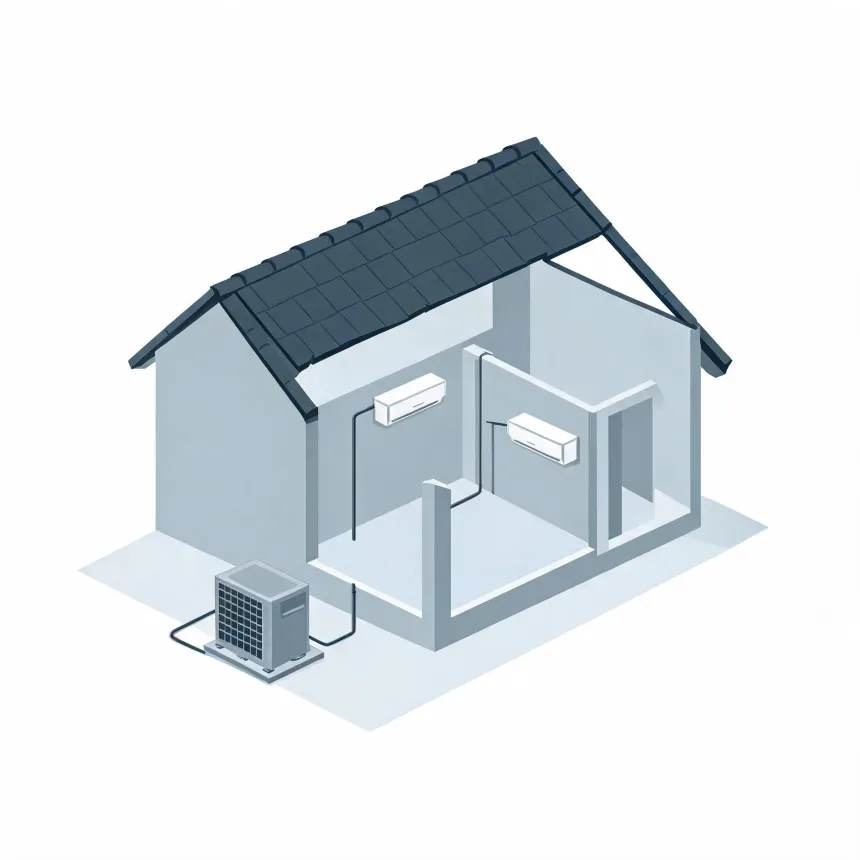
The indoor head goes up first, mounted high on the wall or ceiling on a bracket, with a small hole drilled through to the outside for the line set to pass through. That line set carries refrigerant lines, a drain line and wiring together, usually wrapped in a single insulated bundle so only one penetration is needed in the wall. Outside, the condenser sits on a pad or wall bracket, away from the house long enough for airflow but close enough to keep the line run short. Once the lines are connected, the system gets evacuated with a vacuum pump to pull out air and moisture before refrigerant is released into the lines, since either one left behind will cause problems later. The contractor then checks refrigerant charge against the line length and runs the system in both heating and cooling to confirm each head is doing its job. A clean installation leaves one neat line set running to each indoor head, not a tangle of exposed tubing across the siding.