Maryland electricity isn't cheap
Electricity in Maryland ran 17.86 cents per kilowatthour in 2024. A mini split that runs efficiently matters more here than it would somewhere power costs less.

Takes about a minute. No obligation.
Electricity in Maryland ran 17.86 cents per kilowatthour in 2024. A mini split that runs efficiently matters more here than it would somewhere power costs less.
A mini split earns its keep on the electric bill, not just on comfort. When you're comparing systems for Westminster, the efficiency rating is worth as much attention as the price tag.
NOAA nClimDiv, 1991–2020 normals
Westminster homes run cooling June through August.
May is the month to get a mini split installed, before the heat makes it urgent.




Electricity heats 50.4% of homes in Carroll County, more than any other fuel. A mini split fits right into a home already wired for electric heat, no gas line or oil tank to work around. If your furnace runs on oil or gas, the mini split still works off your electric panel, separate from that system. Either way, you're adding to a load most homes here already carry.
Carroll County falls under zone 4A, and any split-system heat pump manufactured from 2023 on has to clear 14.3 SEER2 for cooling and 7.5 HSPF2 for heating to be sold here, ductless units included. That floor is already built into what a contractor can install for you. On top of that, a federal tax credit is available for qualifying heat pump installations. Get the efficiency details for your home before you decide what to put in.
Find a contractor
Whatever is heating and cooling the space now doesn't just vanish when the new unit goes in. If it's a window unit or an older ductless system, a contractor will disconnect it and haul it away, refrigerant and all, rather than leave it for the homeowner to deal with. If what's there now is a furnace or boiler handling the load, that system usually stays in place rather than coming out. A mini split doesn't have to replace your existing heat, it can run alongside it, covering the rooms it's installed in while the old system still handles the rest. Some homeowners run both for years, switching between them depending on the season. Others phase the old system out room by room as more mini split heads go in. Either way, nothing about adding one forces a decision on the other right away.
A mini split system can run one indoor head or several off the same outdoor unit. Ask how many zones the quote covers and whether each room with a head gets its own thermostat control. A single zone set in the wrong room will leave the rest of the house arguing with it.
Every heat pump loses some capacity as the temperature drops outside. Ask what the unit is rated to do at the lowest temperature this area actually sees, not just its average performance. A system that quietly falls back on backup heat at the coldest point of the year isn't carrying the load alone, even if the spec sheet looks good.
What drives the price of an installation comes down to how much work it takes to get refrigerant lines from the outdoor unit to each indoor head. A single zone tucked near an exterior wall is a straightforward run. Add zones, add distance, or route lines through finished walls and framing, and the labor climbs before the equipment cost even enters the picture. The condenser pad, the electrical disconnect, and whether the panel has room for another circuit all factor in too. Capacity matters as much as any of that. A unit sized to actually cover the square footage and the ceiling height of the room costs more than one that's undersized and struggling, but the undersized one will run constantly and still fall short on the coldest or hottest days.
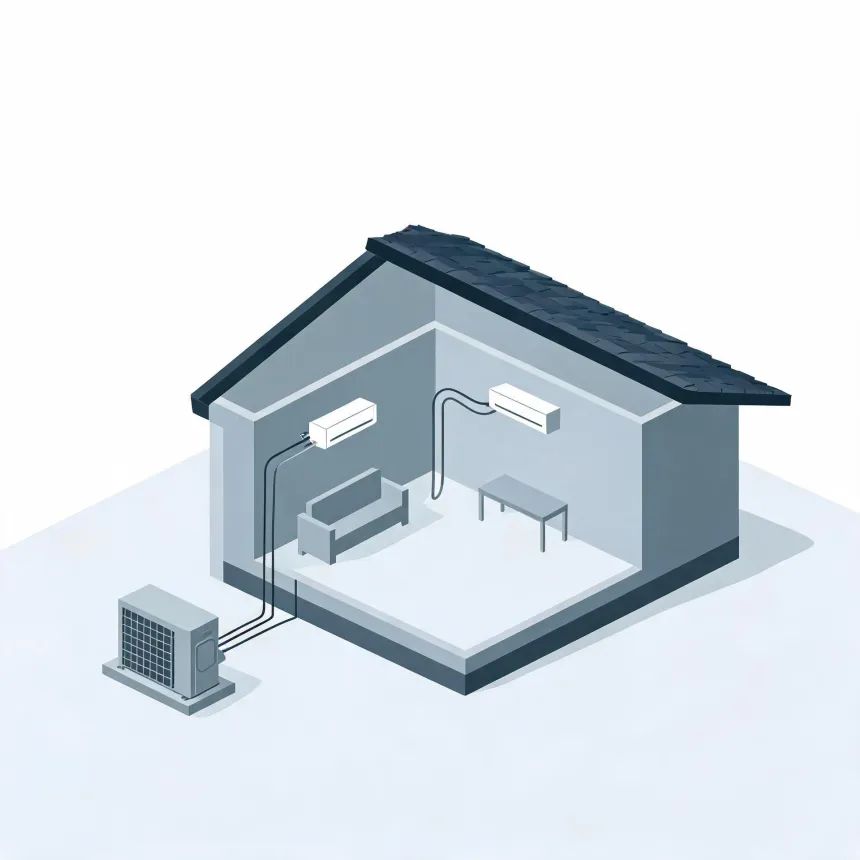
Installation starts outside with the outdoor unit. A contractor sets it on a pad or mounts it on brackets, somewhere with clear airflow on all sides and a short path to the indoor heads. Then come the refrigerant lines, run through a wall from that outdoor unit to each indoor head, usually through a hole no bigger than a few inches across. The indoor head mounts high on the wall and gets connected to the lines and the condensate drain. Before any refrigerant moves through the lines, the whole circuit gets pulled into a vacuum. A contractor checks that it holds, because any moisture or air left behind causes problems later. Once the lines are charged and the electrical hookup is tied in, the system gets powered up and tested on both heating and cooling, with the temperature checked at each head before anyone calls it done.