When to replace a heat pump in Gaithersburg, MD

Your new heat pump project goes to an installer who works in Montgomery County.

Find a heat pump pro

Most heat pumps last 10 to 15 years, and age is the main thing to weigh here. Once a system passes that mark, parts wear out faster than they're worth fixing, and a Gaithersburg winter will find the weak spot. Your heat pump works harder here than it would in a mild climate, since it's pulling double duty: cooling the house through sticky summers and warming it through cold winters, with no furnace backup in most homes. If yours is struggling to keep up on the coldest nights, running constantly, or needing repairs most years, replacing it usually makes more sense than continuing to patch it. A unit still under 10 years old and running fine is worth keeping. One past 15, especially if it's started icing over or short-cycling, is on borrowed time. The decision usually comes down to how old it is and how much trouble it's already giving you.

An older man with gray hair and a beard, wearing a dark jacket dusted with snow, stands smiling in a dimly lit hallway with lamps and a living room visible behind him.
A gray-haired, bearded man in a dark snow-dusted coat stands smiling in a dimly lit entry hall with a staircase, a lit table lamp, a framed picture, and a living room visible through a doorway.
An older man with white hair and a beard, wearing a dark snow-dusted coat and scarf, stands in a warmly lit interior hallway with a framed landscape picture, a table lamp and a potted plant behind him, and a snowy view through a window at left.
A gray-haired, bearded man in a dark coat dusted with snow stands smiling in a dimly lit room with a lamp, mirror, framed art, and a sofa in the background.

What does your heat pump have to put up with here?

  • Winter nights average 27°F

    Winter nights average 27°F. That's below freezing for hours at a stretch, and a heat pump past its prime struggles to keep pulling warmth from air that cold.

  • Heat runs October through April

    Heat runs October through April, seven months of the year. An aging system doesn't get much rest, which means more hours racking up wear on worn-out parts.

  • Cooling runs June through September

    Cooling runs June through September, four more months of steady work. Between the two, a heat pump here is running most of the year with barely a break.

NOAA nClimDiv 1991-2020

Your heat pump is 8 years old and still keeping up, the house stays warm down to the coldest nights, and the power bill hasn't jumped. A unit running like that has years left in it, and there's no reason to replace it early.

Your heat pump is 13 years old, the auxiliary heat kicks in more than it used to, and last winter it couldn't keep the house above 65°F on the coldest nights. That's a system near the end, not one worth another repair bill.

A woman with hair in a bun sits wrapped in a thick cream blanket in an armchair, an open book in front of her, beside a lit lamp and a frosted window.
A woman in a cream knit sweater sits with closed eyes in an armchair beside a window showing orange autumn foliage, with a mug and plate of cookies on a small side table.

Your heat pump doesn't make heat the way a furnace does. It pulls warmth out of the outside air and moves it inside, which still works even when it's 27°F outside, just with more effort. When the outdoor coil frosts over, the system flips into a defrost cycle for a few minutes, melting the ice before it goes back to heating. That switching depends on the reversing valve, and once that part starts to go, the system can get stuck heating or stuck cooling with no way back. The compressor is doing the real work here, and the colder it gets, the harder it runs, which is why an older unit's power draw creeps up every winter. If the outdoor unit can't keep pace on the coldest nights, backup heat strips take over, and a system that needs them often isn't pulling its weight anymore. Even a small refrigerant leak adds up over the years, forcing the compressor to run longer just to hold the house at the same temperature.

How your heat pump works in winter

  • A heat pump moves heat instead of burning fuel, so the outdoor unit still pulls warmth from the air even at 27°F.
  • Below freezing, the outdoor coil frosts up and the system runs a defrost cycle, reversing itself for a few minutes every so often to melt the ice.
  • An aging reversing valve is what usually fails first, and when it sticks the system gets stuck in one mode and stops switching between heat and cool.
  • The compressor works harder for every degree below freezing, so a unit nearing 10 to 15 years old draws more power just to hold the same indoor temperature.
  • Auxiliary heat strips kick in when the outdoor unit can't keep up alone, and a heat pump that leans on them constantly is losing its edge.
  • Refrigerant charge drops slowly through small leaks over the years, and a low charge makes the compressor run longer to move the same amount of heat.
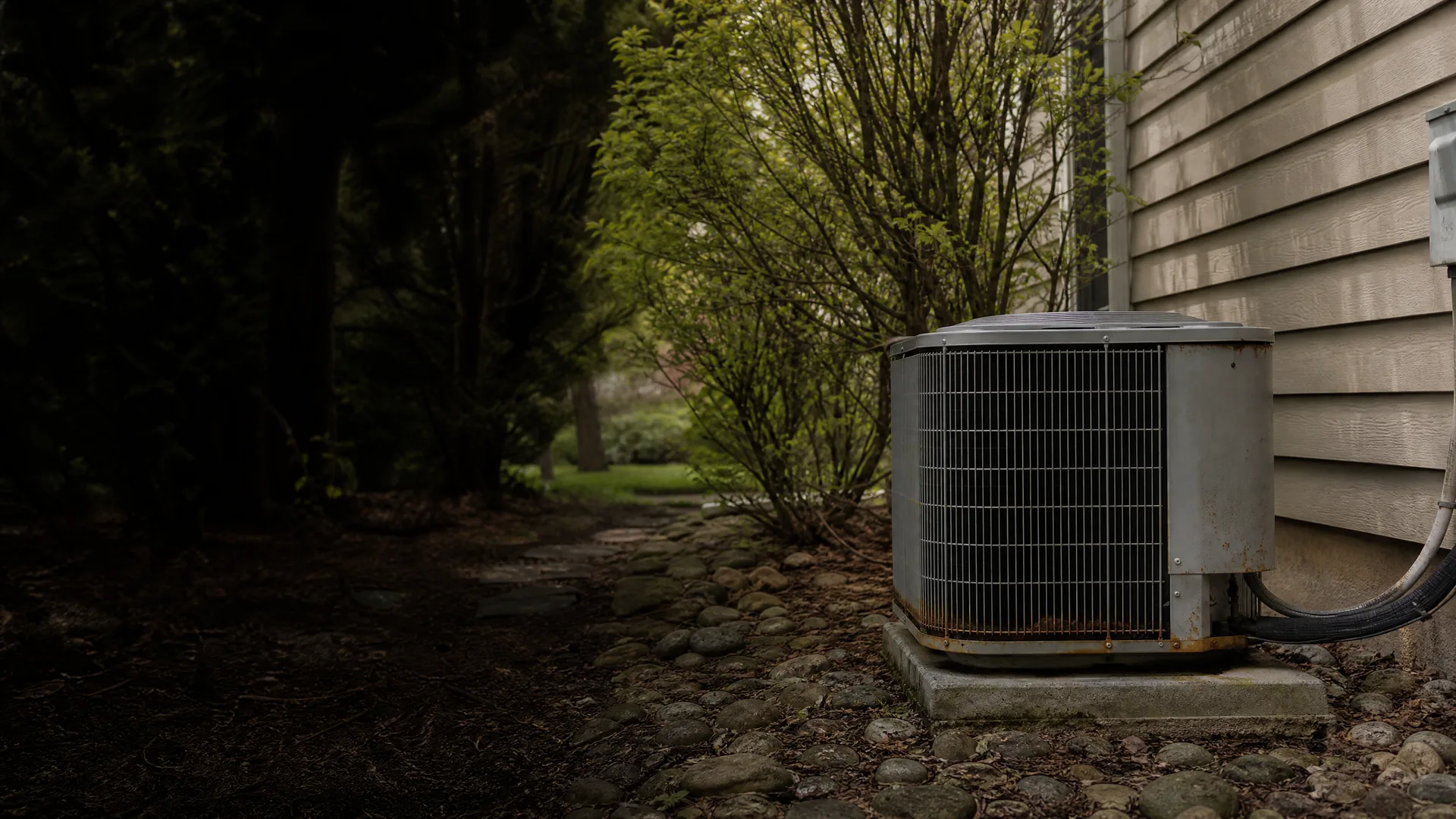
A weathered gray outdoor condenser unit sits on a concrete pad beside a house with horizontal siding, with refrigerant lines entering the wall at left and a mulched shrub bed at right.
Before you get your heat pump installation
A gray outdoor condenser unit on a concrete pad beside a house with gray lap siding, connected by conduit and refrigerant lines to a wall-mounted disconnect box, with a green shrub and mulch bed at left.
After you get your heat pump installation

Get matched with a heat pump pro in Montgomery County

Send the form and stop researching installers for the new heat pump.

You're not committing to anything by asking.

A gray outdoor air conditioner or heat pump unit on a concrete pad beside a house with horizontal lap siding, with conduit and refrigerant lines running up the wall and green shrubs and mulch at left.

Running the way it should

The outdoor unit sits level on its pad, lines running clean into the house. No ice building up where it shouldn't, no strain in the sound it makes. A heat pump in this shape is still pulling its weight, even on the coldest nights.

An outdoor air conditioning condenser unit sits on a concrete pad beside a white horizontal-siding house, with a gray electrical disconnect box and insulated refrigerant lines on the wall, mulch and green shrubs to the right, and a concrete slab in the foreground.

Showing its age

Weathered cabinet, corroded fins, conduit patched over the years. A unit that looks like this has likely seen more winters than it has left, and a Gaithersburg cold snap is when it tends to quit for good.

Why does your heat pump seem to be struggling lately?

It takes longer to bring the house up to temperature than it used to, and the air coming out of the vents feels cooler than it should. The outdoor unit runs long stretches without shutting off, especially on the colder nights. You might hear it cycling into defrost more often, or notice ice holding on the coil longer than a few minutes. The power bill has crept up without anything else in the house changing. The backup heat kicks in more than it used to, which costs more to run. None of this means tonight is an emergency, but a system working this hard to keep up is wearing down its parts faster, and come a hard freeze, it's the kind of strain that leaves a house without heat.

  1. The thermostat calls for heat and the reversing valve shifts position.

  2. The outdoor coil pulls warmth out of the cold air.

  3. Refrigerant carries that heat inside and the indoor coil releases it.

  4. The blower pushes warmed air through the ducts into the house.

A gray outdoor condenser unit on a concrete pad beside a light-colored lap-sided house, with a wall-mounted disconnect box and conduit, dark mulch, and a green shrub to the right.
A heat pump kept clear of leaves and dirt can pull warmth from the air all winter without a fight.
A dirty outdoor air conditioner condenser unit with debris on its coil grille, sitting on a concrete pad beside a light-colored horizontal siding wall, with bare dirt ground in front and a shrub at right.
A coil clogged like this can't move heat the way it should, and a Gaithersburg winter will expose that fast.
An outdoor air conditioning condenser unit on a concrete pad beside a house with horizontal lap siding, surrounded by rocks, shrubs and trees.

The side yard still has that early spring chill in the shade. The outdoor unit sits where it's sat for years, rust creeping up along the base where the metal meets the pad. You crouch down to look closer and see it's worked past the seams now, flaking where you touch it. The fan kicks on with a rattle it didn't used to have. You think about the winter just past, the nights it ran long and never quite caught up, and you wonder how many more cold snaps this unit has in it before the rust gets to something that matters.


Power here costs 21.03 cents per kilowatt-hour

At 21.03 cents per kilowatt-hour, an aging heat pump costs you more every month it keeps running past its prime. A unit that's lost efficiency pulls more power to do the same job, and in Gaithersburg that difference shows up fast on the bill.

EIA-861 2025

Knowing Where You Stand

  • Age past 10 to 15 years is the clearest sign a heat pump is done, not any single breakdown.
  • A unit under 10 years that still holds the house warm on the coldest nights has no reason to be replaced early.
  • Rust at the base, a frosted coil that won't clear, or long runs without shutting off all point the same direction.
  • Montgomery County power rates mean a unit that's lost efficiency shows up on the bill fast, not slowly.
  • Winter nights near 27°F are where a weak heat pump finally shows its hand.
  • Once you send the form, the search for a contractor is off your plate.

Age tells you most of what you need to know. A heat pump that's 13 years old or older is working on borrowed time, and the signs on this page, rust at the base, a coil that stays frosted, long runs that never shut off, are what that borrowed time looks like in practice. A younger unit showing none of that has earned the right to keep running. The deciding factor isn't one bad night or one strange noise. It's whether the system can still do its job when a Gaithersburg winter pushes it, night after night near freezing, without costing more than it's worth to keep alive.

None of this has to stay a guessing game. A contractor who knows these systems can look at the unit itself, the age on the nameplate, the rust, the way it runs, and tell you plainly whether it's a repair or a replacement. That's a different conversation than staring at the outdoor unit wondering if it'll make it through February.

Sending the form doesn't commit you to anything except getting a straight answer from someone qualified to give one. From there, finding the right contractor and getting them out to look at your system stops being something you have to chase down yourself. It moves off your list and onto theirs.

A white clapboard house with black-trimmed windows and a dormer, photographed at dusk with lit windows, an illuminated porch and dark front door, flanked by potted hydrangeas, a stone walkway, clipped hedges and lawn.

Heat Pump Installation

Find a heat pump installation pro in Montgomery County

New system or replacementHeat PumpMontgomery County, MD
Step 1 of 2

What ZIP code is the job in?

  • A pale ceramic vase holding dried hydrangea blooms sits on a wooden windowsill in sunlight, with green foliage blurred beyond the window glass.
    • Get matched with someone who does this kind of work in Montgomery County.
    • Get in touch with a local installer about a new heat pump.
  • Sunlit window seat with a cushioned bench and three textured throw pillows beside a dark wooden round side table holding a small stone bowl and a potted green plant.
    • Send the form and the search for an installer is over.
    • Once you send the form, finding a pro is off your list.
  • A potted olive-like tree in a wide beige ceramic planter sits on a pale stone ledge beside a black-framed window with blurred greenery outside.
    • Skip the round of in-home estimates for a new heat pump.
    • Describe the project once instead of to every installer.
  • A wooden bench by a black-framed window holds a beige striped pillow, a fringed knit throw, and a pale ceramic vase with olive branches, with green foliage and a white house visible outside.
    • A licensed installer who works in Montgomery County gets your project.
    • A licensed pro who works in Montgomery County gets your request.