





Why your mini split light is blinking in Maryland

A white wall-mounted mini-split air conditioner indoor unit with a horizontal louvered vent, shown against a plain light gray background.
Find a mini split pro

Why is the light on my mini split blinking?

A blinking light on your mini split usually shows up when you need it least, in the middle of a muggy Maryland summer or a cold snap when electric heat is carrying the whole house. You keep everyone comfortable in that house, so a blinking light instead of a straight answer is its own kind of stress. The unit is trying to tell you something specific, not just that it's unhappy.

It's an error code, and the number of blinks tells you what's wrong

Mini splits use the blinking light as a built-in error code. The number of flashes, or a pattern of flashes with pauses between, points to a specific problem: a sensor fault, a drainage issue, a refrigerant problem, or something electrical. The exact meaning depends on the brand, since each manufacturer sets its own code, which is why counting the blinks and matching them to your unit's manual matters more than guessing. In Maryland, where mini splits often run hard through the summer and carry real weight on the heating side through winter, that steady demand gives these systems more chances to trip a fault code than one that only runs a few months a year. A blinking light doesn't tell you to panic, but it does mean the system wants attention before it shuts itself down.

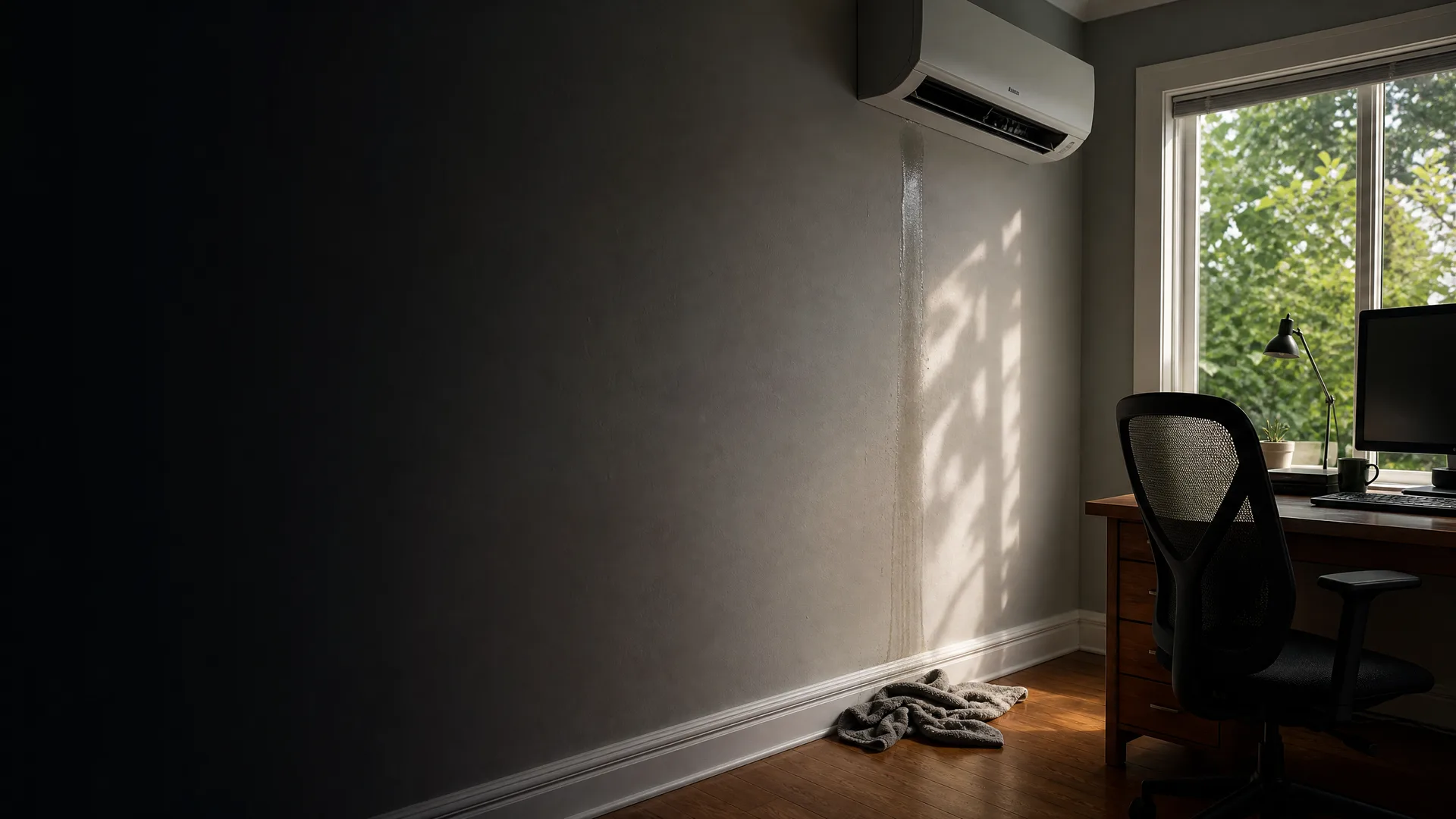
A wall-mounted mini-split air conditioner in a dim room, with a water streak running down the wall below it to a towel on the floor near the baseboard, beside a desk, office chair and monitor by a window.

You're at your desk on a July afternoon, the kind where the air outside sits heavy and still. The mini split on the wall has been humming along all day, and you only look up because something catches the light wrong. A dark streak runs down the wall below the unit, and the carpet under it has gone dark too. You grab a towel and press it against the baseboard, then check the indoor unit and see the light blinking the way it wasn't blinking this morning. The room still feels cool enough, but the wall doesn't, and you're standing there with a wet towel wondering how long this has been running like this.

Call Now or Wait It Out

Call now

  • A blinking light paired with warm air blowing or no air at all usually means the system has already stopped doing its job.
  • Maryland summers push a mini split hard for months at a time, and a unit that's struggling in July won't fix itself by August.
  • If the outdoor unit is frozen or making a new noise along with the blink, waiting risks turning a repair into a bigger one.
  • Electric heat means this unit is likely doing double duty in winter too, so a problem now can mean no backup when it turns cold.
  • A contractor can read the blink pattern against the specific model and tell you in person whether it's the filter, the sensor, or something electrical.

Wait and watch

  • If the blink started right after a filter clean or a reset and the unit is still cooling fine, it may clear on its own in a day or two.
  • Some blink codes just mean the system is in a defrost cycle or has temporarily paused itself, not that anything is wrong.
  • If the house is still comfortable and the air coming out feels normal, there's no immediate strain on the system to worry about.
  • A short wait costs little if the unit was recently serviced and nothing else about its performance has changed.
  • Letting it go too long on a system you rely on for both summer cooling and winter heat means a small issue has more time to turn into a bigger bill.
  1. The indoor unit's sensor board detects a fault signal from the system.

  2. A control chip translates that fault into a specific blink pattern.

  3. The light flashes a count, pauses, then repeats the same count.

  4. That pattern corresponds to a code a technician can look up.

What am I actually seeing on that wall unit

Look at the light itself before anything else. A steady blink every few seconds is different from two quick flashes followed by a long pause, and the pattern is what a technician will ask about first. Check what the unit is doing while it blinks. Is air moving at all, is it warm when it should be cold, or has the fan stopped. Some homeowners notice water marks on the wall or ceiling near the indoor unit, which points to a drain line problem rather than the compressor. If the blinking has gone on for more than a day or two and nothing changes, the system is likely stuck trying to run and failing, which on electric heat means it's still pulling power without doing the job.

A woman with long blonde hair in a light blue shirt leans back on a beige sofa with her eyes closed, in a softly lit living room with cushions and a blurred plant and shelf in the background.
A woman with long dark hair in a gray knit sweater sits on a gray sofa with a cushion, looking toward a window in a living room with framed pictures and a lamp in the background.
A woman with long dark hair in a light grey knit sweater sits on a sofa indoors, looking to her right, with a framed landscape picture, a potted plant and a curtained window behind her.
A woman with long dark hair leans back against a gray sofa with her eyes closed, in a living room with a curtained window, a potted plant, and a dark screen in the background.

Matched to your mini split job

Get the mini split repair search off your mind today.

There's no charge for the request.

Why the pattern matters

A mini split has one small board reading signals from a sensor, a motor, or the refrigerant line, and it only has one light to report back with. So it blinks in counts. Two flashes might mean something electrical, five might point to the compressor, and the gap between flashes tells a technician where to start looking before they even open the panel. Manufacturers don't use the same codes, so a count that means a frozen coil on one brand can mean a drainage problem on another. That's why the model and the pattern both matter when someone comes to look at it.


Why it won't wait until fall

Electric heat in a Maryland winter means your mini split is the only thing standing between the house and the cold once the temperature drops. A blinking light paired with a refrigerant or electrical fault tends to get worse under load, and load is exactly what the unit sees during a stretch of hard heating or cooling. A fault that shows up as an intermittent blink in October can mean no heat at all in January. Waiting rarely resets the code on its own, since the board keeps reporting the same fault until whatever caused it gets fixed.

A smiling older woman with gray hair in a loose bun wearing a ribbed beige sweater stands in a dimly lit kitchen beside a window showing darkness outside, with a loaf of crusty bread on a wooden board in the foreground.
A woman with her hair in a bun holds a sleeping boy against her shoulder, both wrapped in a thick cream knit blanket on a couch in a dim room with a lit lamp, potted plants and a shelf behind them.

The light blinks the same way whether the unit is seven years old or brand new, and a homeowner who ignores it loses nothing right away. The mini split keeps running, maybe worse than before, and the house stays comfortable enough to put off dealing with it.

Wait through a Maryland summer with a fault code flashing and the unit is working harder than it should for every degree it delivers. Electric heat and cooling both run on the same expensive power here, so a system straining against a problem shows up on the bill before it shows up as a breakdown.

A dusty white wall-mounted mini-split air conditioner indoor unit installed high on a beige interior wall below a white ceiling and trim.
Before you get your mini split repair
A white wall-mounted mini-split air conditioner installed near the ceiling on a light-colored interior wall, with a window and green foliage visible at the left edge.
After you get your mini split repair

Power costs 19.53 cents per kilowatt-hour statewide

At that rate, a mini split blinking through a fault and running poorly costs you more every day you leave it alone. Electric heat already carries most Maryland homes through the winter, so a system working harder than it should shows up fast on the bill.

EIA-861 2025 statewide residential average

A man with a duffel bag walks up a concrete path toward a white board-and-batten house where a woman stands in the open wooden front door, flanked by potted plants and black lanterns.

A blinking light is the system telling you what it needs

A blinking light on your mini split is a count, not a mystery. It means a sensor, a motor, or the refrigerant line is reporting a problem the board can't fix on its own. Matching that pattern to the right cause is a job for someone who works on these systems every day, not a guess from across the room.

Once you send in the details, you're not the one who has to track down a technician, compare schedules, or figure out who actually services your unit. A contractor who handles mini splits in your area gets your information and reaches out to you directly. The light keeps blinking until someone with the right tools reads it correctly, but finding that person stops being something you have to manage.

A mug and a small round vase sit on a wooden windowsill beside sheer and heavier curtains, with blurred autumn trees seen through the rain-speckled window and a sofa with cushions and a throw in the foreground.
A modern two-story house with dark siding and stone base at dusk, with lit soffit lights, a path of large rectangular pavers set in dark gravel, planting beds, a lawn, and an orange and blue sunset sky above distant trees and water.

Mini Split Repair

A mini split pro near you

RepairMini-splitMaryland
Step 1 of 2

What ZIP code is the job in?

  • A cream chunky cable-knit throw draped over a beige upholstered armchair beside a bright window, with a wooden side table holding a book and a vase of leafy branches at left.
    • A local pro who knows mini splits gets your details and gets in touch.
  • Living room corner with a gray sofa holding beige pillows and a knit throw, a round wooden coffee table with a dark planter and shallow bowl, a jute rug, a floor lamp, a framed landscape print on the wall, and a window showing trees.
    • Send the request today and stop worrying about who to call.
    • Send the request and finding a pro stops being your problem.
  • A living room corner with a cream sofa and cushion, knit throw, wooden coffee table holding a shallow bowl and dark ceramic vase with green foliage, a floor lamp, potted plant in a woven basket, and linen curtains at a window.
    • Describe what your mini split is doing once, in one form.
    • Describe your mini split job once, to one pro.
  • A round reclaimed-wood coffee table with a black metal base sits on a woven rug in front of a cream sofa with cushions, with a lit built-in fireplace and a tall indoor tree in the background.
    • Your request stays with one local pro.
    • Your request goes to one pro, not a list of companies.








